


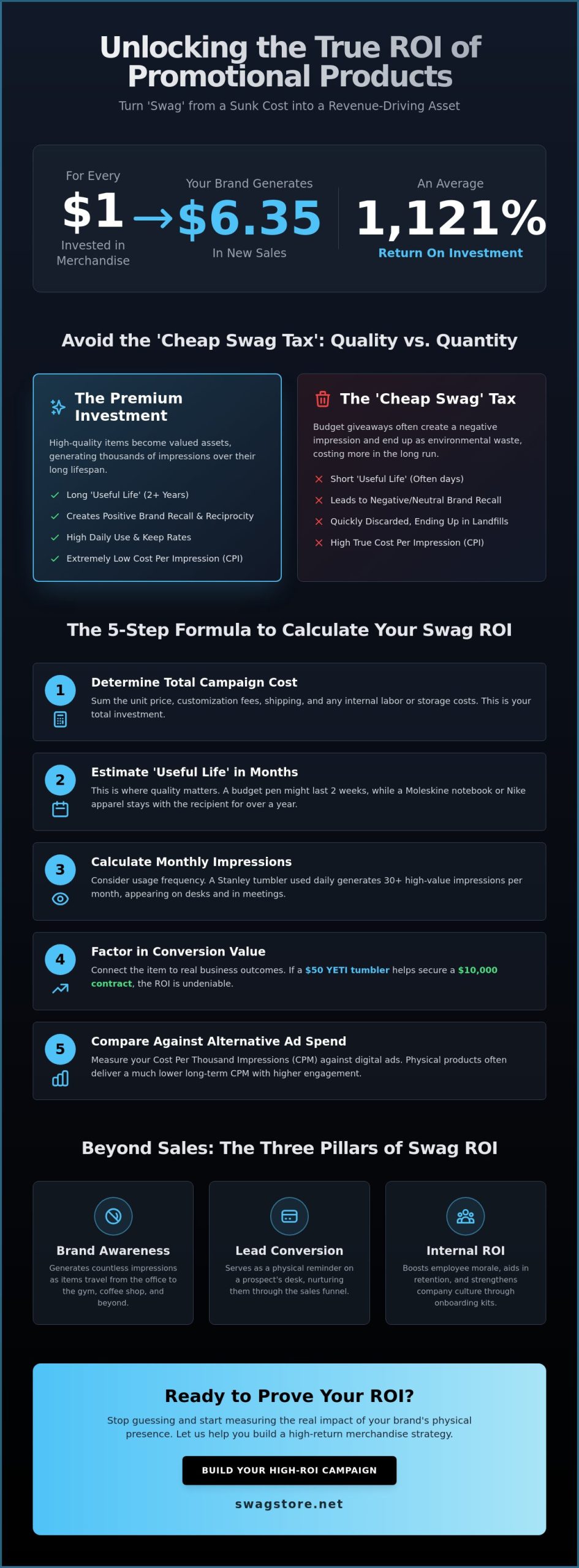
For every $1 your brand invests in merchandise, you could be generating $6.35 in new sales. That’s an average ROI of 1,121%, yet many marketing teams still struggle to justify their gift budget to a skeptical CFO using a promotional products ROI calculator. We’ve all felt that frustration when premium items get dismissed as “swag” because attribution feels impossible to track. It’s difficult to prove the long-term value of a high-end YETI tumbler when you’re looking at a spreadsheet instead of the recipient’s desk three years later.
We’re going to change that narrative. You’ll learn how to turn those gut feelings into hard, actionable data that validates your creative choices. We’ll show you why choosing premium brands like Nike or Moleskine actually lowers your cost per impression by staying in the recipient’s hands for years, not days. We’ll break down the specific math of “Useful Life,” analyze why 90% of people remember the brands on their desk, and give you a clear formula to present at your next stakeholder meeting. It’s time to stop guessing and start measuring the real impact of your brand’s physical presence.
Measuring the success of a marketing campaign is usually a matter of clicks and conversions. Digital ads provide instant gratification through dashboards and real-time data. Physical branding, however, has long been treated like a “black box” where money goes in and hoodies come out, but the direct impact on the bottom line remains fuzzy. To truly understand the impact of your investment, you first need to define what are promotional products in the context of your specific business goals. They aren’t just gifts; they’re strategic touchpoints designed to linger in the recipient’s life far longer than a 15-second video ad.
A promotional products ROI calculator helps you move beyond the “cost-center” mentality. Instead of viewing merchandise as an expense to be minimized, you’ll start seeing it as a revenue driver. When you can show a CFO that a high-quality tech accessory generates thousands of impressions over its multi-year lifespan, you’re no longer asking for a budget. You’re presenting a business case. This structured approach allows you to justify the higher upfront cost of premium items by proving their long-term durability and effectiveness.
ROI isn’t a single number. It’s a structure built on three distinct pillars. Brand awareness is the most obvious, focusing on the sheer volume of impressions an item makes as it travels from the office to the gym. Lead conversion tracks how a specific item, like a laser-engraved metal pen, serves as a physical reminder that pushes a prospect through the sales funnel. Finally, don’t ignore internal ROI. Investing in custom employee onboarding kits reduces turnover and boosts cultural alignment. These aren’t just feel-good metrics; they’re measurable gains in human capital and retention.
Numbers tell half the story. The real magic happens in the recipient’s mind. When you give someone a premium Stanley tumbler or a Moleskine notebook, you trigger the psychological principle of reciprocity. A high-quality gift creates a “thank you” mindset, which builds trust faster than any cold email ever could. This intangible value manifests as brand sentiment. A generic plastic bottle often ends up in a landfill, but a YETI stays on a desk, appearing in the background of Zoom calls and social media posts. That’s organic social proof you can’t buy with a traditional ad. Using a promotional products ROI calculator allows you to quantify these durable impressions and prove that quality always outperforms quantity.
Calculating the true impact of your branded merchandise requires more than just looking at a receipt. To move beyond simple guesswork, you need a structured promotional products ROI calculator approach that accounts for the longevity of the item. While digital ads disappear the moment you stop paying, physical products continue to work for months or even years. We look at the math through a five step process that captures both the immediate cost and the long term value.
Industry data consistently supports these investments. Many experts point to high ROIs in marketing when physical gifts are used strategically. If you’re ready to see how these numbers apply to your next campaign, you can browse our curated collection of retail grade gear.
CPI for physical goods is the total investment divided by total lifetime views. This metric is the ultimate equalizer between budget and premium items. A $5 plastic bottle that breaks after three uses has a massive CPI because its “Useful Life” is negligible. In contrast, a $50 YETI tumbler that stays in use for three years distributes its cost over thousands of impressions, eventually becoming cheaper per view than the low quality alternative. We prioritize items that people actually want to keep, ensuring your cost per impression continues to drop every single day.
ROI isn’t just for external sales; it’s a vital tool for talent retention. The formula for internal ROI is the Cost of the Kit divided by the product of Employee Replacement Cost and the Retention Increase percentage. By using premium onboarding kits, you reduce “new hire ghosting” and increase day one engagement. High quality merchandise improves Glassdoor sentiment scores and signals to your team that they are valued. When an employee feels like a partner from their first hour, the cost of the gift is dwarfed by the savings in recruitment and training.
Buying cheap is often the most expensive mistake a marketing team can make. We call this the ‘Cheap Swag Tax.’ It’s the hidden cost of choosing generic, low-quality items that end up in a landfill within weeks. When a recipient receives a flimsy plastic pen that leaks or a scratchy t-shirt that shrinks after one wash, they don’t just throw the item away. They associate that lack of quality with your brand. Every time a logo appears on a broken or useless object, it creates a negative brand touchpoint. A promotional products ROI calculator that only looks at the initial purchase price misses this vital data. True value is found in durability and utility.
To get better results from your promo products, you must focus on items that solve a problem or enhance a lifestyle. Transitioning from disposable giveaways to cool promotional items ensures your brand stays relevant. When you invest in retail-grade gear, you’re buying a permanent spot in your customer’s daily routine. Research shows that 87% of people keep promotional products for more than a year, but that percentage drops significantly when the item lacks functional quality. High-end merchandise isn’t an expense; it’s a long-term brand insurance policy.
The difference in longevity between budget and premium is staggering. Premium apparel, such as embroidered Nike or Under Armour polos, typically enjoys a 2-4 year keep rate. These are items people wear to the office, the golf course, and social events, generating thousands of high-value impressions. Compare that to budget t-shirts, which are often relegated to sleepwear or rags within months. Tech accessories like custom logo power banks offer even higher utility. They provide daily brand exposure in professional settings where a dead phone battery is a genuine crisis. The longer an item is kept, the lower your cost per impression becomes in your promotional products ROI calculator.
Psychology plays a huge role in gifting through the ‘Halo Effect.’ When you co-brand with names like YETI or Stanley, their reputation for ruggedness and quality transfers directly to your company. This is especially critical for high-level outreach. Generic gifts won’t cut it for C-suite executives; they require sophisticated, monogrammed gifts that reflect their professional status. Choosing premium brands isn’t just about aesthetics. It’s about the ‘Cost of Quality’ versus the ‘Cost of Replacement.’ By gifting a product that lasts for years, you eliminate the need for constant re-purchasing, ultimately protecting your budget and your brand’s reputation.
Social media offers another layer of organic return that digital ads can’t replicate. When you provide items that are visually striking and high-quality, recipients are naturally inclined to share them. An “unboxing” moment with a custom logo power bank or a premium Stanley tumbler creates free reach that often exceeds the cost of the item itself. These digital impressions, combined with the physical durability of the product, create a dual-threat marketing asset that continues to perform long after the initial campaign launch.
Stop handing out expensive gear to every person who walks past your booth. We recommend a “Tiered Swag” model to protect your budget and maximize impact. Use lower-cost, eco-friendly tote bags for general traffic, but reserve your premium embroidered polos for qualified leads and decision-makers. This strategy ensures that your trade show giveaways act as a permanent business card on a prospect’s desk. When calculating your return, compare your cost per lead against the lifetime value of those specific connections. It’s about quality conversations, not just scanned badges.
Internal branding is often the most overlooked part of the promotional products ROI calculator. In a hybrid world, physical touchpoints are essential for culture building. Sending high-quality tech accessories to remote employees ensures your brand is present in every Zoom call, fostering a sense of belonging that digital tools simply can’t replicate. You can even track the effectiveness of these internal gifts by including QR codes that lead to custom landing pages or feedback forms. This data allows you to measure engagement and refine your strategy for future onboarding efforts. If you’re ready to elevate your team’s experience, explore our premium employee gift options today.
A promotional products ROI calculator is only as effective as the quality of the data you feed it. If your campaign starts with low-tier items that fail to engage your audience, the final numbers will always disappoint. We’ve built our business on the belief that quality is the ultimate cost-saving measure. By focusing exclusively on promotional items that people actually want to keep, we ensure your investment continues to pay dividends for years. We don’t just supply products; we act as creative consultants to help you design high-impact kits that align with your specific business objectives.
Our partnerships with retail giants like YETI, Nike, and Stanley ensure that your brand is associated with excellence from day one. These aren’t just generic substitutes. They’re the exact same products people buy for themselves with their own money. This retail-grade quality guarantees high “keep rates,” which is the single most important variable in your promotional products ROI calculator. When your logo is on a product that stays on a desk or in a gym bag for three years, your cost per impression drops to fractions of a penny. We focus on bulk efficiency to ensure that even these premium brands remain accessible for large-scale corporate initiatives.
Brand integrity depends on the details. We use professional-grade techniques like precision laser engraving and high-fidelity screen printing to ensure your logo looks as good on day 500 as it did on day one. Cheap printing that peels or fades is a fast track to negative brand sentiment. By specializing in bulk orders, we’ve optimized our processes to deliver retail-quality customization at a scale that lowers your total CPI. Whether it’s embroidered Under Armour polos or laser-engraved metal pens, we maintain strict quality control to protect your brand’s visual identity.
Success in physical marketing requires a blend of data and creativity. Our team is ready to help you navigate the complexities of budgeting for large-scale gifting, from employee onboarding kits to international trade show strategies. We’ll help you select the right mix of tech accessories and apparel to hit your specific ROI targets without wasting a cent on “landfill swag.” Stop guessing about the value of your merchandise and start building a strategy that delivers measurable results. Get a custom quote for your high-impact corporate swag and let’s design your next high-return campaign together.
Physical marketing is no longer a guessing game. By shifting your focus from disposable giveaways to durable, retail-grade gear, you’re investing in years of positive brand impressions rather than days of clutter. We’ve explored how the “Useful Life” of a product can drastically lower your cost per impression; proving that a premium YETI tumbler or a Nike polo is often a smarter financial choice than budget alternatives. Implementing a promotional products ROI calculator into your planning process ensures that every dollar spent is backed by data and strategic intent.
At SwagStore.NET, we bring over 15 years of corporate branding expertise to your most ambitious projects. As official partners with industry leaders like YETI, Nike, and Moleskine, we specialize in delivering high-volume, premium bulk orders that elevate your brand’s perceived value. We don’t just print logos; we help you build connections that last. It’s time to stop settling for generic swag and start creating experiences that drive real business results. Design your high-ROI swag campaign with SwagStore.NET today. Let’s make your next campaign your most profitable one yet.
A high-performing campaign should aim to meet or exceed the industry average of $6.35 in new sales for every $1 spent. According to 2026 industry data, the average ROI for promotional product campaigns reaches 1,121%. We measure success not just in immediate sales, but through brand recall, as 90% of recipients remember the brand name on the products they keep.
You calculate CPI by dividing the total investment of the campaign by the total number of impressions the item generates throughout its life. For instance, wearable items can generate approximately 2,400 impressions at a cost as low as $0.003 per view. Using a promotional products ROI calculator allows you to factor in daily usage rates to see how quality items outperform digital ads over time.
Premium brands deliver a superior return because they drastically increase the “keep rate” and daily utility for the recipient. Research shows that 82% of consumers have a more favorable impression of a brand after receiving a gift, and this sentiment is strongest with retail-grade gear. While the initial cost is higher, a YETI or Stanley tumbler is rarely discarded, ensuring your brand stays visible for years instead of days.
The most effective way to track direct sales is by using unique redemption codes, custom landing pages, or dedicated lead-capture forms tied to the gift. You should also tag recipients in your CRM to monitor how receiving a high-value item, such as a Moleskine notebook, influences their movement through the sales funnel. This data provides the concrete conversion values needed for an accurate promotional products ROI calculator report.
Apparel continues to lead the market, representing 46% of total sales, followed closely by high-utility tech and drinkware. Items like embroidered Nike polos, branded power banks, and Stanley tumblers are highly valued because they integrate into a person’s daily routine. Additionally, 72% of consumers now prefer items made from sustainable or recycled materials, making eco-friendly tote bags a top choice for longevity.
A product’s useful life is the primary multiplier for your return on investment. Since 87% of people keep promotional products for more than a year, a durable item provides thousands of additional free impressions long after the initial purchase. Choosing items with high durability ensures that your brand remains a permanent fixture on a prospect’s desk, which lowers the long-term cost per engagement.
Internal ROI is measured through employee retention and culture building, while external ROI focuses on lead generation and brand equity. Onboarding kits help reduce the high cost of recruitment by increasing day-one engagement and lowering turnover. For external audiences, the focus is on brand recall; 89% of consumers can recall a brand from a promotional product they received in the last two years.
QR codes are the perfect bridge between physical merchandise and digital analytics. By printing a custom QR code on a tech accessory or a notebook, you can direct recipients to a specific product demo or a discount page. This allows you to track real-time engagement and attribute specific revenue growth directly to your physical branding efforts.