


What if your most impactful brand assets are losing their “wow factor” simply because they are sitting in a cramped storage closet? You have put heart and strategy into your custom screen printed t-shirts, so watching them get buried in messy boxes is more than an eyesore; it’s a risk to your brand integrity. If you are wondering how to store bulk t-shirts without damaging the screen printing or losing track of your inventory, you’re in the right place. We know that a chaotic swag pile leads to wrinkled garments and wasted time during high-stakes events.
We’re here to turn that clutter into a streamlined, professional inventory system. You’ll learn the exact methods used by experts to preserve print quality and organize sizes for instant retrieval. We will walk through climate-conscious storage, smart stacking techniques, and labeling systems that ensure your team always looks sharp. By the end of this guide, your swag closet will be a high-efficiency hub that protects your investment and keeps your brand’s visibility at its peak.
Your brand is a collection of touchpoints. Every time someone wears your logo, they’re representing your values and your commitment to quality. If those garments spend months compressed in acidic cardboard boxes, you’re essentially sabotaging your own marketing efforts. Cardboard boxes are designed for transit, not for preservation. They’re the enemies of premium apparel.
Learning how to store bulk t-shirts is about more than just finding an empty shelf. It’s about protecting the physical integrity of the ink and fabric. Improperly stored apparel often suffers from “box-living” syndrome. This results in permanent creases, ink cracking, and even fabric yellowing over time. Every moment a shirt stays in a shipping container is a moment it’s losing its premium feel. We believe your swag should look as fresh on the day it’s handed out as it did the day it left the press.
Efficiency also plays a major role in your daily operations. We’ve all seen the “swag scramble” before a major event. Teams waste hours digging through unlabeled boxes to find a specific size, only to find the shirts are wrinkled and unwearable. A professional storage system eliminates this friction. It transforms a messy warehouse corner into a high-performance inventory hub. This isn’t just about cleaning up; it’s about reclaiming your team’s time and ensuring your brand’s visibility remains uncompromised.
Screen printing involves layering ink onto fabric. Under the heavy pressure of stacked boxes, that ink can migrate or “ghost” onto the back of the shirt above it. This is a common risk for custom screen printed t-shirts that use specific plastisol inks. Beyond the ink, cotton blends are prone to “set-in” creases that are nearly impossible to steam out. Following the professional principles of textile preservation helps keep these fibers flexible and the prints vibrant. Proper storage prevents the mechanical stress that leads to premature aging of the garment.
A welcome gift is a statement of value. If a new hire receives a crumpled, dusty shirt, the message is clear: the details don’t matter. A crisp, clean, and neatly organized garment suggests precision and care. Your storage quality directly reflects the value you place on your promotional items. A well-organized swag closet creates an environment of professional excellence. It ensures that every piece of apparel distributed is a perfect representation of your brand’s standards and your respect for the recipient.
Storing apparel is a constant battle against the elements. You might think your inventory is safe tucked away in a back office, but environmental factors are silent brand killers. Heat, light, and moisture work together to degrade fabric fibers and ink quality over time. When you are figuring out how to store bulk t-shirts, you have to treat your storage area like a gallery vault rather than a junk drawer. A proactive approach here saves you from the heartbreak of opening a box to find ruined merchandise.
Temperature fluctuations are particularly dangerous for screen-printed items. High heat can cause plastisol inks to soften and become tacky. When shirts are stacked under pressure, this leads to “blocking,” where the designs literally fuse together. Once this happens, pulling the shirts apart often results in the ink peeling or cracking. Cold isn’t much better; extreme cold can make some inks brittle and prone to flaking. Aim for a consistent, climate-controlled environment to keep your prints flexible.
Humidity is the next major hurdle. Excess moisture in the air creates a breeding ground for mildew, which can ruin an entire shipment in a matter of weeks. Conversely, air that is too dry can make natural fibers like cotton feel scratchy and lose their natural luster. Following professional textile storage guidelines ensures you maintain a stable atmosphere that preserves the “new shirt” smell and feel. We recommend keeping your storage space at a steady 50% relative humidity whenever possible.
Dust and pests are often overlooked until it’s too late. Cardboard boxes actually attract silverfish and moths that love to snack on organic fibers and the adhesives used in packaging. Sealed plastic bins are your best defense here. They create a physical barrier against particles and critters alike. If you are managing high-end custom logo apparel, these small investments in protection pay off in long-term brand longevity.
Performance brands like Nike and Under Armour use advanced synthetic blends designed to wick moisture and breathe. These technical fabrics are highly sensitive to heat. Storing them in a warehouse that frequently tops 80°F can damage the elasticity of the fibers, leading to a “stretched out” look before they’re even worn. The ideal range for bulk apparel is 60-75°F. Drop a few silica packets into your storage bins to manage micro-climates and keep everything bone-dry and fresh.
UV rays are relentless. Even fluorescent office lights can cause “shoulder fading” on shirts sitting at the top of a stack. This happens when the light breaks down the chemical bonds in the fabric dyes. Dark storage is the gold standard for colored garments. If your storage area has windows or high-intensity lighting, switch from clear bins to opaque ones. These solid-colored containers act as a total blackout shield for your inventory, ensuring colors stay as vibrant as the day they were printed.
Selecting the right physical hardware is the foundation of a functional swag closet. You’ve already handled the environmental threats; now you need a structural strategy that matches your volume. Most teams default to stacking boxes on the floor. This is a recipe for crushed fabric and hidden inventory. When considering how to store bulk t-shirts, your choice between bins, shelves, or racks depends entirely on your distribution frequency and the value of the garments themselves.
Plastic bins offer the highest level of protection against dust and pests. They’re also modular, making it easy to rearrange your space as your collection grows. However, if you’re constantly “picking” individual shirts for daily shipments, unstacking heavy bins becomes a physical burden. This is where industrial shelving shines. It allows you to utilize every cubic foot of your storage room, turning a cramped corner into a high-capacity warehouse. For high-end embroidered Nike or Under Armour polos, we recommend garment racks. Hanging these items prevents the heavy embroidery from pulling or distorting the fabric during long-term storage.
Clear containers are a favorite for fast-paced marketing teams. They let you see exactly what is inside without peeling back tape or reading messy Sharpie labels. To make this work without risking light damage, keep clear bins on the lower shelves or in a windowless room. Always nest your bins carefully. High-quality plastic tubs with reinforced corners prevent the weight of the top bins from crushing the shirts at the bottom of the stack. A heavy-duty 66-quart latching bin is the ideal size for storing a standard 50-count stack of adult large t-shirts without over-compressing the fibers.
If you’re managing thousands of units, shelving is non-negotiable. Bulk cotton is deceptively heavy; a single box of 72 shirts can weigh over 30 pounds. Ensure your shelving units are rated for at least 500 pounds per shelf to avoid bowing or collapse. Following National Archives textile preservation guidelines by using powder-coated steel rather than raw wood prevents acids from leaching into your apparel.
Organize your shelves into “pick zones.” Place your most common sizes, like Medium and Large, at waist height for easy access. This setup is particularly effective when you’re assembling custom employee onboarding kits. Having your inventory visible and accessible reduces the time spent kitting and ensures your new hires receive a perfectly preserved garment every time.
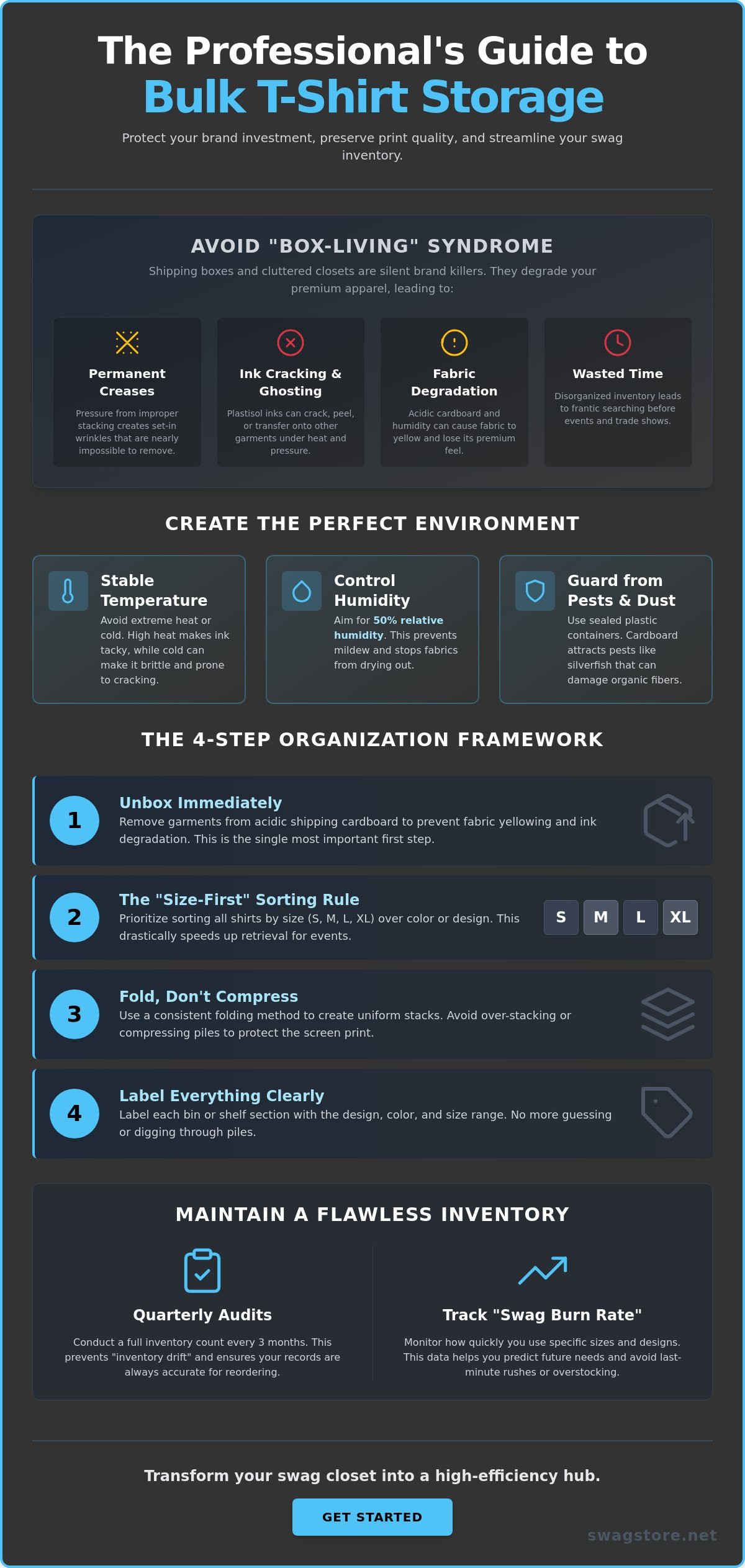
A chaotic swag closet is a drain on your company’s productivity. If your team spends twenty minutes digging for a specific size, your storage system has failed. Professional organization isn’t just about tidiness; it’s about building a repeatable workflow that anyone can follow. When you master how to store bulk t-shirts, you create a scalable asset for your marketing and HR departments. We believe that a well-oiled inventory system is the secret weapon of high-growth brands.
The framework begins the moment the delivery truck arrives. Audit your counts against the packing slip immediately. This catches vendor errors before they become your problem. Once verified, implement a First-In, First-Out (FIFO) rotation. Always place new inventory at the back or bottom of your system. This simple habit prevents older garments from becoming “stale” or developing permanent creases from years of deep compression at the bottom of a stack.
Next, apply the “Size-First” rule. In the heat of a corporate event, size is the primary filter. Sorting by color might look better for a photo, but sorting by size is what gets your team through the distribution line faster. Label every container for the “uninformed user.” This means a temp worker or a busy executive should be able to walk into the room and find a Large navy tee in under ten seconds. Efficiency is the ultimate goal of professional storage.
Visual cues are significantly faster than reading text. We recommend using color-coded tape on the corners of your bins. For example, red tape always signifies Small, while green tape indicates Large. Every label must include four critical data points: the size, the specific style name, the date received, and the current quantity. If you want to modernize your workflow, integrate QR codes. A quick scan can link a physical bin to your digital inventory sheet, making it easy to track your stock levels without manual counting.
How you fold determines how much you can fit in your available space. The “File Fold” method is the professional standard for high-volume inventory. Instead of stacking shirts on top of each other, you stand them up vertically like folders in a filing cabinet. This allows you to pull one shirt out without disturbing the rest of the row. To prevent “ink-on-ink” sticking, especially with heavy plastisol prints, avoid folding the design directly against itself. Using thin cardboard inserts ensures every stack is perfectly uniform, which maximizes every inch of your storage space.
Ready to upgrade your inventory? Check out our latest custom screen printed t-shirts to see how we combine premium quality with professional distribution standards.
Inventory is never static. It’s a dynamic asset that requires active management to stay valuable. Even after you’ve mastered how to store bulk t-shirts, you can’t just set it and forget it. We recommend a quarterly audit schedule to ensure your stock remains in peak condition. Use this time to check for the environmental damage we mentioned earlier, like ink migration or dust accumulation. These check-ins are your last line of defense before a garment reaches an employee or client. If you find “stale” inventory that hasn’t moved in a year, it’s a sign to refresh your designs or donate the stock to make room for new growth.
Data is your best friend when scaling. Track your “Swag Burn Rate” to see exactly how fast your inventory moves. If you’re consistently running out of Mediums while XLs collect dust, your storage data should dictate your next purchase. This prevents “inventory bloat,” where you pay for space to store items that aren’t moving. Smart storage isn’t just about protection; it’s about optimizing your marketing budget. When you know your numbers, you can predict reorder points with precision, avoiding the high costs and stress of rush shipping before a major launch.
There comes a point where a closet isn’t enough. If your team is spending more than five hours a week kitting or shipping, it’s time to consider a professional partner. Scaling your brand means focusing on strategy, not tape and boxes. Professional warehousing is especially vital for delicate monogrammed gifts that require climate-controlled precision. Moving off-site often offers a high ROI by freeing up your staff’s time for high-value creative work. It ensures that every order is picked, packed, and shipped with the same professional rigor you’ve established in your own office.
Complexity is the enemy of efficiency. As you grow, standardize your size runs and style choices. Selecting cool promotional items that are stackable and durable makes the logistics of how to store bulk t-shirts much simpler. A streamlined catalog means fewer bins, easier audits, and faster distribution. We’re here to help you navigate these choices and ensure your brand always makes a premium impression. Your storage system should support your growth, not hinder it. By following these professional standards, you turn your swag from a logistical burden into a powerful brand engine.
Ready to elevate your brand’s presence? Let SwagStore.NET handle your next premium bulk order and experience the difference that professional care makes for your brand’s visibility.
Master your inventory today to ensure every garment represents your brand with excellence tomorrow. By implementing professional climate controls and a structured organization framework, you protect your custom screen printing from the “box-living” damage that ruins quality. We’ve shown you that success lies in the details; from selecting the right industrial shelving to mastering the FIFO rotation. Learning how to store bulk t-shirts is an investment in your brand’s long-term visibility and professional reputation. It’s the difference between a wrinkled handout and a premium brand experience.
Since 2010, we’ve specialized in high-volume corporate orders with national fulfillment expertise that takes the weight off your shoulders. We partner with premium brands like Nike and Under Armour to deliver apparel that people actually want to wear. Our team understands that your swag is a tool for connection, and we’re committed to making that process seamless. Ready to elevate your next campaign with gear that stays fresh from the press to the person? Browse Premium Bulk Apparel for Your Next Event and let us help you build a swag strategy that scales. Your brand deserves to be seen in its best light.
We don’t recommend long-term storage in standard plastic bags because they trap moisture and lead to mildew. If you must use bags, ensure they are breathable or acid-free to prevent the fabric from yellowing. For high-volume inventory, switching to latching plastic bins with silica packets is a much more reliable way to manage micro-climates and protect your brand assets.
You should limit traditional horizontal stacks to 10 or 12 shirts to prevent the weight from crushing the bottom layers. When you’re learning how to store bulk t-shirts for long-term preservation, the vertical “file fold” method is superior. This technique eliminates stacking pressure entirely, ensuring that the screen printing on the bottom garment stays as crisp as the one on top.
Folding is the professional standard for t-shirts to avoid “hanger bumps” and shoulder stretching over time. Hanging is only preferred for heavier items like embroidered Nike or Under Armour polos, where the weight of the logo might cause the fabric to pucker if folded. For standard cotton tees, a neat fold in a dedicated bin is the best way to maintain garment shape.
Keep your white garments away from cardboard boxes and direct UV light. Cardboard contains acids that leach into cotton fibers, causing distinct yellow lines along the fold marks. Use acid-free tissue paper or opaque plastic containers to create a neutral environment. This is a critical step in how to store bulk t-shirts if you want your white apparel to stay bright for more than one season.
The ideal temperature range for bulk apparel is between 60°F and 75°F. Consistent climate control prevents plastisol inks from becoming tacky in the heat or brittle in the cold. Avoid storing your inventory in uninsulated warehouses or basements where temperature swings can cause the prints to “block” or fuse together, which permanently ruins the design.
A handheld steamer is the safest and most effective tool for removing storage creases. If you’re in a hurry, a quick five-minute tumble in a dryer on low heat with a damp cloth can also work. Never use a traditional iron directly on the screen printing. The high heat will melt the ink and destroy the garment instantly.
Size-first organization is the gold standard for professional retrieval speed. While color-coded shelves look beautiful in photos, your team will thank you for sorting by size when they’re middle of a busy event. We recommend using size-based zones and then sub-sorting by color within those zones to create the most efficient picking workflow possible.
Address the humidity levels immediately by installing a dehumidifier or using activated charcoal moisture absorbers. A musty smell is a warning sign of high moisture that can lead to permanent mildew damage. Move your inventory to a space with better airflow and check for any damp cardboard boxes that might be harboring odors before they transfer to your fabric.