


Replacing a single employee in 2026 can cost your organization up to 200% of their annual salary. That is a staggering figure that makes “culture” feel less like a soft metric and more like a critical line item on the balance sheet. We understand the uphill battle you face in the boardroom. When you suggest an investment in premium branded gear, leadership often pushes back, viewing it as a “nice-to-have” expense or “fluff” that eventually ends up in a junk drawer. This friction usually stems from the difficulty of proving the value of employee gifts to leadership in a way that speaks the language of the C-suite.
It’s time to change that narrative. You’ll learn how to transform your gifting program from a reactive expense into a data-backed strategy for retention and brand equity. We’ll provide the clear framework you need to secure buy-in for high-quality merchandise like YETI tumblers or custom Moleskine notebooks. We’ll explore how shifting from cheap trinkets to strategic, bulk-ordered onboarding kits ensures your culture investments deliver a measurable, long-term return on investment while driving up employee engagement scores.
Corporate gifting is often mislabeled as a discretionary expense. It’s time to correct that. Strategic gifting is a deliberate investment in your organization’s human capital and brand culture. In the 2026 talent market, where the cost of a single non-executive hire averages $5,475 according to SHRM, retention isn’t just a goal; it’s a financial necessity. Proving the value of employee gifts to leadership requires moving beyond the “nice-to-have” mindset. You must focus on how high-quality physical touchpoints reinforce digital-first employee experiences. When your team spends most of their day behind a screen, a premium physical object becomes a rare, tangible anchor to the company’s mission.
Low-quality “landfill swag” does more than waste budget. It actually alienates your high-performers. Cheap, disposable trinkets signal that an employee’s contribution is only worth a minimal, thoughtless investment. This creates a “hidden cost” where the gift intended to boost morale actually triggers a disconnect. We see a clear shift toward high-utility, premium brands that employees genuinely want to use. By choosing quality over quantity, you align the physical workspace with the professional excellence you expect from your team.
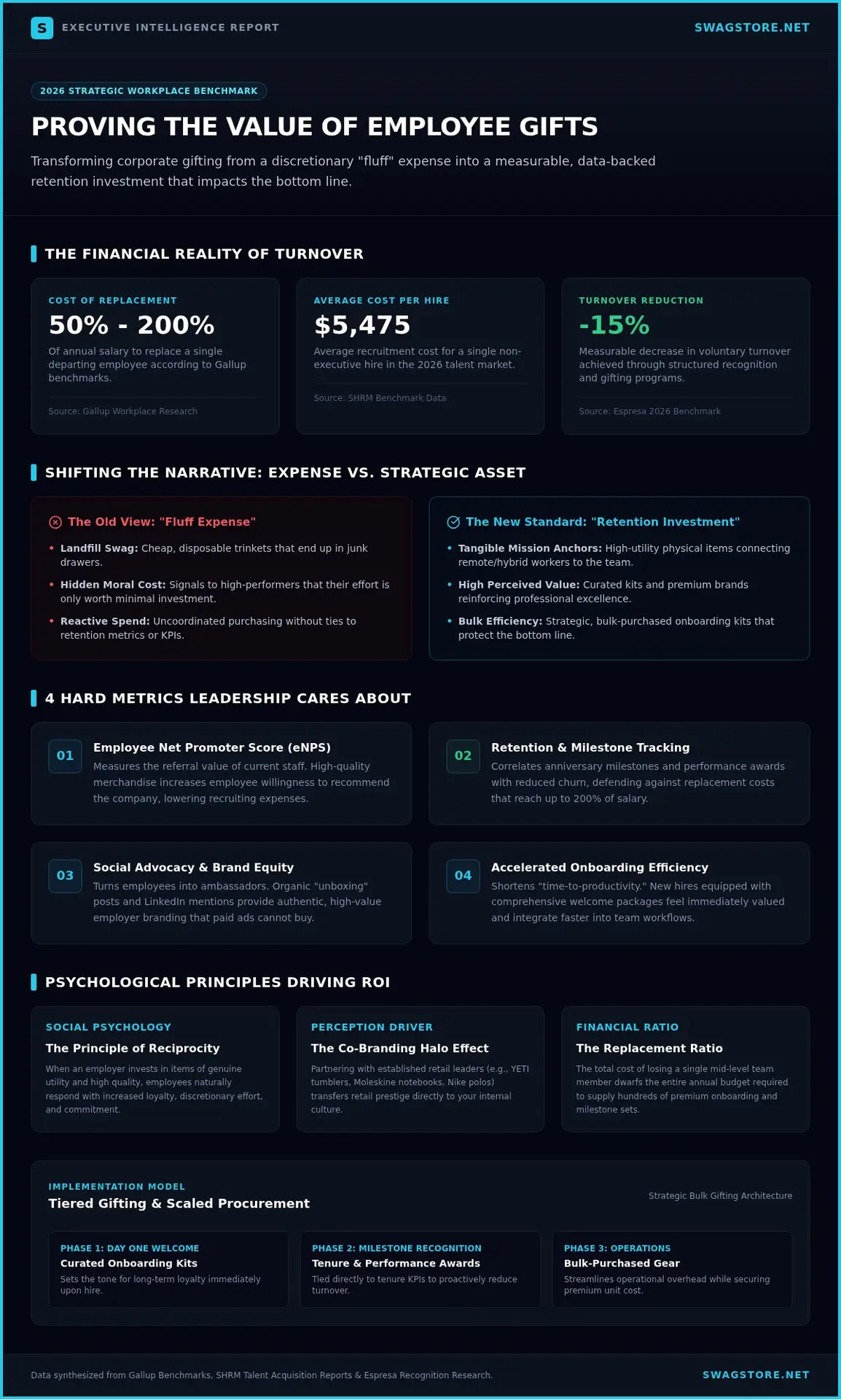
Gallup benchmarks show that replacing an employee costs between 50% and 200% of their annual salary. When you lose a mid-level manager, the financial hit is massive. It completely dwarfs the investment of a premium onboarding kit or a high-end anniversary gift. We define the Replacement Ratio as the total financial and cultural impact of turnover, where the cost of a single departure equals the price of hundreds of premium gift sets. Curated onboarding kits set the tone for long-term loyalty from day one. They offer a warm, professional welcome that makes new hires feel like valued members of an elite team rather than just another headcount.
High-end items do more than sit on a desk. They turn your team into internal brand ambassadors. When employees wear embroidered Nike polos or carry a custom Moleskine, they project the company’s prestige into their daily lives. This strategy is deeply rooted in the social psychological principle of reciprocity. When an employer provides something of genuine value, employees feel a natural drive to return that value through increased loyalty and discretionary effort. In hybrid and remote environments, these physical objects bridge the geographic gap. They create a shared identity that survives across time zones and digital channels, fostering a sense of belonging that is often lost in a remote-only world.
Leadership teams prioritize data over sentiment. To succeed in proving the value of employee gifts to leadership, you must translate “gratitude” into “growth.” We focus on four specific KPIs that demonstrate how a well-executed gifting strategy impacts the bottom line:
We use pulse surveys to track sentiment before and after major gifting campaigns. This data allows you to identify the direct correlation between “appreciation touchpoints” and discretionary effort. According to Gallup workplace recognition research, employees who don’t feel adequately recognized are twice as likely to quit within a year. By measuring this emotional ROI, you prove that gifts aren’t just objects; they’re psychological triggers that sustain positive performance cycles and long-term loyalty.
Think of your team as a mobile marketing force. You can calculate the media value of custom screen printed t-shirts or embroidered jackets worn in public. Unlike a digital ad that disappears after a click, premium items like a Stanley tumbler or a YETI cooler provide years of brand impressions. We also track internal adoption rates: if your employees are actually using the gear in their daily lives, the investment has succeeded. High-utility items boast an 85% brand recall rate, ensuring your company remains top-of-mind for both the employee and their professional circle. If you’re ready to elevate your internal brand, consider exploring premium bulk solutions that align with your corporate aesthetic.
The quality of the object you choose communicates more than the logo printed on it. It speaks to the status of the relationship between employer and employee. When you select a premium brand like YETI or Moleskine, you trigger the “Halo Effect.” This psychological phenomenon transfers the prestige, reliability, and innovation associated with those world-class brands directly to your company. It is a powerful shortcut in proving the value of employee gifts to leadership because it elevates the perceived status of the organization in the recipient’s mind from day one.
One of the most compelling arguments for premium gifting is the gap between perceived value and actual cost. Bulk purchasing allows you to secure retail-quality items at a price point that makes sense for the corporate balance sheet. However, the employee sees a high-end tumbler or a luxury notebook and associates it with the full retail price. They don’t see the volume discount. This disparity creates a surplus of goodwill, making the gift feel like a significant personal investment rather than a generic corporate handout.
In 2026, the modern workforce is increasingly sensitive to environmental impact and durability. Gifting an eco-friendly recycled tote bag or a laser-engraved metal pen isn’t just about the item. It’s about demonstrating corporate social responsibility. Durable goods that last for years reduce waste and reinforce the idea that your company invests in things that endure. This shift away from novelty items toward high-utility accessories is a key component in proving the value of employee gifts to leadership, as it aligns your strategy with broader ESG goals.
Co-branding with giants like Nike or Under Armour serves as a silent endorsement of your company’s stability. Receiving an embroidered Nike polo suggests that the organization is professional and values high performance. It moves the conversation from “why are we spending money on shirts?” to “how can we align our brand with excellence?” For more inspiration on high-impact selections, check out our guide on Cool Promotional Items for 2026. These are the pieces people actually keep, wear, and use in their daily lives.
Utility is the backbone of long-term engagement. Cheap pens and novelty keychains are destined for the trash, but functional items become part of an employee’s daily ritual. High-use items like branded tumblers often stay on desks for years. When a gift serves a purpose, it survives the annual desk clean-out and creates a “Daily Reminder” effect. Every time they reach for a drink or open a notebook, they are reminded of the company’s appreciation. By selecting gear that fits a modern lifestyle, you ensure your brand remains top-of-mind during both professional and personal hours.
A successful proposal shifts the conversation from product selection to performance metrics. Leadership needs to see how a laser engraved metal pen or a custom Moleskine notebook directly supports corporate KPIs. If your data shows a spike in turnover within the first three months, high-end onboarding kits can be positioned as a primary tool for reducing 90-day churn. This turns a simple gift into a strategic intervention. Proving the value of employee gifts to leadership starts with aligning your inventory with the goals already on the executive dashboard.
We recommend a tiered approach to structure your budget effectively. This ensures consistency across the organization while rewarding longevity and high-impact performance. You might allocate a specific budget for standard onboarding kits, a separate tier for three and five-year anniversaries, and a “prestige” tier for departmental safety or sales milestones. This structured roadmap demonstrates that you aren’t just spending money; you’re managing a cultural asset with professional precision.
Operational efficiency is another critical pillar of your business case. Managing individual gift purchases across different departments is a logistical nightmare that wastes valuable HR hours and leads to brand fragmentation. By centralizing through bulk ordering and professional kitting, you ensure total brand consistency and significant per-unit savings. This scalability mitigates the risk of low-quality items slipping through and damaging your internal brand equity. If you’re ready to build your proposal with data-backed solutions, start your bulk strategy with SwagStore.NET.
Moving beyond the simple line-item cost is essential for C-suite approval. You must present the “Total Value of Gifting” (TVG). This metric looks at the fully burdened value of a happy employee, including their productivity levels and referral potential. The Gifting Lifecycle represents the strategic sequence of physical touchpoints designed to reinforce an employee’s commitment from their initial offer letter to their most senior career milestones. Use internal pilot data to show how teams receiving premium gear outperform those with no recognition strategy. Proving the value of employee gifts to leadership becomes much easier when you can show that the cost of the gift is a fraction of the value it preserves.
Expect pushback and be prepared to reframe the narrative. When an executive says, “It’s just extra stuff,” respond by defining gifts as cultural infrastructure. These items are the physical tools that build a sense of belonging in a hybrid world. If they question the bulk cost, show the math on per-unit savings compared to reactive, last-minute shopping. Finally, address measurability by providing the eNPS and retention tracking framework we established in the previous sections. Clear data always beats anecdotal hesitation.
Strategic gifting only works if the execution matches the ambition. Managing multiple vendors, tracking shipments, and ensuring quality control across a national organization can quickly become an operational burden that drains HR resources. SwagStore.NET eliminates this friction by offering a centralized, bulk-only solution designed for professional scale. We don’t just ship items; we provide the logistical infrastructure that makes proving the value of employee gifts to leadership a seamless reality. By consolidating your efforts into a single, high-volume partner, you protect your brand’s integrity while maximizing your internal return on investment.
Impact isn’t about a single object; it’s about the narrative you build through a cohesive experience. We specialize in mixing premium retail giants like YETI, Nike, and Moleskine into curated kits that tell a story of quality and appreciation from the moment they are opened. For a deeper dive into this strategy, see The Ultimate Guide to Custom Employee Onboarding Kits in 2026. These “First Day” kits are essential for both remote and in-office staff, providing a tangible anchor to the company culture. Adding a touch of classic professionalism with laser engraved metal pens ensures that even the smallest details in the kit reflect the high standards of your organization. This curated approach transforms a simple box into a powerful welcome ritual that reinforces long-term loyalty.
Efficiency is the final piece of the business case. We take the heavy lifting off your internal teams through professional kitting and shipping solutions that handle the complexity of national distribution. Our expertise in high-end embroidery, custom screen printing, and precision laser engraving guarantees that every logo is perfectly executed, maintaining brand consistency across thousands of units. This level of quality control prevents the “cheap swag” perception that destroys ROI and alienates top talent. We handle the bulk logistics and inventory management so you can focus on the strategic outcomes of your engagement scores. If your organization is ready to move beyond generic solutions and invest in a premium experience, contact SwagStore.NET for a custom bulk gifting quote and transform your culture into a data-backed retention machine.
We’ve moved beyond the outdated notion that corporate gifting is a discretionary expense. By focusing on premium brands and data-driven metrics like retention and eNPS, you transform physical touchpoints into measurable loyalty drivers. Successfully proving the value of employee gifts to leadership requires this fundamental shift from anecdotal appreciation to hard-hitting ROI. It’s about showing that the right gear, delivered at the right time, preserves the human capital that powers your bottom line. When your team feels truly valued through high-utility items, their commitment to the organization deepens.
SwagStore.NET supports this transition through professional bulk customization for iconic brands like Nike, YETI, and Stanley. Our team handles the complex logistics of national distribution and specialized onboarding kit curation, ensuring your brand integrity remains flawless at every scale. You now have the framework to present a business case that speaks the language of the C-suite. It’s time to turn your culture into a competitive advantage that employees wear and use with pride. Your organization’s identity is too important to be left to low-quality alternatives.
Ready to prove the value of your gifting program? Explore SwagStore.NET’s premium bulk kits.
You calculate ROI by comparing the total investment in premium gifting against the cost of employee turnover and recruitment. If a strategic gift prevents a single resignation, you avoid the $5,475 average cost of a non-executive hire reported by SHRM. Additionally, measure productivity increases and eNPS improvements. This data-driven approach is essential for proving the value of employee gifts to leadership by showing that small, intentional investments protect large-scale human capital expenses.
Focus on Employee Net Promoter Score (eNPS) to track internal brand sentiment and referral likelihood. Monitor retention rates within specific departments receiving milestone awards compared to those that do not. You should also track social advocacy, such as unboxing posts on LinkedIn, which provide authentic employer branding. These metrics provide a clear bridge between physical touchpoints and long-term engagement; making the business case much stronger for executive stakeholders.
Premium brands like YETI, Nike, and Moleskine offer an immediate “Halo Effect,” transferring their prestige and quality to your organization. Generic swag often ends up in landfills, representing a total loss on investment. Leadership values premium gear because it signals professional stability and high standards. High-utility items boast an 85% brand recall rate; ensuring your logo stays on the employee’s desk or in their daily life for years rather than days.
Budgeting depends on your organizational tiers, but focus on the “Replacement Ratio” rather than just the line-item cost. Successful firms often allocate a portion of their recruitment budget toward high-end onboarding kits to secure early loyalty. Since replacing a mid-level manager can cost up to 200% of their annual salary, investing in a curated kit with a custom power bank or embroidered polo is a fraction of that financial risk.
Yes, structured recognition programs lead to a 15% reduction in voluntary turnover according to the Espresa 2026 Recognition Benchmark Report. Gifts act as tangible anchors of appreciation, especially in hybrid work environments. When employees receive high-end items like laser engraved metal pens or Stanley tumblers for milestones, they feel a stronger connection to the brand. This sense of belonging is a primary driver in reducing churn and maintaining a stable workforce.
An incentive is a reward tied to a specific performance goal or metric, such as a sales target. A gift is an unconditional gesture of appreciation, like a welcome kit or a holiday present. While both are tools for proving the value of employee gifts to leadership, they serve different purposes. Incentives drive short-term results, while strategic gifting builds long-term brand equity and emotional loyalty through the psychological principle of reciprocity.
Co-branding with retail leaders like Nike or Under Armour signals that your company is elite and professional. Employees perceive a higher level of personal value when they receive items they would actually purchase themselves. This perception of status fosters a sense of pride in the workplace. Using these brands ensures that your gifts are used daily; keeping your corporate identity top-of-mind during both professional hours and personal time.
HR should frame the proposal around “Cost Avoidance” and “Total Value of Gifting.” Highlight how bulk orders of premium merchandise like custom Moleskine notebooks or tech accessories offer significant per-unit savings compared to reactive, small-scale purchases. Present data on turnover costs and show how preventing just a few departures pays for the entire annual program. CFOs respond to scalability, operational efficiency, and clear links between culture and the bottom line.