
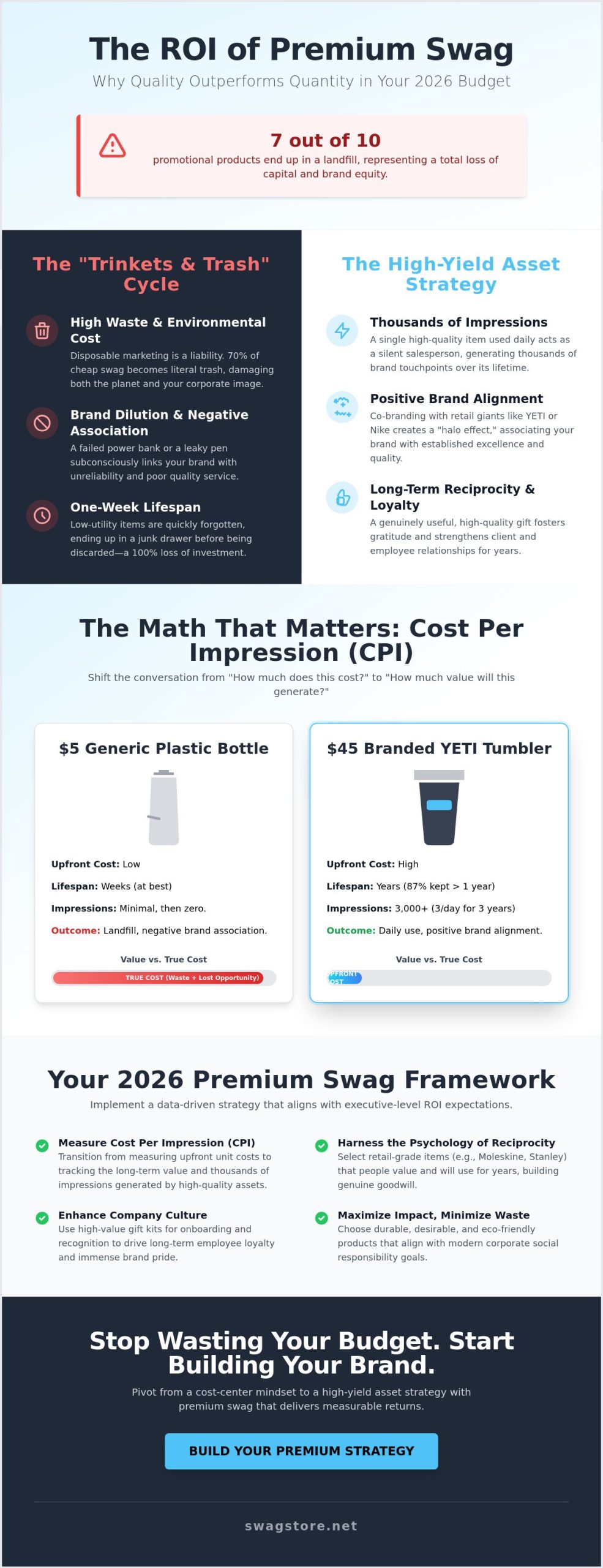
What if spending $50 on a single client gift actually cost your company less than a $5 giveaway? It sounds counterintuitive until you realize that 7 out of 10 promotional products currently end up in a landfill, representing a total loss of both capital and brand equity. We know the uphill battle of justifying premium swag budget allocations to executives who still view merchandise as “trinkets and trash.” It’s a frustrating cycle of high waste and brand dilution that fails to reflect the innovative spirit of your organization.
We believe your brand deserves better than a one-week lifespan in a junk drawer. You’ll learn how to pivot from a cost-center mindset to a high-yield asset strategy using our data-driven 2026 ROI framework. We’ll explore how high-value items like branded YETI tumblers or embroidered Nike polos lower your long-term cost-per-impression while navigating the latest IRS gift rules and market trends. Let’s look at the math that turns premium gifting into a powerful engine for client and employee retention.
The era of the “junk drawer” is officially over. In 2026, the definition of success in promotional marketing has shifted from sheer volume to strategic value. We aren’t just handing out objects anymore; we’re distributing brand representatives. To understand The Evolution of Swag, we must acknowledge how premium merchandise now functions as a high-yield brand asset rather than a sunk cost. Today, quality is the new quantity. A single, well-crafted item like a custom branded Moleskine notebook acts as a silent salesperson, sitting on a client’s desk for years and providing thousands of subtle impressions.
Modern consumers and employees have reached a saturation point with low-quality giveaways. They don’t want more stuff; they want better tools. When you’re justifying premium swag budget allocations, the focus must be on utility and durability. Premium swag in 2026 is defined by its longevity. It’s the difference between a plastic pen that runs out of ink in a week and a laser engraved metal pen that becomes a professional staple. By choosing items that people actually want to keep, you ensure your brand remains visible in their daily lives long after the initial interaction.
Cheap items are surprisingly expensive in the long run. If a custom logo power bank fails after one use, the recipient doesn’t just blame the hardware. They subconsciously associate that failure with your company’s reliability and service standards. It’s a psychological red flag. With an estimated 7 out of 10 promotional products ending up in landfills, “disposable” marketing is a liability in a world focused on corporate social responsibility. We believe that if an item isn’t good enough to be used daily, it isn’t good enough to carry your logo. Investing in quality prevents your brand from becoming literal trash.
The 2026 landscape is dominated by the “halo effect.” By selecting retail-grade products like branded YETI and Stanley tumblers or embroidered Nike and Under Armour polos, you borrow the equity of these established giants. You aren’t just giving a shirt; you’re providing a piece of high-performance gear that people are proud to wear in public. This shift from “branded items” to “curated gift experiences” is the most effective way of justifying premium swag budget increases. It signals to your partners and employees that you value excellence, turning a simple gesture into a powerful statement of brand alignment.
Marketing departments often fall into the trap of evaluating promotional spend based solely on the upfront invoice. This narrow focus ignores the only metric that truly drives brand growth: Cost Per Impression (CPI). When justifying premium swag budget requests to your C-suite, the math must shift from “how much does this cost today” to “how long will this represent us in the field.” Data from April 2026 shows that 87% of consumers keep high-quality promotional products for more than one year. In contrast, cheap alternatives quickly become a liability, both financially and environmentally.
The “Retention Multiplier” is where premium investments truly shine. High-value items like custom branded Moleskine notebooks or tech accessories don’t just sit in a drawer; they integrate into the recipient’s daily workflow. This constant presence creates a compounding return on your initial investment. Every time a client reaches for a laser engraved metal pen or checks their phone powered by your custom logo power bank, your brand’s authority is reinforced without additional spend.
Let’s look at the lifecycle of drinkware. A generic plastic bottle often cracks or leaks within weeks, leading to an immediate loss of the initial $5 investment and a 100% stop in brand impressions. While generic plastic bottles are often discarded within weeks, premium stainless steel drinkware is retained for years, becoming a permanent fixture in the recipient’s daily routine. If a branded YETI or Stanley tumbler generates just three impressions a day over three years, you’ve secured over 3,000 high-quality touchpoints. The math is clear: the “expensive” item actually delivers a significantly lower cost-per-day than its disposable counterpart.
Budget sourcing carries hidden costs that rarely appear on a quote. Administrative overhead is the silent budget killer. Every time your team has to source, proof, and re-order low-quality items because the previous batch failed, you’re burning billable hours. Sourcing premium items in bulk is a strategic move that streamlines logistics and ensures brand consistency. For a deeper look at maximizing your volume orders, explore The 2026 Guide to Bulk Monogrammed Gifts to see how high-volume premium orders unlock better brand positioning.
Relying on “cheap” giveaways also creates a replacement cycle that damages your sustainability goals. With 7 out of 10 promotional products estimated to end up in landfills, the environmental cost of low-quality items can alienate eco-conscious clients. By justifying premium swag budget allocations for eco-friendly recycled tote bags or durable retail-grade gear, you’re investing in a marketing asset that reflects a modern, responsible business model. We help you choose the right tools to ensure your brand remains a valued part of your client’s life, not a footnote in their waste bin.
A gift is never just an object. It’s a physical manifestation of how you view a relationship. When you’re justifying premium swag budget requests, you’re really arguing for a deeper psychological connection with your audience. High-value items trigger the Reciprocity Principle, a social psychology norm where people feel a natural urge to return a favor. In a corporate context, this translates to increased loyalty and higher response rates. Generic items rarely trigger this response because they’re seen as clutter. Premium items, however, feel like a genuine token of appreciation that demands a positive professional response.
The unboxing experience is your first chance to make a lasting impression. When a client receives a weighted, well-designed box containing a custom branded Moleskine notebook and a laser engraved metal pen, the perceived value of your brand instantly skyrockets. This isn’t just about the items themselves. It’s about the care shown in the presentation. Premium packaging signals that you don’t cut corners. This is a vital message to send when you’re justifying premium swag budget allocations to your leadership team. You aren’t just buying merchandise; you’re buying a sensory experience that reinforces your brand’s commitment to quality.
A premium gift shifts the power dynamic in a sales negotiation. It moves the conversation from a cold, transactional exchange to a collaborative partnership. According to research published in August 2025, 79% of recipients are more likely to do business with the brand that gave them a promotional product. This effect is amplified when the gift has high utility and retail value. We see this most clearly in client meeting conversion rates. Providing a high-end employee onboarding gift kit or a premium client tech bundle creates a sense of belonging and “indebtedness” that a $2 plastic keychain simply cannot achieve. It differentiates a thoughtful gesture from a bribe, positioning your company as a high-tier partner.
Social proof is the strongest marketing tool in your arsenal. The question is simple: will your employees actually wear a generic, scratchy t-shirt in public? Probably not. It will likely end up as a gym rag or in a donation bin. However, embroidered Nike and Under Armour polos or branded YETI and Stanley tumblers are items people are proud to use in their personal time. This creates the “Public Billboard” effect. When your team wears your brand to the golf course or the grocery store, they provide authentic, off-the-clock impressions to new audiences. Finding the right balance between style and utility is key. Check out our list of Cool Promotional Items for 2026 to see which high-performance gear is currently leading the market. By investing in wearability, you transform your team into a fleet of brand ambassadors who carry your message naturally into the world.
Effective budgeting in 2026 requires moving away from the “one-size-fits-all” approach. Instead of a flat annual spend, we recommend a tiered structure that prioritizes impact over department. This method simplifies the process of justifying premium swag budget requests by showing exactly how each dollar supports a specific business objective. A strategic budget isn’t just a list of costs; it’s a roadmap for brand visibility and relationship management. By categorizing your spend, you ensure that every item serves a distinct purpose, whether it’s closing a deal or welcoming a new lead developer.
We also advise setting aside a 10% “Reserve” budget. This flexibility allows your team to capitalize on unexpected 2026 marketing opportunities, such as a sudden viral moment or a last-minute executive summit invitation. Having these funds pre-approved prevents administrative delays when speed is essential for brand relevance.
Success starts with identifying your 2026 milestones early. Map out your major conferences, seasonal holidays, and projected hiring surges to avoid last-minute rush fees. We suggest allocating funds based on the desired “Impact” rather than departmental silos. For example, a “Culture” budget for new hires is often more effective than a generic “HR” budget because it focuses on the outcome: long-term retention. To master this for your team, check out The Ultimate Guide to Custom Employee Onboarding Kits for a detailed breakdown of kit components that work.
When you face pushback on unit prices, pivot the conversation to replacement costs. It’s much easier defending a premium purchase when you show that one high-quality item outlasts five cheap alternatives. Frame your swag as a “Retention Tool” rather than a “Marketing Expense” to align with long-term financial goals. A Tier 1 executive gift kit should be expected to secure at least one high-value referral or contract renewal within its first year of deployment. Ready to build your strategy? Browse our premium collection to find the assets that fit your 2026 tiers.
Strategy only matters if the execution matches your ambition. Moving your promotional spend from disposable items to high-yield assets requires a shift in how you procure. Bulk sourcing isn’t just about hitting a lower unit price. It’s about unlocking access to retail powerhouses like Nike, YETI, and Stanley that typically don’t play in the single-unit space. When you’re justifying premium swag budget allocations, bulk procurement is your strongest logistical argument. It ensures that every executive gift or employee kit maintains the same high standard across your entire organization.
Professional consistency is the foundation of brand trust. If your logo looks different on a t-shirt than it does on a power bank, your brand equity suffers. By centralizing your premium sourcing, you eliminate these “quality leaks.” We recommend starting with a full audit of your current inventory. Toss the items that no longer align with your 2026 vision and replace them with a curated selection of durable goods. This proactive approach turns your storage closet from a graveyard of unused “trinkets” into a strategic arsenal of brand-building tools.
The method of branding is just as important as the product itself. Laser engraving on metal pens offers a permanence that screen printing on plastic can’t match. It doesn’t chip, fade, or peel over time. Similarly, protecting the aesthetic of a premium garment requires high-stitch-count embroidery. When we customize embroidered Nike and Under Armour polos, we use techniques that respect the original manufacturer’s quality. This attention to detail ensures your logo doesn’t just sit on the fabric; it becomes part of a high-performance garment. For a deeper dive into these technical standards, read The Ultimate Guide to Promotional Items to see how strategic customization builds long-term equity.
In 2026, you don’t need a vendor; you need a strategic consultant. A true partner helps you navigate the procurement process, from selecting eco-friendly recycled tote bags to designing complex employee onboarding gift kits. We take the logistical burden off your shoulders, ensuring that your premium bulk orders are executed with surgical precision. This level of support is essential when justifying premium swag budget spends to stakeholders who demand flawless execution. Let’s move beyond transactional orders and start building a legacy of quality for your brand. Elevate your 2026 brand strategy with a premium bulk quote from SwagStore.NET and see the difference that professional execution makes.
The shift from disposable items to strategic brand assets isn’t just a trend; it’s a financial necessity in a crowded market. We’ve explored how measuring Cost Per Impression (CPI) and leveraging the psychology of reciprocity turns every gift into a high-yield investment. By adopting a tiered budget framework, you move beyond guesswork and start building lasting brand equity with every onboarding kit and executive gift.
Success in justifying premium swag budget allocations comes down to proving that quality outlasts and outperforms quantity every time. As official partners for Nike, YETI, and Stanley, we specialize in high-volume premium branding that protects your professional image. From expert laser engraving to high-density embroidery, we ensure your logo sits on products that people actually keep. It’s time to stop spending on waste and start investing in visibility.
Ready to justify your premium strategy? Get a bulk quote on retail-brand swag today.
Let’s work together to make your brand the one people choose to carry every day. We’re here to help you turn your promotional spend into your most powerful marketing asset.
You calculate ROI by dividing the total investment by the projected number of impressions over the item’s lifespan. While cheap items have a lower upfront price, their early failure leads to a high cost-per-impression. Premium items like YETI tumblers often generate thousands of impressions over several years. This longevity makes them a more efficient use of your marketing capital in the long run.
Investing in retail-grade brands is worth it because you leverage their established brand equity through the halo effect. Recipients are far more likely to wear an embroidered Nike polo or use a Stanley tumbler in public than a generic alternative. This “wearability” ensures your logo reaches new audiences naturally. High-quality brand associations lead to 79% of recipients being more likely to do business with you.
Focus on the perceived value and utility rather than a rigid dollar amount. A successful 2026 kit typically includes a mix of high-performance essentials like a custom Moleskine notebook and a tech accessory. The goal is to foster immediate brand loyalty. Choose items that reflect your company’s commitment to excellence from day one to ensure the kit feels like a gift rather than a chore.
Cheap items carry hidden costs like frequent re-ordering administrative time and high shipping fees for multiple small batches. There’s also the “brand damage” cost to consider. If a custom logo power bank fails, it subconsciously signals poor service quality to your client. This risk is a major hurdle when justifying premium swag budget allocations to your leadership team.
Premium swag improves retention by making employees feel genuinely valued through high-quality “de minimis” fringe benefits. Items like embroidered Under Armour gear become cultural markers that build a sense of internal pride. When employees feel your brand invests in their daily comfort and professional aesthetic, they are more likely to stay engaged and loyal to the organization over time.
Use the “Impact” tiering method to distribute your spend effectively across different attendee levels. Reserve your Tier 1 premium items for high-stakes leads and VIP speakers to ensure a high-value connection. For general attendees, use Tier 3 items like eco-friendly recycled tote bags. These provide high visibility and utility without the “trinket” feel that often clutters trade show floors.
The difference lies in the lifespan of the impression. A $5 plastic bottle might be tossed in two weeks, resulting in a high cost-per-impression. A $50 premium tumbler that is used daily for three years secures over 3,000 impressions. This brings the cost per touchpoint down to fractions of a cent while protecting your brand integrity for the long term.
Always choose to lower quantity over quality to protect your brand’s reputation from dilution. Distributing a few premium items to key stakeholders is more effective than flooding the market with low-grade products that end up in landfills. Maintaining a high standard when justifying premium swag budget shifts ensures your brand remains associated with excellence, even during lean fiscal periods.