


What if the right client gift budget isn’t a fixed dollar amount, but a decision shaped by the relationship? If you’re wondering how much to spend on client gifts, start with the occasion, your connection with the recipient, and your organization’s gift policies. A thoughtful gift should feel appropriate, useful, and in proportion to the gesture, not impersonal or excessive.
You can build a clear budget without making every gift identical. Decide what you want the gesture to achieve, then consider who will receive it and what they are likely to use. A well-chosen branded item or curated gift kit can make a planned budget feel considered when its quality, presentation, and branding suit the moment.
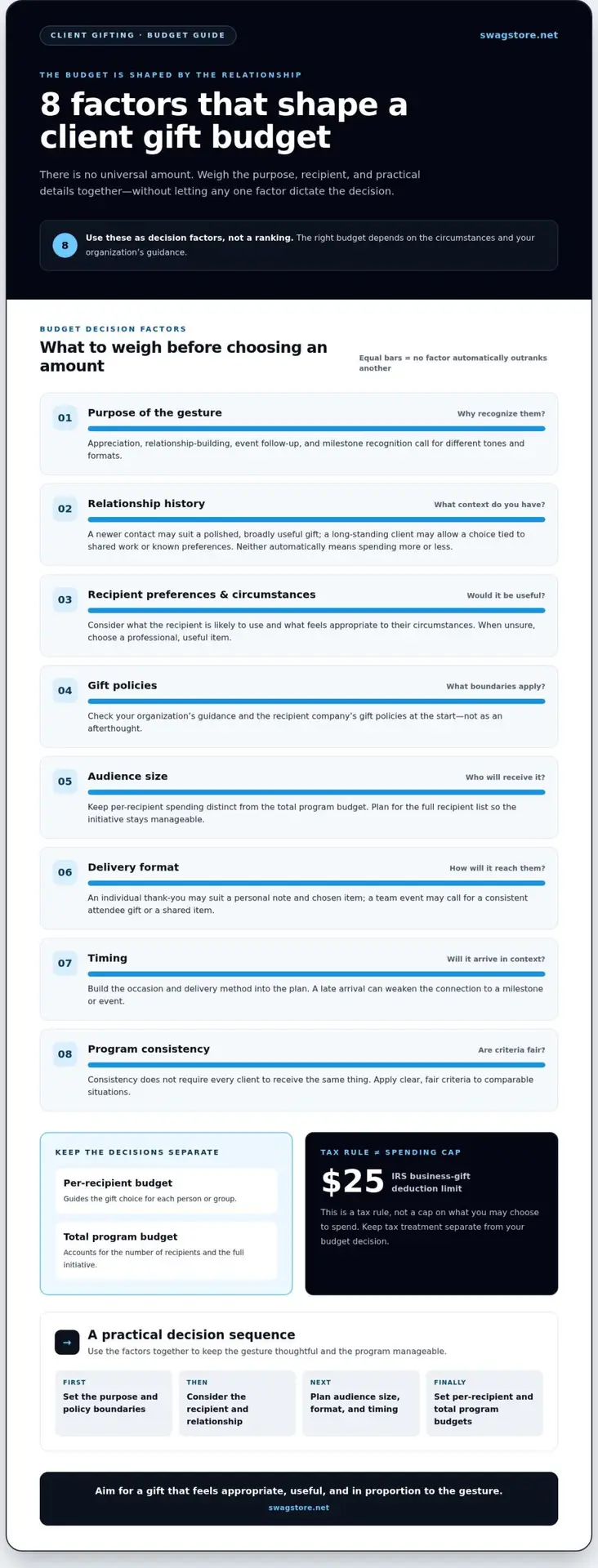
This guide explains how to set a practical per-recipient budget, choose gifts for different relationships, and plan quantities so the full program stays manageable. It also explains why the IRS’s $25 business-gift deduction limit is a tax rule, not a spending cap, so you can distinguish tax treatment from your own budget decision.
Choose a client-gift amount based on its purpose, your relationship with the recipient, the recipient’s circumstances, and your organization’s policies. There is no universal answer to how much to spend on client gifts. A modest, useful thank-you after an introduction serves a different purpose from recognizing a major project milestone or a long-standing partnership.
A client-gifting budget is a planned amount tied to the purpose of the gesture and the people receiving it. First decide what you want the gift to communicate, then choose a suitable format and cost. A consistent process helps your team make thoughtful decisions across different relationships while staying within internal guidelines.
Reasonable spending depends on the circumstances, not a single industry-wide benchmark. Consider the relationship’s history, the business context, and what the recipient would find useful. A gift for someone who helped resolve a time-sensitive issue may call for a different tone from one included in a broad event follow-up. Account for your organization’s gift policies at the start, rather than treating them as an afterthought.
Keep two decisions distinct. The per-recipient budget guides your choice for each person or group. The total program budget accounts for the number of recipients and the full scope of the initiative. A thoughtful item may work well for a focused group, while a larger audience may call for a consistent, practical format. Setting the overall limit first helps prevent a sensible individual choice from turning into an unmanageable program.
Start with a genuine reason to recognize the client, not an automatic sales touch. Appreciation, relationship-building, event follow-up, and milestone recognition are distinct goals. The gift should reflect the one you have in mind. Business giving can take different forms, including corporate donations, but a client gift works best when its purpose and recipient are clear.
The occasion shapes both tone and format. A simple note paired with a useful branded notebook may suit a personal thank-you; a curated gift kit could make a milestone feel more distinctive. In every case, make the gesture about recognition, not an implied obligation to buy, renew, or respond. That clarity keeps the relationship at the center.
A useful budget reflects more than an item’s price. Consider the relationship’s history, the business context, the reason for recognizing the client, and what would feel appropriate to the recipient. Then account for your organization’s guidance and practical program details, including how many people will receive a gift and how it will be distributed.
The main factors in a client-gift budget are purpose, relationship, recipient preferences, policy, audience size, delivery format, timing, and program consistency. Weigh them together rather than letting any one factor dictate the decision. This gives you a practical way to decide how much to spend on client gifts while keeping the gesture relevant and professionally appropriate.
Relationship history can guide tone and relevance, but it shouldn’t become a spending formula. With a newer business contact, a polished, broadly useful gift can express appreciation without assuming personal familiarity. For a long-standing client, you may have more context to choose something that reflects shared work or known preferences. Neither relationship automatically calls for a higher or lower spend.
Focus on what you know, not what you hope to gain. A gift shouldn’t be sized to buy loyalty, secure a renewal, or guarantee future business. Its value lies in recognizing the relationship with care. If you’re unsure how personal to make it, choose a professional, useful item suited to the context, with branding that supports rather than overwhelms the gesture.
The recipient group and occasion can affect the format as much as the amount. An individual thank-you may suit a personal note and a carefully chosen item. A team-wide event could call for a consistent gift for each attendee or a shared item for the group. Consider who will receive it, how it will be presented, and whether individual delivery or distribution at an event makes more sense.
Plan for the full audience and delivery method before settling on a format. A gift that works for a small group may require different logistics when the recipient list expands. Timing matters, too: a late arrival can weaken the connection to a milestone or event, so build the occasion and delivery method into your plan. Consistency doesn’t mean every client must receive the same thing. It means applying clear, fair criteria to comparable situations.
Respect your organization’s internal guidance and the recipient company’s gift policies. Expectations can vary by workplace, role, and cultural context, so don’t assume one approach fits every audience. Review applicable guidance before committing to the gift and its format. Keep the gesture professional, appropriate, and easy for the recipient to accept. For planned programs, bulk branded merchandise and curated gift kits can create a consistent look across gifts for a defined audience.
A clear process turns a broad question into a decision your team can explain and repeat. To decide how much to spend on client gifts, work from the purpose and audience toward the format. Avoid choosing an item first and trying to make it fit the budget afterward.
The total program budget depends on per-recipient planning and the number of recipients, with customization, presentation, and delivery included in the plan.
Start with the outcome, then work through the recipients and boundaries before considering specific items. For example, an event follow-up for a defined group may call for one consistent, useful format; a milestone for a particular client may suit a more tailored presentation. Decide whether one gift will work for everyone or whether a few options are more appropriate. Set the program limit before choosing products, branding details, or packaging. This order helps keep the purpose from being overshadowed by add-ons.
Review comparable clients and occasions side by side. Similar situations should generally receive comparable consideration, even if the final gift differs to reflect recipient needs. Keep a simple record of the purpose, audience, format, quantities, customization, packaging, and delivery approach. Revisit the plan if recipient counts shift or the campaign objective changes. Bulk-branded merchandise or curated gift kits can support a cohesive program, and branded merchandise and gift kits provide formats to consider as you shape yours.
A higher spend doesn’t automatically make a gift more meaningful. Recipients are more likely to appreciate a gesture that fits their work, preferences, and relationship with your organization than one that feels expensive but disconnected. When deciding how much to spend on client gifts, focus on the experience: usefulness, recipient fit, presentation, and relevant branding can make a considered choice feel special without unnecessary extras.
Start with the recipient’s everyday context. A notebook may suit someone who takes notes in meetings, while a branded tumbler could be practical for a client who travels between offices. A gift connected to a shared project or event can also feel more personal than a generic item. The aim isn’t to guess at someone’s private tastes. Choose something useful and professional that makes sense for the moment.
Let the item lead and the logo support it. Choose branding that’s clear and appropriate to the product, so the gift remains useful rather than reading like an advertisement. Consider bulk branded gifts for corporate branding as a way to explore personalization while keeping the overall look cohesive. Before production, review the artwork proof for legibility, placement, and how the branding sits on the item. SwagStore.NET’s in-house art department provides proofs for review before production.
Presentation matters, but it doesn’t have to be elaborate. A well-chosen item, neat packaging, and a brief note explaining why you’re sending it can create a more intentional impression than decorative extras with no connection to the recipient. Keep the message sincere and specific to the occasion.
A single item can be the right choice when you want a focused gesture that’s straightforward to distribute. Consider a branded Moleskine notebook or a laser-engraved metal pen for a professional thank-you. A curated kit may make sense when complementary items contribute to a shared experience, such as welcoming a client team to an event. The trade-off is practical: a single item simplifies selection and distribution, while a kit gives you more room to coordinate items and presentation.
Compare formats by asking whether each item will be useful, whether the branding suits the recipient, and whether the format fits the occasion and fulfillment plan. A branded tumbler and notebook might complement one another, but adding items just to make a package feel larger can dilute the idea and complicate distribution. Choose a coherent set only when its pieces belong together.
Build the impression through fit, not excess. Explore custom-branded merchandise and curated gift kits to shape a client gift around the recipient, occasion, and experience you want to create.
You’ve considered the purpose, audience, policies, and overall budget. Now turn that plan into a format your recipients can use and your team can manage. SwagStore.NET supplies bulk branded merchandise and curated gift kits for corporate gifting, including branded drinkware, apparel, tech accessories, notebooks, and kits.
Before choosing products, pull together a concise project brief. It can keep budget decisions, artwork, and fulfillment aligned as the program takes shape.
A coordinated bulk order can create a consistent look across a defined recipient group, whether you’re preparing branded drinkware for an event or notebooks for a client program. It also gives your team a clear format to plan around as you align quantities, branding, and presentation. The right choice still depends on the audience: consistency should support relevance, not replace it.
SwagStore.NET’s in-house art department provides proofs so you can review artwork before production. Check that the logo is legible and that the design suits the item and occasion. Free setup on most products and no hidden fees help clarify the ordering plan as you organize the program.
Bring the recipient count, occasion, delivery needs, brand assets, preferred product categories, and budget boundary into one brief. The more clearly these details fit together, the easier it is to compare formats for usefulness and brand relevance. A corporate gifting guide can help organize your program ideas; for welcome moments involving new employees, a guide to custom employee onboarding kits may offer a useful format to consider.
Use the brief to align your gift with the people receiving it and the experience you want to create. A useful item with considered branding can work for a simple gesture, while a curated kit can bring complementary pieces together for a coordinated presentation. For your next planned gifting program, explore branded merchandise and curated gift kits that fit your audience, occasion, and budget.
A client gift can do more than mark a date on the calendar. Treat it as a small, lasting expression of how you work together: useful, considered, and connected to your brand. As your program evolves, keep a record of what resonates and use that insight to make future gifting more relevant.
There’s no universal answer to how much to spend on client gifts. The strongest choice is one you can explain: it fits the recipient, the occasion, and the experience you want to create. When you’re ready to turn that thinking into a polished gifting program, SwagStore.NET brings promotional-products experience recognized as a National Winner of the Promotional Products International Association five times and with its Best in the US title for five separate years.
Plan a memorable client gift with SwagStore.NET by choosing bulk branded merchandise or a curated gift kit that fits your audience, occasion, and budget.
There’s no fixed amount that fits every client gift. Decide what the gesture is for, who will receive it, and what your organization and the recipient’s workplace consider appropriate. For example, a thank-you to one project contact and gifts for an entire client team may call for different formats. Set a program limit before choosing items, then make sure the per-recipient choice feels professional, considerate, and free of pressure to do business.
No single standard budget applies across businesses, clients, and occasions. A practical way to decide how much to spend on client gifts is to use consistent criteria rather than copy another company’s figure. Write down the occasion, audience, relevant policies, and gift format you’re considering. This gives colleagues a shared rationale for decisions and makes it easier to adjust the plan if the recipient group or purpose changes.
Account context can inform your planning, but it shouldn’t determine a gift’s value by itself. A client’s account size doesn’t tell you what that person prefers, what their company permits, or whether a particular gesture fits the occasion. Use the same professional criteria across comparable relationships, and avoid tying a gift to a renewal or purchase. The recipient should be able to accept it as appreciation, not as an expectation of future business.
Yes, branded gifts can be appropriate when the item suits the recipient and the relationship. A notebook for a client who regularly attends working sessions, for instance, can connect the branding to a useful object. Keep the logo legible but proportionate, and avoid copy or presentation that turns the gift into a sales pitch. If the recipient works under formal gift rules, factor those into your choice before arranging the gift.
Choose a gift the recipient can use, then add a personal detail that explains why you chose it. A short note referencing a completed collaboration can make a standard item feel specific to the relationship. Check that the branding is clear and the presentation is tidy, rather than adding items that don’t serve a purpose. Thoughtfulness comes from relevance and care, not simply from selecting a more expensive gift.
Give the gift when its timing makes sense for the reason behind it. A thank-you can follow a helpful collaboration, while a seasonal gesture should arrive in a window when the recipient can enjoy it. For an event follow-up, refer to the conversation or shared moment so the gift feels connected rather than promotional. Build in time to review artwork, coordinate production, and arrange delivery, and make sure the timing respects workplace policies.