


What if the tote carrying your logo gets noticed for the right reasons, not just because it’s reusable? Choosing eco-friendly tote bags wholesale with logo means balancing material information, everyday usefulness, and a design that stays clear on the finished bag. A thoughtful choice starts with the people who will use it and what they’ll carry.
Look beyond a green-sounding label. Recycled and organic describe different material claims, and broad sustainability language alone doesn’t explain what a specific bag is made from. The format and design also need to suit the audience, whether recipients are carrying event materials, groceries, or everyday essentials.
This guide explains how to compare material information, match a bag to your campaign, and prepare a readable logo. It also covers the bulk-order details that help your team move from concept to production, including reviewing artwork proofs before approval. With a clear purpose and a considered design, branded totes can feel practical, polished, and aligned with your campaign.
A tote can do more than carry event materials. Ordered in bulk and customized with an organization’s name, colors, or artwork, it turns a practical bag into a mobile expression of your brand. If recipients find it useful, they may carry it beyond the event where they received it. That makes eco-friendly tote bags wholesale with logo a campaign option worth assessing for both everyday function and the message it conveys.
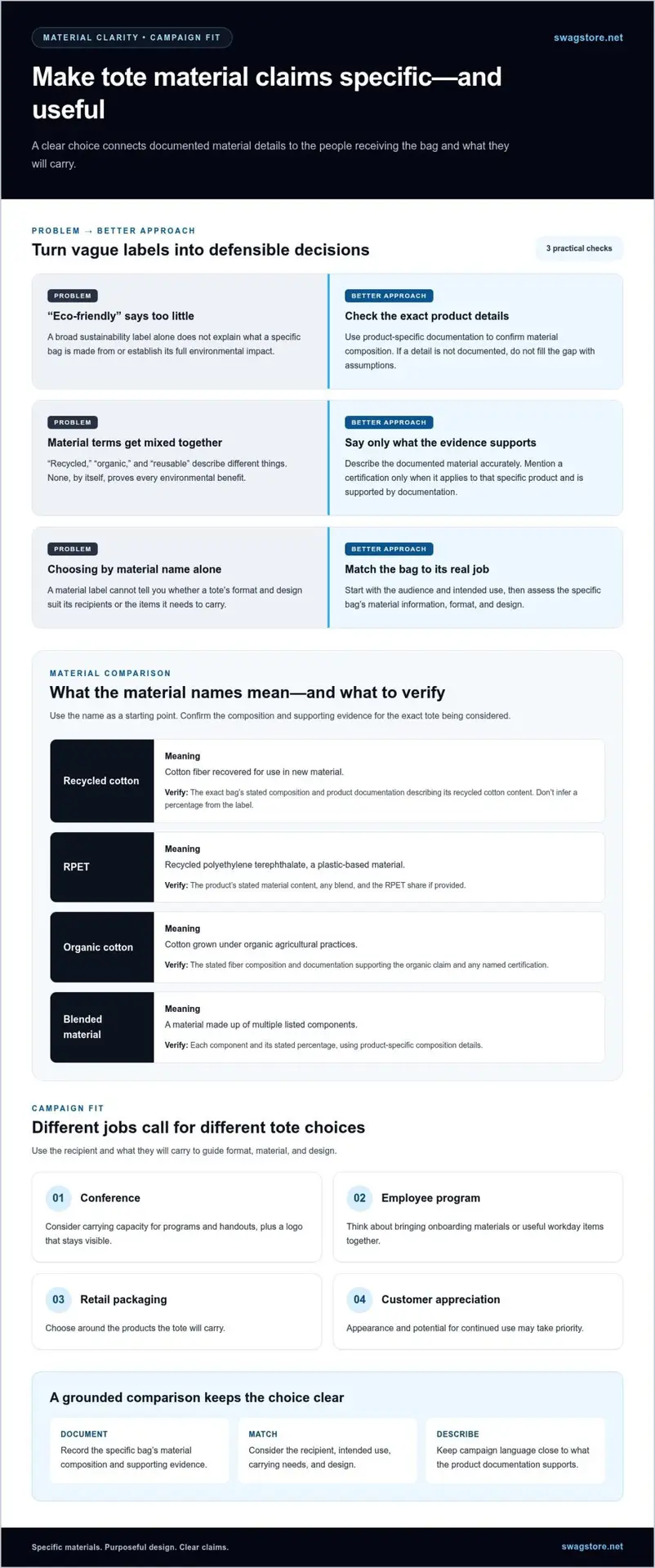
Start with the purpose, not the label. A material description is only one part of the decision, and “eco-friendly” by itself doesn’t establish a product’s full environmental impact. Consider how the tote will be used, what its product information says about composition, and whether its design suits the people receiving it. For broader context on materials, reuse, and the environmental impact of tote bags, consult an overview alongside the details for the specific product.
Use sustainability terms precisely. “Recycled” describes material made with recycled content; “organic” describes how a natural fiber was grown; and “reusable” describes an intended use, not a material source. These terms aren’t interchangeable, and none proves every environmental benefit. For a responsible comparison, connect each description to evidence for that specific bag, such as its documented material composition. Avoid claims about certification, lifecycle impact, or biodegradability unless the product documentation supports them.
This clarity helps keep your campaign credible. Rather than relying on a broad green claim, explain what is known about the bag and why it suits the project. If a material detail isn’t documented, don’t fill the gap with assumptions.
Think about the bag’s job. At a conference, it may need to hold programs and handouts, so carrying capacity and a visible logo matter. For employee programs, a tote can bring together onboarding materials or useful workday items. For retail packaging, consider the products it will carry. As a customer appreciation gift, its appearance and potential for continued use may take priority. Each role points to different choices in size, material, and design.
For an event, plan around what attendees will carry and how the tote will look alongside other promotional items. A focused design helps the organization’s identity read clearly without competing with event materials. Explore related ideas in this guide to trade show giveaways.
Before comparing bags, write down three decisions: who will receive the tote, what they’re expected to carry, and what material information you can substantiate. That brief connects the campaign goal to the product and the logo, making it easier to choose a tote that feels intentional rather than simply branded.
A material label is a starting point, not a complete sustainability assessment. For a fair comparison, record what the specific bag is made from, how that claim is documented, and whether the bag suits the way recipients are likely to use it. This keeps product facts separate from broader assumptions about environmental benefits.
These terms describe different things. Recycled cotton is cotton fiber recovered for use in new material. RPET refers to recycled polyethylene terephthalate, a plastic-based material. Organic cotton refers to cotton grown under organic agricultural practices. For a specific tote, use its product documentation to establish the material and composition. Don’t assume every recycled, organic, or blended bag has the same content or attributes.
| Material name | Documented composition | Intended use | Claim evidence |
|---|---|---|---|
| Recycled cotton | Use the composition stated for the exact bag; don’t infer a percentage from the label. | Match the bag’s format to the items recipients are expected to carry. | Product documentation describing its recycled cotton content. |
| RPET | Check the specific product’s stated material content and any blend. | Assess the bag against the campaign’s carrying needs and expected reuse. | Product documentation identifying RPET and its share, if provided. |
| Organic cotton | Use the stated fiber composition for the bag being considered. | Choose based on the bag’s role, audience, and design requirements. | Documentation supporting the organic claim and any named certification. |
| Blended material | Record each listed component and its stated percentage. | Evaluate the complete bag for its intended campaign use. | Product-specific composition details, not a general material description. |
Keep campaign language close to the evidence. If documentation identifies recycled content, describe that material accurately. Mention a certification only when it applies to the specific product and is supported by documentation. A reusable-bag benefit is distinct from claims about emissions, waste reduction, or lifecycle impact. The EPA’s overview of the benefits of sustainable manufacturing offers broader production context, but it doesn’t verify claims for an individual tote.
Material alone can’t establish a bag’s total environmental impact or whether recipients will reuse it. Size, suitability for the task, and the likelihood that it will remain useful all matter. Avoid sweeping promises such as “zero impact” unless robust product-specific evidence supports them. A concise, credible description names the documented material without implying more than the evidence shows.
Responsible sourcing language should match documented product details. Apply that standard as you compare recycled tote bag options for a branded campaign. For eco-friendly tote bags wholesale with logo, clear material information gives your team a sound basis for aligning the product story with the campaign’s purpose.
Choose the tote around the moment it needs to serve. Who will receive it? What are they likely to carry? Where should your logo be visible? These questions help narrow the options without assuming one format works for every audience. Compare each candidate’s documented material, intended use, carrying capacity, and available design area, then weigh those details against the campaign experience you want to create.
| Campaign | Audience and expected use | Selection priorities |
|---|---|---|
| Conference handouts | Attendees carrying programs, notes, and materials collected during the event. | Choose a format suited to the items being distributed; keep the logo easy to spot among event materials. |
| Employee merchandise | Team members using the tote for onboarding items or workday essentials. | Consider whether the bag fits the broader branded experience and feels relevant to its recipients. |
| Customer gifts | Clients or customers receiving a practical branded item. | Balance a useful format with documented material details and a polished, uncluttered design. |
Start with the contents, not an assumed ideal size. For an event, list what attendees are expected to carry and select a format that suits those materials. For employee or client gifts, consider how the tote complements other branded items and the impression you want the full gift to make. In retail or everyday contexts, prioritize practical relevance to the recipient. A suitable format can encourage use, though no design can guarantee how long a bag will remain in rotation.
Consider material and purpose together. Use the product’s documented material information alongside its intended role, rather than choosing on a sustainability label alone. For RPET options, the recycling innovation for plastic bags provides context about efforts to develop end markets for recycled plastic content. That broader context doesn’t establish the composition or environmental performance of a particular tote, so keep product claims tied to its own details.
A logo needs room to read. Keep it recognizable at the distance people are likely to see the bag, and use strong contrast between the artwork and its background. Avoid crowding the mark with secondary copy or decorative elements. These are general design principles, not promises about how artwork will appear on every material or production method. Reviewing a product-specific proof helps you assess placement and legibility before production.
Think of the tote as one part of a coordinated campaign. The promotional items strategy guide can help connect the bag’s role to the rest of your branded merchandise. For a practical starting point, explore SwagStore.NET’s recycled tote bags and compare the product details with your audience, use case, and logo priorities.
A clear brief helps turn a branded tote idea into an order your team can approve with confidence. Before production, align the audience, quantity, product choice, and artwork. Artwork requirements and final appearance depend on the selected tote and its production specifications, so plan to review a product-specific proof rather than assume every design will translate the same way.
Gather the essentials first: your logo file, preferred brand colors, target quantity, intended recipients, and distribution date. Decide whether the design should feature the full logo, a short campaign message, or both. Share the artwork and brief so the selected product’s requirements can guide the production details.
A simple sequence keeps the project moving:
A proof gives buyers an opportunity to review artwork before production. SwagStore’s in-house art department provides proofs before production, creating a practical checkpoint for the design. Review the logo spelling, proportions, color treatment, and placement. Consider whether the mark will be easy to recognize at the scale shown, and make sure any accompanying message supports rather than crowds the main identity.
Bring the right people into the review early. A marketing lead may focus on brand consistency, while an event or program owner checks that the design suits its audience. Collect comments in one place, separate required corrections from preferences, and describe requested changes specifically. Clear feedback gives the team a useful direction to refine and helps stakeholders agree on the artwork before production begins.
Keep the proof focused on what can be evaluated: artwork content and its proposed presentation. It helps you catch visual issues, but it isn’t a substitute for product-specific specifications. Free setup is available on most products. Review the details for your selected item as you finalize the order.
Ready to turn an approved design into a coordinated bulk order? Explore branded tote options and prepare your artwork for review.
A strong bulk order brings four decisions into alignment: the tote’s documented material, its role in your campaign, a logo that reads clearly, and a proof your team has reviewed. SwagStore.NET offers eco-friendly recycled tote bags as part of its bulk branded merchandise, giving organizations a practical option for events, employee programs, and customer campaigns.
Keep the product story precise. Use the material details for the selected tote to shape sustainability language, then match the bag to its recipients and intended use. A useful campaign brief should also explain what the logo needs to communicate, whether that’s brand recognition, a specific program, or a concise message. That context connects the item to a larger experience rather than treating it as an isolated giveaway.
SwagStore.NET provides professional printing for branded merchandise, supported by an in-house art department that supplies proofs before production. The proof gives your team a chance to review the proposed artwork and share feedback before moving forward. Artwork requirements and final appearance depend on the selected product and its production specifications, so use the product-specific proof to assess the visual presentation.
Free setup is available on most products. Use the details for your chosen tote to guide the order and artwork review.
Bring a focused brief to the project. Share the campaign purpose, target quantity, intended audience, logo, and preferred creative direction. For example, explain whether the tote is for an event, employee merchandise, or customer appreciation, and whether the artwork should prioritize the organization’s identity or a message tied to that moment. Those details give the project a clear starting point.
Then coordinate the tote with the rest of your merchandise plan. A branded bag can be one element in a welcome package, event set, or customer gift, with each item reinforcing a consistent visual identity. If you’re developing the broader mix, explore cool promotional items for 2026 for complementary campaign ideas.
With the material information and campaign purpose aligned, review the artwork proof with the relevant stakeholders. Check that the logo and message reflect the approved direction, gather feedback clearly, and proceed once your team is ready to approve production. Ready to plan your branded tote order? Explore SwagStore.NET’s eco-friendly recycled tote bags and bring your campaign brief and logo into the process.
A branded tote can be more than a useful item. It can bring your organization’s identity into a recipient’s everyday routine, creating a tangible connection that continues after a campaign ends. Define what you want that connection to feel like: welcoming, polished, practical, or unmistakably tied to a specific event. Let that intention guide your choices.
As you shape your plan for eco-friendly tote bags wholesale with logo, keep the campaign’s audience at the center. A considered order needs a clear purpose, a cohesive visual direction, and a product story your organization can stand behind. SwagStore.NET’s 5-star Google rating offers an additional signal of the experience customers value.
Bring your campaign concept into focus and turn it into branded merchandise your audience can connect with. Explore branded merchandise and start planning your tote order. Your next campaign can begin with one purposeful choice.
Neither material category is automatically the better choice for every campaign. Recycled describes recovered material used in a new product, while organic refers to how cotton is grown. Compare the exact bag’s documented composition, supporting claims, and suitability for its intended use. For example, the right option for event materials may differ from a tote selected as part of an employee welcome package.
Check whether the claim is specific to the tote you’re considering. Product documentation should support statements about material composition, and any certification claim should apply to that product. Keep your marketing copy within those boundaries: a documented recycled-content claim doesn’t, by itself, verify claims about carbon impact, biodegradability, or the entire product lifecycle. If evidence doesn’t support a broad promise, use narrower wording.
Prioritize quick recognition. Use a clear version of your logo, strong contrast against the bag color, and enough open space around the design. If the artwork includes small text, SwagStore.NET recommends bold fonts and text at least ¼ inch tall for clarity. Keep secondary copy brief, then review the supplied artwork proof for spelling, proportions, color treatment, and placement before approving production.
Yes, they can be useful at a trade show if they suit what attendees will collect and carry. Consider a tote for programs, notes, and materials gathered at exhibitor booths, and make its branding easy to recognize in a busy venue. Coordinate the design with your booth identity and other handouts. A bag that serves a clear purpose is more likely to feel like a useful takeaway than an extra item.
Prepare your target quantity, recipient details, campaign purpose, logo, preferred brand colors, and planned distribution date. Decide whether the design should emphasize your logo, a short message, or both. SwagStore.NET’s in-house art department provides proofs before production, so your team can review the artwork before approval. Free setup is available on most products. Share a clear brief to align the order with your campaign.