
A giveaway can attract a crowd and still leave your sales team with little useful to follow up on. The best branded items for lead generation aren’t simply the most popular or premium; they’re the ones that matter to the intended audience and make a relevant next step feel natural. A low-value giveaway may be quickly forgotten, while an appealing one may attract people who aren’t likely to become customers.
Choose merchandise to fit the campaign, rather than selecting an item in isolation. A recycled tote bag may suit a broad event audience, while a branded tumbler, embroidered polo, custom-logo power bank, or Moleskine notebook may fit a more focused prospect interaction. The right choice depends on who you want to reach, what action you want them to take, and how you’ll identify and follow up with people who show relevant interest.
This guide compares merchandise categories by audience, campaign goal, and follow-up potential. It also covers practical criteria for planning distribution, connecting each item to a clear next step, and evaluating whether branded merchandise supports meaningful lead generation rather than simply creating booth traffic.
A branded item can open a conversation, make a campaign more memorable, and give a prospect a useful reminder of your brand. But the item itself won’t tell you who received it, what they’re interested in, or whether they’re a good fit. The Promotional merchandise overview offers background on the broader marketing role of branded products. For lead generation, the key is connecting that role to a defined audience and a trackable next step.
Lead-generation merchandise is a campaign touchpoint that supports lead capture and follow-up; it doesn’t replace either one. This distinction separates a giveaway intended to build general visibility from an item used to support a meaningful prospect interaction. The best branded items for lead generation suit the people receiving them and the action the campaign is designed to encourage, not just their appeal on a giveaway table.
Start with a specific audience and a relevant offer, question, or conversation starter. At an event, an item could prompt someone to visit a campaign landing page or speak with a representative. After a sales conversation, a more targeted gift can reinforce the topic discussed. In either case, the item provides context. A landing page, event form, or sales conversation captures details and helps your team understand the prospect’s interest.
A broad giveaway can attract attention, but participation alone doesn’t qualify anyone. Connect distribution to a clear step, such as submitting an event form or requesting relevant information, so you can learn who is interested. Collect only details people knowingly provide, then use the interaction to guide appropriate follow-up.
Judge each option against the campaign rather than choosing on novelty alone. Ask whether it’s relevant to the recipient, useful enough to keep, easy to carry in the setting, and visible when used. Then consider whether its format and perceived value suit the next action you want, whether that’s starting a booth conversation or acknowledging a qualified prospect after a meeting.
Define what success means before distribution. Depending on the campaign, you might track completed forms, qualified conversations, or follow-up responses. Treat impressions as an estimate of exposure, not proof of lead quality or conversion. With these criteria in place, compare products by the job each one needs to do and how its contribution will be evaluated.
There’s no universal winner. The best branded items for lead generation depend on who you’re trying to reach, where they’ll receive the item, and what you want them to do next. Use this comparison to connect product choice with a purposeful interaction instead of treating every giveaway as interchangeable.
| Product category | Suitable setting | Audience | Intended next step |
|---|---|---|---|
| Recycled tote bags | Trade shows and conferences | Attendees carrying materials between booths | Start a booth conversation or direct them to a campaign offer |
| Screen-printed T-shirts | Events, team activities, or broad brand campaigns | Event participants or prospects who welcome casual apparel | Prompt a conversation or reinforce an event-specific message |
| Embroidered Nike and Under Armour polos | Sales teams, hosted events, or selected prospect outreach | Team members or prospects suited to a more polished apparel item | Support a personal meeting or a coordinated brand presence |
| Branded YETI and Stanley tumblers | Prospect meetings or event follow-up | Contacts likely to value reusable drinkware | Continue a sales conversation or reinforce a relevant offer |
| Branded Moleskine notebooks and laser-engraved metal pens | Business meetings and targeted follow-up | Prospects who take notes or plan their work | Reconnect around a discussion, presentation, or next meeting |
| Custom-logo power banks and tech accessories | Technology-focused events or prospect outreach | Contacts whose work makes practical tech accessories relevant | Invite a product inquiry or continue a related conversation |
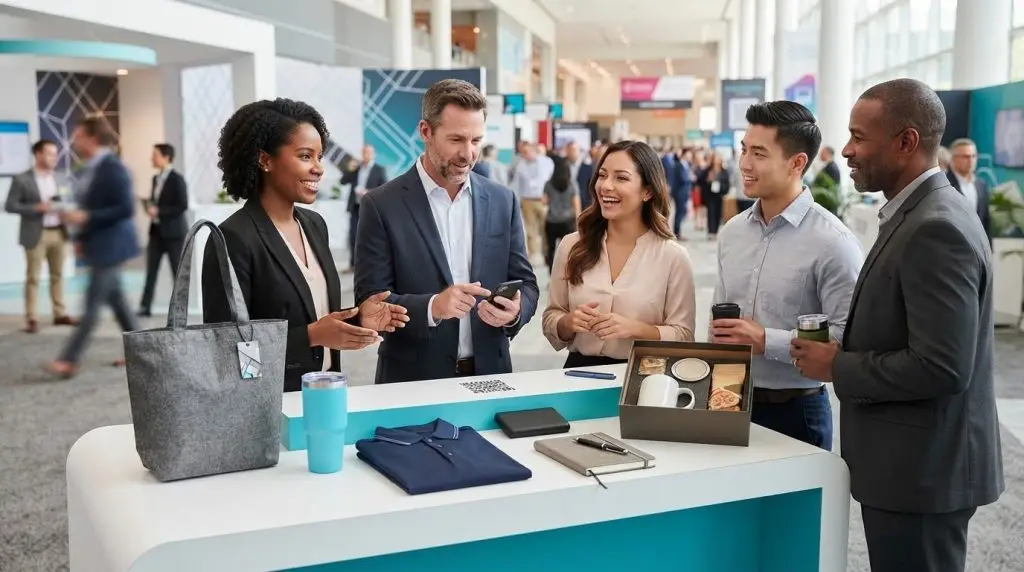
Tote bags are easy to carry at busy events and can hold materials attendees collect. T-shirts can work when casual apparel suits the event and audience, while drinkware may suit a longer-lasting follow-up touchpoint. Pair distribution with a booth conversation, event form, or trackable campaign offer. For planning ideas, see this trade show giveaways strategy guide.
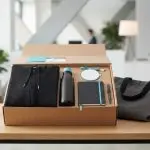
After a meaningful discussion, choose an item that connects to what the prospect does: a notebook and pen for working sessions, a tumbler as a practical thank-you, or a power bank when tech accessories fit the context. A curated gift kit can bring selected items together into an intentional follow-up. Explore the bulk monogrammed gifts guide for ideas on personalized corporate gifts.
SwagStore.NET offers these merchandise categories for bulk corporate orders. If you’re shaping a campaign brief, review bulk branded merchandise options and match the product to the audience, setting, and planned next step.
Branded items can support lead generation, but a giveaway alone can’t guarantee leads, qualify prospects, or prove that an item influenced a sale. A popular item may bring more people to a booth, but some visitors may have no interest in your offer. The best branded items for lead generation are part of a campaign with a clear audience, desired action, and follow-up plan.
A brand impression is exposure, a captured contact is someone who shares their details, and a qualified lead is a contact who also fits your criteria for meaningful follow-up. Keeping these outcomes distinct helps teams avoid treating giveaway participation as sales potential.
Start with audience relevance, not maximum reach. An item that’s useful to your intended prospects may be a better fit than a broadly appealing giveaway, especially when distribution is tied to a relevant conversation or offer. Set expectations before handing it out: explain what the campaign is about and invite people to take a related next step, such as discussing a business need or requesting information.
A simple qualification step can help filter entries with little connection to your campaign. For example, ask visitors to identify their role, area of interest, or the challenge they’re exploring. Keep questions proportionate to the interaction, and make clear when someone is choosing to share contact details for follow-up. The goal isn’t to make participation cumbersome. It’s to give your team useful context and help prospects understand what happens next.
Broad giveaways still have a role when awareness or event engagement is the objective. Their limitation is that distribution alone tells you little about intent. A targeted offer, conversation, or follow-up gift can create a stronger connection between the item and a prospect’s expressed interest, but it still needs a deliberate capture and follow-up process.
Choose measures that reflect the campaign goal, then compare them with a defined baseline or a previous comparable effort. Track the steps that show whether attention moved toward business relevance:
Interpret the results in context. A campaign designed to start relevant conversations may succeed without maximizing entries, while a broad awareness activity needs different measures. Avoid applying universal benchmarks to campaigns with different audiences, offers, or follow-up processes. For more planning context, see this promotional items strategy guide.
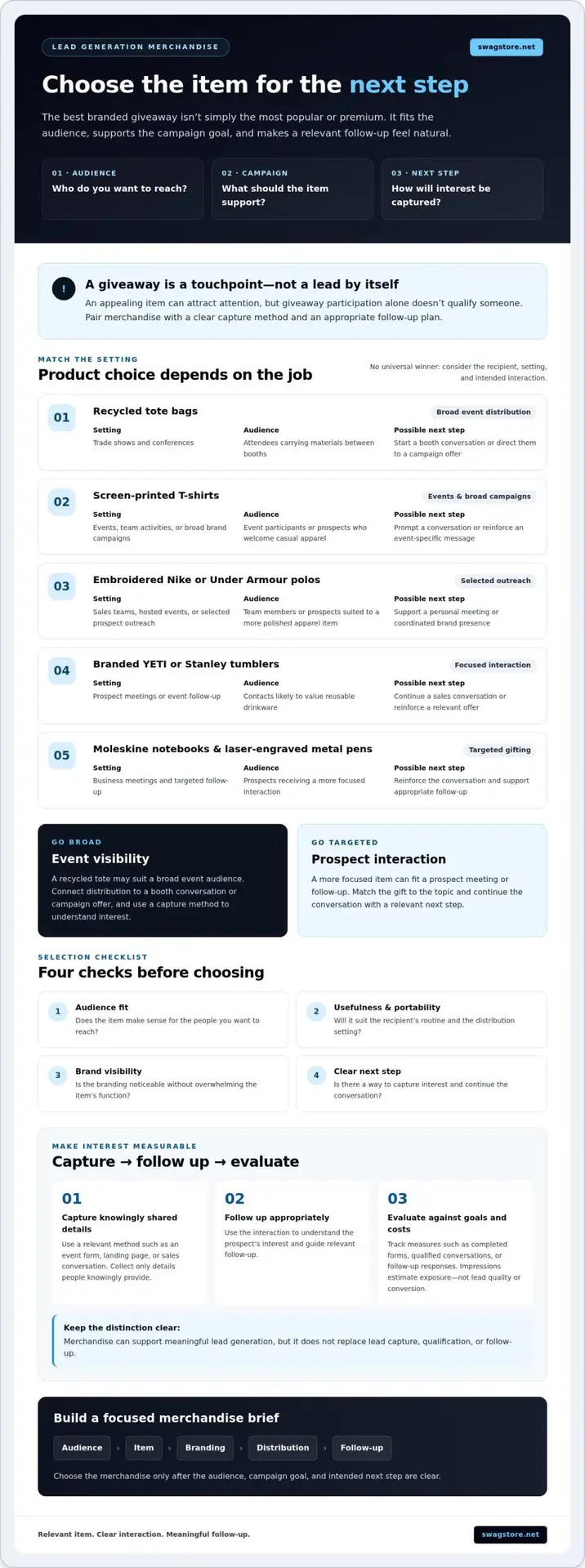
Start with the prospect, not the product. A clear selection sequence helps you choose merchandise that fits the audience and gives your team a practical way to connect distribution with follow-up. The best branded items for lead generation aren’t simply attractive; they have a defined role in the campaign.
Planning principle: Every item should connect to a defined audience and a clear next action. That connection keeps merchandise, lead capture, and follow-up working as one campaign rather than as separate tasks.
For bulk planning, confirm how the item will be branded, where it needs to go, and whether several products should be coordinated as a kit. Screen printing, embroidery, and laser engraving suit different merchandise categories, so consider how the branding method fits the product and campaign design. If you’re preparing a curated gift set for selected prospects, plan the contents and distribution together so the handoff feels intentional.
Prioritize practical use and legible branding over novelty for its own sake. Recycled tote bags can be a fitting option when the material and campaign context suit your audience. Keep sustainability and sourcing language precise: use material or environmental claims only when they’re verified for the specific product. Clear, accurate details help your merchandise reflect the same care as the campaign around it.
SwagStore.NET offers bulk branded merchandise, including recycled tote bags, apparel, drinkware, tech accessories, notebooks, and laser-engraved pens. Plan your bulk branded merchandise around the audience, branding approach, distribution needs, and follow-up you’ve defined.
A focused merchandise brief turns your campaign strategy into a practical bulk order. It gives your team and merchandise partner a shared picture of who you want to reach, what the item should support, and how you’ll recognize useful campaign results. SwagStore.NET supplies bulk custom-branded merchandise and curated corporate gift kits, with options across apparel, drinkware, tech accessories, bags, notebooks, and pens. Product choice can support the plan, but it doesn’t guarantee leads or conversions.
Make the brief specific enough to guide product selection and preparation. Include the campaign details that affect the item, branding, and handoff:
A clear brief also makes it easier to compare options against the campaign’s purpose. For example, screen-printed T-shirts may suit an event where casual apparel feels appropriate, while embroidered polos may fit a more polished team or prospect setting. The best branded items for lead generation make sense for the recipient and connect naturally to a planned next step.
Consider screen-printed T-shirts and embroidered Nike and Under Armour polos, branded YETI and Stanley tumblers, custom-logo power banks and tech accessories, recycled tote bags, branded Moleskine notebooks, and laser-engraved metal pens. Each category offers a different fit, so weigh the audience, distribution context, and campaign objective before deciding. Curated corporate gift kits may suit targeted prospect follow-up when a coordinated selection feels relevant. Employee onboarding gift kits are another option, intended for onboarding rather than automatically suited to prospect campaigns.
Bring your audience, campaign goal, preferred product fit, and bulk requirements into the conversation. Explore SwagStore.NET’s branded merchandise and identify options that fit your plan.
The best branded items for lead generation are chosen for a specific audience and campaign purpose, then connected to a clear next action. A product can help start a conversation or keep your brand visible, but lead quality depends on how you capture interest and follow up.
Before ordering, define who you want to reach, where they’ll receive the item, and how you’ll measure the response. SwagStore.NET supports bulk corporate orders and curated gift kits, with options including apparel, premium drinkware, tech accessories, recycled tote bags, notebooks, and metal pens. Screen printing, embroidery, and laser engraving can help align the branding with the product and campaign.
Ready to shape your next campaign brief? Explore bulk branded merchandise for your next campaign and consider which options fit your audience, distribution plan, and follow-up goals. A thoughtful item paired with a clear next step gives your team a stronger foundation for meaningful prospect conversations.
The best choices match the audience, campaign setting, and next action rather than following a universal ranking. Recycled tote bags or screen-printed T-shirts may suit broad event engagement, while branded notebooks, metal pens, drinkware, or tech accessories can fit a more focused prospect interaction. Consider usefulness and how the item will connect to a conversation, contact-capture step, or follow-up. Merchandise supports the campaign; it doesn’t qualify prospects on its own.
Promotional products can help attract attention and open conversations, but an item alone doesn’t capture contact details or establish lead quality. Pair distribution with a relevant offer, event form, landing page, or sales discussion that invites prospects to share their information and interests. Then follow up appropriately. Track participation separately from captured contacts and qualified leads to see whether the campaign is creating useful opportunities, not just distributing merchandise.
The right trade show giveaway depends on attendee needs, booth goals, and how the item will be carried or used. Recycled tote bags can be practical for holding event materials, while T-shirts or drinkware may suit audiences likely to value those items. Connect the giveaway to a booth conversation or trackable offer, and consider reserving more targeted items for prospects who meet your qualification criteria. Measure relevant interactions, not just items distributed.
Estimate quantity from your distribution plan, not a generic rule. Consider expected attendance or the number of selected prospects, which interactions warrant an item, and whether you’ll use a tiered approach with different merchandise for broad audiences and qualified contacts. Review relevant campaign history if available, and account for how items will be distributed and tracked. For bulk orders, confirm your planned quantity and requirements with the supplier before finalizing the brief.
A premium item may make a targeted follow-up feel more considered, but it doesn’t automatically make a recipient a qualified lead. Lead quality comes from audience fit, expressed interest, and your qualification criteria. Reserve higher-value merchandise for prospects after a meaningful interaction, and connect it to a relevant sales conversation. This helps distinguish purposeful prospecting from broad giveaways that attract participants with little connection to your offer.
Define the campaign objective and baseline before distribution, then track participation, permission-based contact capture, qualified leads, and sales progression where available. Compare revenue attributable to the campaign with its total campaign cost to assess ROI, while stating how you assign revenue and costs. Don’t treat impressions or items handed out as proof of sales impact. Compare campaigns with similar audiences and goals, since results depend on the offer and follow-up as well as the merchandise.
Yes, curated gift kits can suit targeted prospect follow-up when the contents fit the recipient and reflect a prior conversation or relevant business need. They’re usually more purposeful for selected prospects than as an indiscriminate giveaway. Choose items that work together, make the reason for the gift clear, and pair delivery with a thoughtful follow-up message. SwagStore.NET offers curated corporate gift kits, as well as Employee Onboarding Gift Kits for employee onboarding.