


Company swag can turn brand identity into something people use, wear, and remember. In PPAI’s Product Power 2026 consumer study, 90% of consumers reported that receiving a promotional product improved their perception of the organization providing it. That helps explain how company swag impacts brand perception: the item’s usefulness, quality, and design all contribute to the impression it leaves.
Company swag is more than a logo on a giveaway. It includes branded merchandise such as apparel, drinkware, and tech accessories, selected to represent a business and connect with the people around it. A useful, well-made item can make a brand feel thoughtful and professional; a poor fit may send the opposite message.
This article explains what company swag is, how to align it with your brand identity, and how spending on it can shape perceptions among employees, clients, and partners. We’ll look at the choices that make merchandise feel relevant and useful, and why the right item can carry your brand beyond a single interaction.
Promotional spending works best when each item supports a clear goal, such as brand awareness, appreciation, or repeat engagement. Track what you distribute, how recipients respond, whether they use the items, and any resulting inquiries or sales. These measures can show whether merchandise supports business outcomes, but impressions alone do not establish revenue or prove causation. A shirt worn in public increases visibility; a useful desk item keeps your brand present at work.
Useful, well-made products are more likely to leave a positive impression than items recipients discard. According to the Advertising Specialty Institute (ASI), 47% of consumers keep promotional T-shirts for two years or longer, and promotional T-shirts generate 3,400 lifetime impressions. ASI also reports that 89% of consumers own promotional pens or other writing instruments. These findings point to a practical strategy: select merchandise that fits the audience’s routines, then prioritize quality. A product’s finish and function become part of the company’s perceived reputation.
Which types of company swag create the most positive brand impressions? Useful, durable items that match recipients’ needs are strong choices, including drinkware, apparel, and writing instruments. PPAI’s Product Power 2026 consumer study found that 83% of consumers felt appreciated after receiving a promotional product. That response can support trust and loyalty when the gift feels relevant, not like an unwanted giveaway.
How does swag compare with digital advertising for brand recall and marketing ROI? Digital campaigns can track clicks and conversions, while physical items can stay in use and generate repeated exposure. Compare each channel against its objective and measure outcomes consistently. For recall, ASI’s 3,400 lifetime-impression figure for promotional T-shirts offers a concrete benchmark, not a guaranteed return.
To measure brand recall, pair campaign records with follow-up questions about recognition and product use. Branded company stores can also let employees, customers, and partners choose merchandise while the organization manages inventory, fulfillment, and brand standards. Store sales may contribute revenue, while the merchandise supports visibility. Review demand and audience feedback to guide future spending.
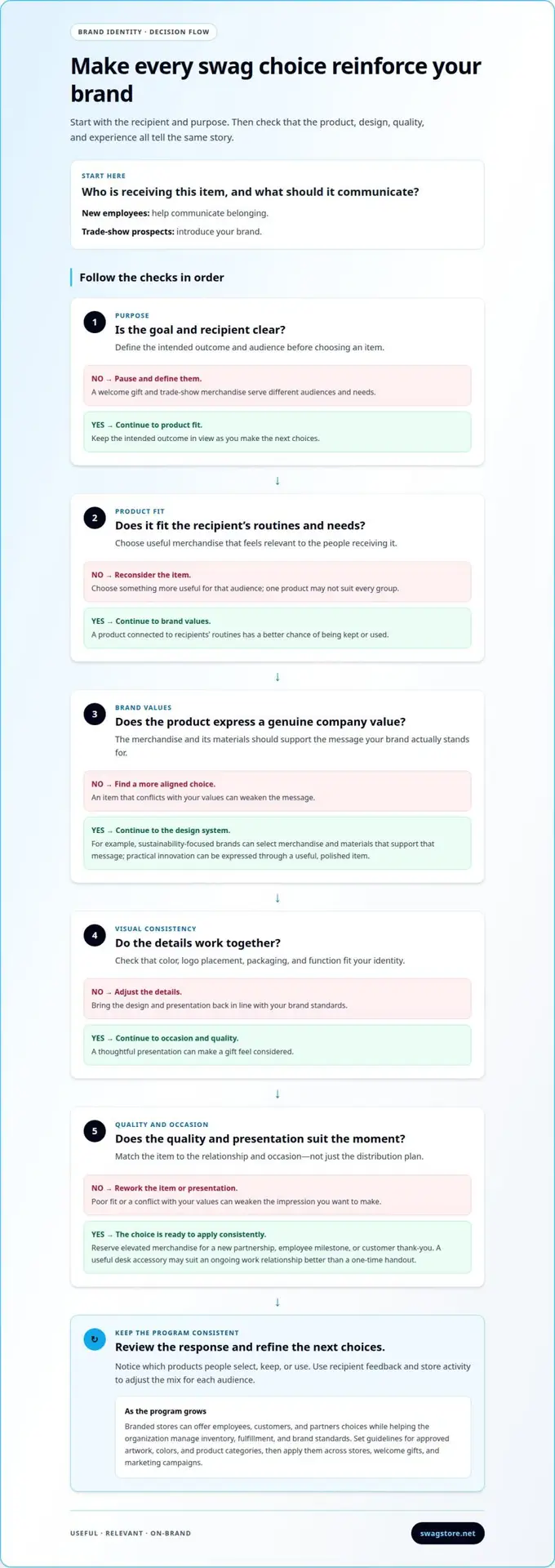
Start with a clear objective. A welcome gift for new employees should communicate belonging, while trade-show merchandise should introduce your brand to prospective customers. These audiences have different needs, so one item may not serve both well. Define the recipient and intended outcome first, then choose promotional items that fit their routines and your visual identity.
Choose products that express a genuine company value. If sustainability is central to your brand, select merchandise and materials that support that message. If your identity centers on practical innovation, choose a useful item with a polished design. Color, logo placement, packaging, and function should work together. A thoughtful presentation can make a gift feel considered, while an item that conflicts with your values can weaken the message.
Keep the experience consistent as your program grows. Branded stores can offer employees, customers, and partners choices while helping your organization manage inventory, fulfillment, and brand standards. Set guidelines for approved artwork, colors, and product categories, then apply them across stores, welcome gifts, and marketing campaigns. This keeps your identity recognizable without making every gift identical.
Higher-quality merchandise can signal that a relationship matters. Reserve elevated items for moments such as a new partnership, an employee milestone, or a customer thank-you. A useful desk accessory, for example, may suit an ongoing work relationship better than a one-time advertising handout. Match the presentation to the occasion and keep the design consistent with your brand standards.
Use recipient feedback and store activity to refine future choices. Notice which products people select, keep, or use, then adjust the mix to better fit each audience. If you’re shaping a cohesive program, explore branded merchandise options that can support your objectives and identity.
A thoughtful gift can turn a workplace value into a tangible impression. Employees may read a useful, well-presented item as recognition, especially after a completed project or team milestone. One survey found that 59% of employees who receive branded company merchandise have a more favorable impression of their workplace. The gesture works best when it feels connected to a real contribution, not like an automatic distribution.
Culture shapes how that gesture is received. In survey findings, 94% of executives and 88% of employees said a distinct workplace culture matters to business success. Employees’ ratings of collaboration, work environment, and alignment with company values were 20% higher at organizations with strong cultures. Swag cannot create culture by itself, but a consistent gift can reinforce existing values through a visible, practical expression.
Onboarding is a natural opportunity to make your values tangible. A welcome gift can help a new employee feel included while learning how the team works. New employees may spend their first couple of months assessing whether they fit in, so thoughtful presentation and a message tied to your organization’s mission can make the welcome feel personal. Recognition gifts are most meaningful when connected to a specific milestone or achievement.
Clients and partners form impressions through the same details: relevance, quality, and timing. A gift that reflects a shared project or partnership makes appreciation feel specific, strengthening the relationship rather than simply displaying a logo. That personal connection can support brand loyalty, especially when the item suits the recipient’s work or interests.
Employer reputation matters before a candidate joins, too. A survey of HR professionals found that 74% consider company reputation critical to successful recruiting. Treat employee merchandise as one part of the broader experience: align it with workplace values, use it consistently, and make recognition meaningful. A polished onboarding gift, for example, can reinforce the same culture candidates encounter during hiring and new employees experience on their teams.
Company swag shapes perception through what it signals, not just the logo it carries. Understanding how company swag impacts brand perception starts with the quality, usefulness, and design recipients experience. A well-designed item can suggest care and attention to detail; a flimsy product with hard-to-read branding can suggest the opposite.
According to the Advertising Specialty Institute (ASI), 71% of Gen Xers are more likely to do business with an advertiser that gave them promotional drinkware. ASI also reports that 51% of consumers would be more likely to do business with an advertiser that gave them a promotional writing instrument. Practical items can keep a brand present during everyday routines.
Visibility adds another dimension. Someone carrying a branded water bottle or wearing a company shirt in public brings the brand beyond its original recipient. That visibility can prompt recognition, but only if the item is something people want to use. Choose a product that suits the audience, then make the logo and design feel considered rather than intrusive.
In PPAI’s Product Power 2026 consumer study, nearly three-quarters of consumers associated branded merchandise with positive emotions such as pride, belonging, and gratitude. A shared shirt can express team identity, while a useful gift can make appreciation tangible. The practical test for how company swag impacts brand perception is whether the item fits the relationship and feels valuable to its recipient.
Before distributing an item, consider what its quality, usefulness, and visual style communicate about the organization. Then gather recipient feedback and observe which products people choose to keep using. Explore branded merchandise to shape a swag program that reflects the impression you want to make.
SwagStore.NET helps businesses turn their brand identity into custom-branded merchandise for employees, clients, and partners. Whether you’re planning a welcome program, a client gift, or a campaign with a consistent look, align your product choice with the audience and the impression you want to create.
Options include custom screen printed T-shirts, embroidered Nike and Under Armour polos, branded YETI and Stanley tumblers, and custom logo power banks and tech accessories. Choose items suited to recipients’ everyday needs, then carry your visual identity through the design. This connects the practical value of swag with the qualities you want people to remember about your brand.
Contact SwagStore.NET to discuss branded merchandise for your organization.
Choose one quality you want people to associate with your organization, then turn it into a clear creative brief. If you want your brand to feel approachable, consider how color, tone, and presentation can express that. If dependability matters most, focus on a practical item recipients can incorporate into their routines. This gives your merchandise a purpose beyond putting a logo on an object.
That’s the strategic value of understanding how company swag impacts brand perception: every design choice helps make your brand recognizable in a real-world moment. Before your next campaign, define who will receive the item, what you want them to remember, and how the design can support that impression. A focused brief makes it easier to create a cohesive experience across future brand touchpoints.
Ready to shape that brief into branded merchandise? Contact SwagStore.NET to discuss your swag, and take the next step toward a brand experience people can see and use.
Company swag is branded merchandise an organization gives or distributes to employees, customers, event attendees, or business partners. Examples include a logo-marked notebook at a conference or a welcome gift for a new team member. The best choice depends on who will receive it and how they might use it. That context helps the item feel intentional rather than like leftover event stock.
Company merch can be worthwhile when it serves a clear audience and purpose. Before ordering, consider whether recipients will use the item, whether it suits the occasion, and whether your organization can distribute it thoughtfully. A useful item for a team event may make sense; a generic giveaway with no audience in mind may go unused. Start with the purpose, then choose merchandise that fits.
Turn your brand guidelines into a practical design brief. Identify the audience, occasion, message, and visual elements the item should carry. A formal client event, for example, may call for restrained branding, while a creative team gathering could suit a more expressive design. Review the complete layout before production to ensure the logo, colors, and message work together.
In business, swag usually means promotional products or branded items distributed without a standard retail purchase. The term can cover apparel, drinkware, office supplies, and other useful goods bearing an organization’s identity. Its use varies by context: an event organizer might call attendee giveaways swag, while an employee may use the term for branded items received at work.
In business, swag refers to merchandise that represents an organization and creates a tangible brand touchpoint. Companies may distribute it at events, include it in employee programs, or give it to clients. Its role depends on the occasion: a staff item can express team identity, while a customer gift can acknowledge a business relationship.
Merch is short for merchandise, including products created or selected to represent a brand. Physical objects can carry brand colors, messaging, and identity into everyday settings. A branded notebook used during meetings, for example, can make an organization visible at work. Choose merch that suits the audience and accurately reflects your brand.