
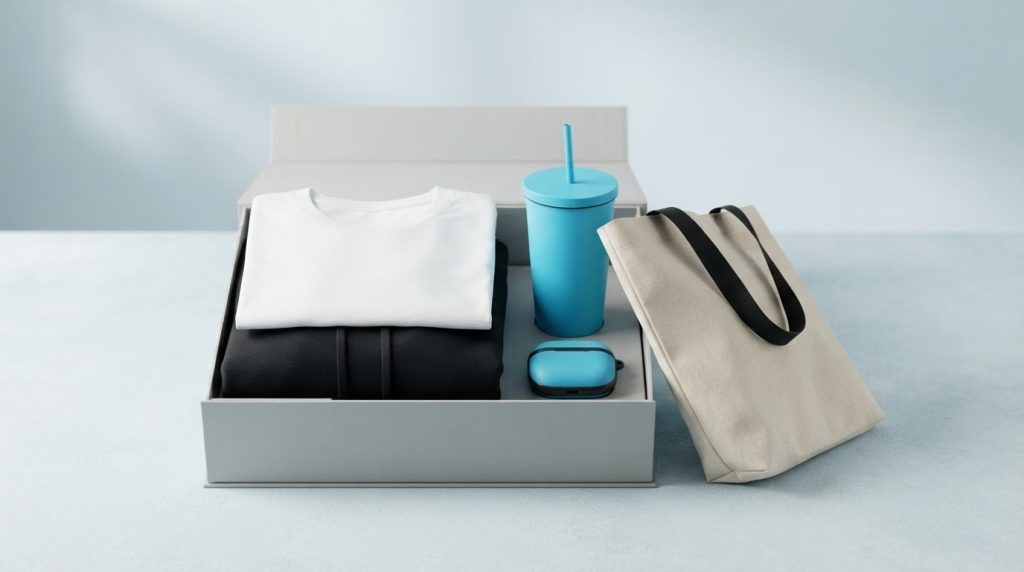
Bespoke items make a product launch tangible. Branded merchandise for product launches can reflect a product’s colors, features, or identity, helping press, analysts, customers, and employees connect the physical item with the announcement. The value isn’t just the object itself; it’s how thoughtfully it fits the launch.
Branded merchandise for product launches should feel considered, not like a collection of unrelated giveaways. Apparel, drinkware, tech accessories, and useful carry items each have a role when their design and purpose support the product story.
This guide explains how tailored merchandise can strengthen a launch, how to shape kits for different audiences, and what to consider when choosing apparel, colors, and practical items. It also covers how to plan a cohesive set that feels useful and fits the moment you introduce your product.
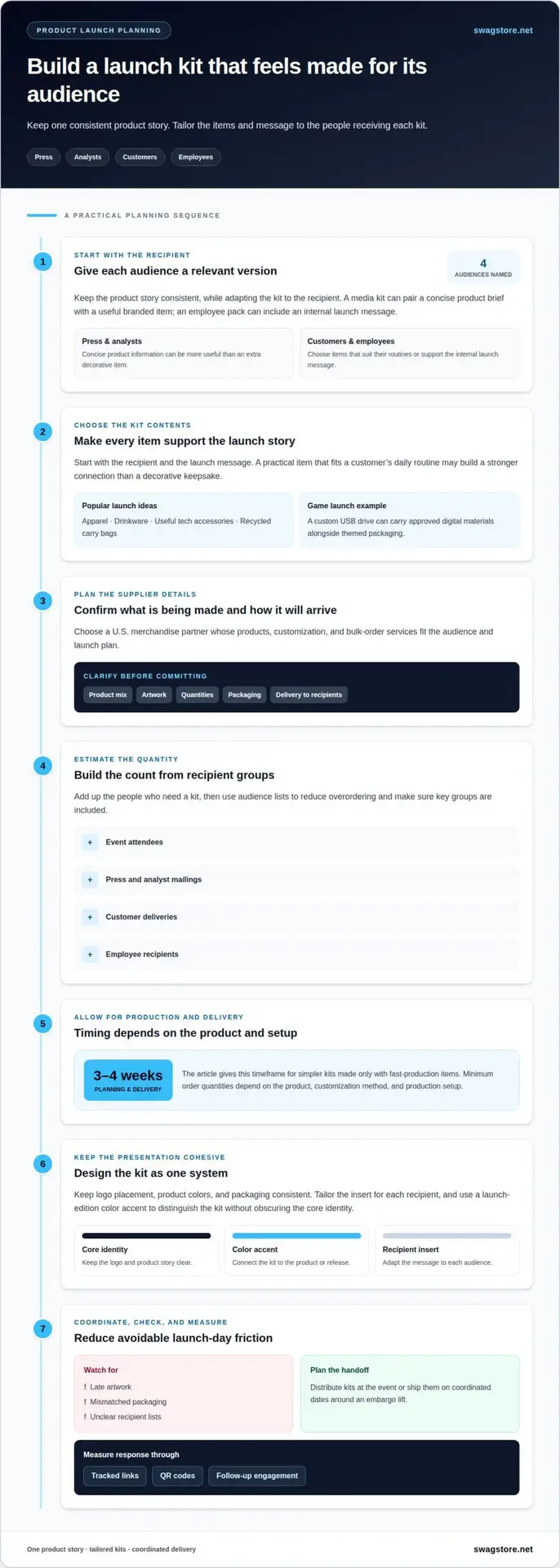
A launch kit gives each audience a physical connection to your announcement. Create versions for press, analysts, customers, and employees, while keeping the product story consistent. A media kit might pair a concise product brief with a useful branded item, while an employee pack includes an internal launch message.
Choose a U.S. merchandise partner whose products, customization, and bulk-order services fit your audience and launch plan. Before committing, clarify the product mix, artwork, quantities, packaging, and how kits will reach recipients.
For U.S. giveaways and sweepstakes, publish official rules that clearly cover eligibility, entry steps, timing, prize details, and winner selection. Have the terms reviewed for applicable federal and state requirements before promotion.
Choose products by starting with the recipient and the launch message. A practical item that fits a customer’s daily routine may build a stronger connection than a decorative keepsake; an analyst kit may benefit more from concise product information.
Popular launch ideas include apparel, drinkware, useful tech accessories, and recycled carry bags. For a game launch, a custom USB drive can carry approved digital materials alongside themed packaging.
Minimum order quantities depend on the product, customization method, and production setup. For simpler kits made only with fast-production items, allow three to four weeks for production planning and delivery.
Design the kit as a system: keep logo placement, product colors, and packaging consistent, then tailor the insert to each recipient. A launch-edition color accent can distinguish the kit without obscuring the core identity.
Estimate quantities by adding up event attendees, press and analyst mailings, customer deliveries, and employee recipients. Use audience lists to reduce overordering and make sure key groups are included.
Common risks include late artwork, mismatched packaging, and unclear recipient lists. Distribute kits at the event or ship them on coordinated dates around an embargo lift; measure response through tracked links, QR codes, or follow-up engagement. A useful gift can also encourage customer loyalty by giving recipients a reason to remember the launch.
Apparel can turn a launch message into something people wear beyond the event. A software company might outfit its demo team in logo shirts, while conference staff wear coordinated polos. Match the garment to the setting and wearer: a relaxed tee suits an informal product reveal, while a polished polo works well for customer meetings. Keep the product name visible, but leave enough breathing room for a design people will wear after launch day.
Start with the product’s visual identity, then adapt the artwork for the garment. A bright interface accent could become a sleeve detail or small chest mark, while the main logo stays clear. Review the design at its actual print size, not just on a screen. Simplify fine lines and small text if they lose definition when reduced, and share one approved design across the team for consistent event photos.
A launch-edition colorway can signal a special release without changing the core brand palette. For example, a consumer device launching in midnight blue might inspire an apparel accent in the same shade. Use the color selectively on a collar, graphic, or packaging insert. Compare the proposed shade with the product and existing brand colors to create a recognizable connection without introducing a competing identity.
Before production, confirm the garment style, decoration placement, artwork, and size mix in one review. Ask a small internal group to assess comfort, fit, and legibility; include people who will wear the apparel during a full event day. Keep a record of the approved colors and artwork for consistent reorders. For launch apparel planning, explore custom branded apparel options as part of the broader merchandise concept.
Start a merchandise store with 3-4 apparel items. This keeps the initial range manageable while allowing shoppers to compare distinct styles, colors, and decoration approaches. Choose pieces that reflect the launch audience and give each item a clear role, rather than offering several near-identical versions. Revisit the assortment after seeing which options fit the brand and wearer needs.
A discount changes the price; a well-chosen gift changes the experience. For a product launch, pair the new item with something useful that reinforces its story. A reusable metal straw, for example, can complement a beverage product without reducing its listed price. Make sure the gift feels connected, not like an unrelated extra. A thoughtful match makes the offer easier to understand and the launch easier to remember.
Use a gift-with-purchase to introduce a new product alongside a familiar bestseller. A skincare brand, for example, could include a sample of its new formula with a customer’s regular purchase. The sample lets recipients experience the launch in a familiar context. Keep the offer simple by explaining which purchase qualifies and what the gift includes.
Consider useful items with lasting value. Reusable metal straws can carry different branding treatments and remain in use beyond the launch period. That repeated visibility gives the item a role after the initial announcement. Choose an object that fits the product and the recipient’s habits, then make the logo or launch message clear without overwhelming the design.
A limited-time gift or an offer available while supplies last can add urgency. State the end date or availability condition clearly, and keep the terms consistent across emails, product pages, and event signage. If you are coordinating on-site displays, custom signage from SiteSmart can help reinforce those promotional terms at the venue. The launch email and checkout message, for example, should describe the same gift and eligibility conditions. Clarity helps customers understand the offer before buying.
Evaluate the gift as part of the launch experience, not just as a giveaway. Track offer redemptions, product purchases, and customer responses, then compare them with your objective: trial, awareness, or repeat purchase. If customers value a sample, consider pairing it again with a related bestseller. If a practical item gets attention, refine it for the next release. This keeps merchandise purposeful rather than adding cost without a clear role.
A carry item can keep a launch visible after guests leave the venue. Start by listing what recipients need to transport, such as a notebook, product sample, or event materials. A compact tote suits conference handouts, while a more structured bag may better protect a demo kit. Match the format to the contents and check that the branding remains visible when carried. Branded merchandise for product launches works best when every item has a clear purpose.
Build the design around one clear focal point. A product logo on one side and a short launch message on the other can create a purposeful layout. Avoid filling every surface with copy so recipients can recognize the brand quickly, even in event photos. Check the artwork against the bag’s material and color, and review a full-size proof before production.
Material choice shapes both the look and the recipient’s experience. A recycled-fabric tote can support a launch focused on material choices, while a paper carry bag may suit a short event handout. Describe materials accurately in campaign copy, without making environmental claims the item cannot support. Consider whether the bag will carry light printed materials or heavier samples, then choose a suitable construction.
Packaging matters, too. Place a product card or launch note inside the bag, and position fragile samples so they won’t shift in transit. For mailed kits, test the packed set before shipping to check that the contents fit neatly and the outer packaging protects them.
Plan branded merchandise for product launches around the recipient journey: event staff can hand out bags at registration, while online launches can include them with selected customer orders. Track distributions and audience feedback to guide future designs. If carry items are part of your launch plan, explore branded merchandise options for a cohesive concept.
SwagStore.NET helps businesses carry a product launch identity across branded apparel and useful merchandise. Custom Screen Printed T-Shirts can feature a launch graphic or logo, while Embroidered Nike and Under Armour Polos offer a polished option for event teams and customer-facing staff.
For a coordinated kit, pair apparel with Branded YETI and Stanley Tumblers or Custom Logo Power Banks and Tech Accessories. Choose items according to who will receive them and how they support the launch: apparel can give a team a unified look, while drinkware and tech accessories add practical value.
Turn to SwagStore.NET when you’re planning bulk merchandise and want each item to support one clear product story. Share your launch concept and intended audience to guide the selection, then contact SwagStore.NET to discuss merchandise for your next product launch.
Your launch merchandise can do more than mark a single announcement. Treat it as a lasting touchpoint: choose items recipients will use, connect the design to the product story, and plan how each audience will receive it. That gives your team a clear creative direction and helps every item feel intentional rather than incidental.
For a coordinated program, SwagStore.NET offers Custom Screen Printed T-Shirts, Embroidered Nike and Under Armour Polos, and Branded YETI and Stanley Tumblers. These products can bring a shared launch identity to staff, customers, and event recipients in different settings.
Bring your audience, launch concept, and merchandise priorities together before production begins. A focused plan makes it easier to shape a cohesive experience with branded merchandise for product launches, from the first design decision to distribution. Contact SwagStore.NET about launch merchandise, and take the next step toward a launch people can remember.
A bespoke item can make a launch feel connected to the product rather than interchangeable with any campaign. A fitness app launch, for example, could include a branded training journal that supports everyday use. That link between item and experience helps recipients understand the launch idea. Tailor the format, message, and finish to the audience so the item feels considered and worth keeping.
The best merchandise is useful to its recipient and relevant to the product’s purpose. For a home-technology launch, a practical desk accessory may suit customers better than apparel; for a team reveal, wearable items can help staff look cohesive. Before choosing the final mix, consider where recipients will use each item, how it supports the product story, and whether it fits the distribution setting.
Choose a vendor that can match your audience, branding, product mix, and delivery plan. Compare its customization, bulk production, packaging, and coordinated-shipping capabilities.