


Cash is an obvious employee referral reward, but it isn’t always the incentive employees find most motivating. It’s easy to understand, yet unclear eligibility or payout rules can make even a generous offer feel unfair. The strongest employee referral program rewards fit the people you want to motivate, the roles you’re hiring for, and the way your company works.
This guide compares eight reward ideas, from cash bonuses and experiences to points, time off, recognition, and practical branded gifts. You’ll learn what each option can do well, where it may fall short, and how to choose an approach employees can understand and use. We’ll also cover the rules to spell out, including who can participate, when a referral qualifies, and when a reward is paid. If a tangible, non-cash incentive suits your culture, branded apparel, drinkware, or tech accessories may be worth considering for a bulk program. The aim is a clear, thoughtful reward strategy, not simply a bigger payout.
A referral reward recognizes or incentivizes an employee for making a referral that meets the program’s stated criteria. The distinction is simple: a referral reward is any defined incentive or recognition for a qualifying referral; a referral bonus is specifically a cash payment. A reward might recognize an early action, such as submitting an eligible candidate, or be tied to a later hiring milestone. State which applies.
A reward is only one part of the program. Employees also need to know who can participate, how to submit a referral, how its status will be tracked, and when they’ll hear what happened. These steps connect referral activity to the wider recruitment process. Without clear ownership, communication, and follow-through, even an appealing incentive can leave employees unsure whether their referral counted or what happens next.
Set a realistic goal. Rewards can encourage participation and recognize valuable contributions, but they can’t guarantee a hire, a successful placement, or long-term retention. A clear process explains what action is being recognized. Hiring decisions still depend on role requirements and candidate fit.
Choose the behavior before choosing the incentive. If the reward is for submitting a qualified candidate, define what makes the referral eligible. If it’s tied to a hiring milestone, specify that milestone, such as the candidate being hired or reaching another stated point in the process. Employees shouldn’t have to guess whether a referral counts, when recognition is earned, or whether a reward depends on an outcome outside their control.
Put the criteria in writing and apply them consistently. A manager’s thank-you or a team announcement can add meaningful recognition, but neither replaces transparent eligibility rules. Recognition should complement the promised reward, not change the terms after an employee has referred a candidate.
People value incentives differently. A cash bonus may appeal to employees who prefer flexibility; others may respond more to time off, an experience, a practical gift, or visible appreciation. Role, workforce preferences, and company culture all shape what feels worthwhile. No reward type works for everyone, so gather employee input and consider the effort involved in administering each option.
Individual incentives make personal contributions visible, while team recognition can celebrate shared participation, especially when hiring is a collective effort. You can use both if the distinction is clear: explain who receives an individual reward, what qualifies, and how team appreciation works. That clarity makes employee referral program rewards easier to understand and gives employees a fair reason to take part.
The right reward balances what employees value with what your team can administer consistently. Use this comparison to shortlist options, then check your policy and workforce preferences before deciding. No single choice suits every company.
| Reward type | Possible appeal | Administrative considerations | Suitable use cases |
|---|---|---|---|
| Cash bonus | Flexible; recipients decide how to use it. | Define qualifying milestones and payment timing. Confirm payroll and tax treatment with qualified advisers. | Programs prioritizing a direct, individual incentive. |
| Points | Employees can choose from a reward catalog. | Explain how points are earned, valued, redeemed, and handled if unused. | Organizations seeking choice across a range of rewards. |
| Gift cards | Simple to present and tied to a retailer or service employees may enjoy. | Choice may be limited; check applicable tax and payroll treatment with qualified advisers. | A straightforward option when recipients’ preferences are reasonably understood. |
| Experiences | Can make recognition feel memorable and personal. | Consider scheduling, accessibility, location, and whether employees can select an alternative. | Teams that value shared activities or experiential recognition. |
| Extra time off | Offers personal time rather than another item or payment. | Set approval, scheduling, and usage rules; review workplace policies with qualified advisers. | Workplaces where time away is practical to arrange. |
| Recognition | Makes a contribution visible through a personal thank-you or team announcement. | Offer a private alternative for employees who prefer not to be named publicly. | Adding appreciation to another reward or celebrating team participation. |
| Branded merchandise | A useful item can create a tangible reminder of the employee’s contribution and company identity. | Choose quality and usefulness carefully; plan selection and customization for bulk orders. | Organizations whose culture and employees suit practical branded gifts. |
| Charitable donation | Connects recognition with a cause meaningful to the employee. | Clarify how recipients choose a charity and verify policy and tax treatment with qualified advisers. | Teams that want an option aligned with shared or individual causes. |
Cash gives employees the most flexibility, while points let them choose from a reward catalog. Gift cards are tangible but limit where the reward can be used. In every case, explain earning and redemption rules in plain language. For help designing a referral program, consider how the reward fits its goals, process, and tracking.
Experiences and public recognition depend on personal preference, so offer a choice where practical. Merchandise is another option, not a universal motivator. Consider branded apparel, drinkware, or tech accessories only if they suit your workforce and company identity. Explore cool promotional items for 2026 for examples, or browse custom-branded merchandise for bulk reward planning.
Before launch, ask qualified payroll, tax, and policy professionals to review how your chosen reward should be handled. Requirements can depend on the reward and your circumstances, so avoid relying on assumptions.
Choose a reward after clarifying what you want employees to do and what your organization can reliably deliver. A thoughtful mix considers five factors: employee preferences, hiring priorities, company culture, administrative effort, and available budget. The right employee referral program rewards should feel relevant to participants and manageable for the team running the program.
Consider how people work before deciding what will feel useful. Remote employees may have different preferences from on-site teams, and roles across functions may call for different approaches. Don’t assume that everyone in one job group or demographic values the same thing. Ask employees directly through a short survey, listening sessions, or a pilot, then compare responses with the roles you most need to fill.
Look for patterns rather than assuming a preference. If employees prioritize flexibility, a choice-based catalog may be worth exploring. If team contribution is central to your culture, pair an individual incentive with shared recognition. Practical branded items may suit a workforce that appreciates useful company gear, while experiences may appeal to employees who value activities. For ideas on a branded employee experience, custom employee onboarding kits show how selected items can reflect company identity. Treat them as inspiration, not proof that every employee wants merchandise.
Compare the work behind each option, not just its perceived appeal. A single reward is often simpler to communicate and distribute. A choice-based catalog offers more flexibility but may require redemption instructions and ongoing coordination. Milestone-based options can recognize different stages, but they need precise tracking and rules so employees know what qualifies.
An ATS or HRIS may support referral tracking if it’s configured to capture the information your program needs, such as the referring employee and the candidate’s progress. Confirm who reviews entries, approves eligibility, arranges distribution, and documents completion. If those steps are difficult to maintain, simplify the reward structure before launch. Check that your chosen options fit the budget over time, not just for the initial rollout.
Ask these questions before choosing:
Use the answers to narrow the options, then share the proposed rules with employees before launch. Their feedback can reveal confusing steps early and help shape an approach that feels considered and practical.
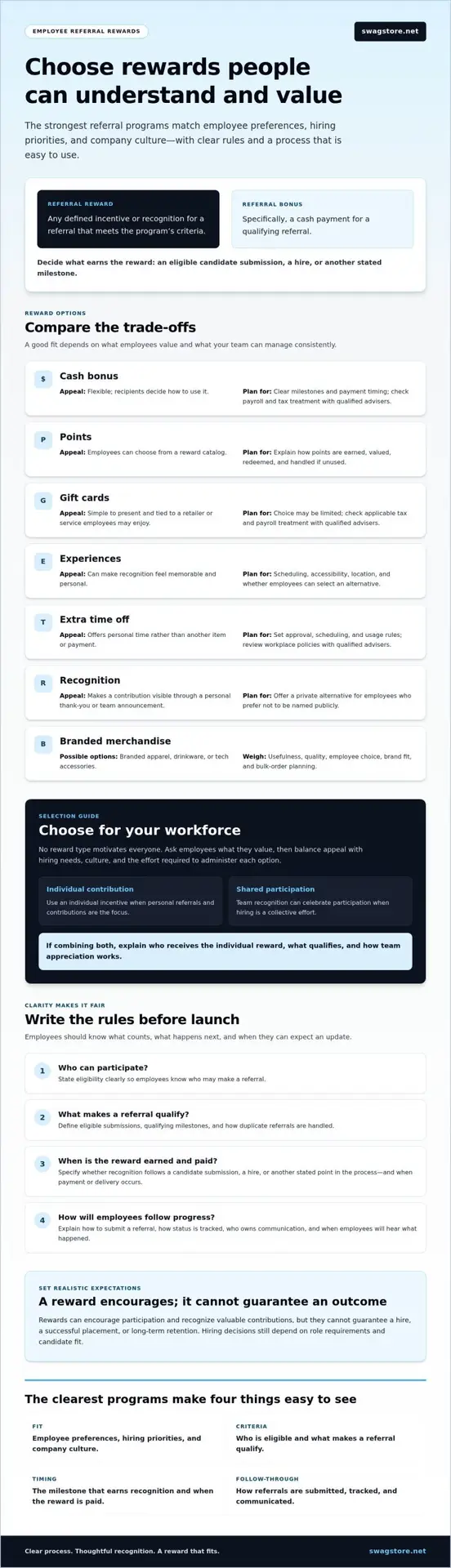
Clear rules help employees understand how a referral qualifies, who makes the decision, and what happens next. Write the policy before announcing the reward. Apply it consistently across teams, and document decisions so similar referrals receive similar treatment.
Specify who can refer, which openings are included, and how employees must submit a candidate for the referral to count. Then name the event that earns each reward, such as an eligible submission, a hire, or a stated employment milestone. Don’t leave employees to guess whether a candidate’s progress triggers recognition or a payout.
Use this setup sequence to make the policy easy to check:
Set a specific rule for duplicate referrals. For example, the policy might use the first complete referral submitted through the designated channel, or another documented method. State how HR will verify submission dates and handle cases where two employees refer the same person around the same time. Apply the same method consistently instead of making undocumented case-by-case decisions.
Tell employees where they can check referral status and when to expect an update, even if the candidate is still being considered. If a referral doesn’t qualify, explain why in a way that respects candidate privacy. Send policy changes through the same official channels, make the updated version easy to find, and state when new rules take effect. Keep a record of exceptions so the process remains accountable.
Before launch, ask HR to review the policy with appropriate legal and payroll specialists. Tax, payroll, and employment requirements can depend on the circumstances, so avoid assumptions about how a particular reward should be handled. Have qualified advisers review those details and any later changes.
Once eligibility and timing are clear, you can plan a branded reward without blurring the rules. Explore custom-branded merchandise for employee rewards as an optional, bulk-planned incentive, with the item and terms stated clearly in the policy.
A branded item can make recognition tangible, but it works best when it feels useful to the employee rather than like an obligation to promote the company. Compared with cash or points, merchandise offers less flexibility. Its potential value comes from thoughtful selection: an item employees can use and a design that reflects the company without overwhelming the product. Treat merchandise as one option in your employee referral program rewards, not a universal fit.
Consider merchandise if your company culture makes room for branded apparel, drinkware, tech accessories, totes, or gift kits, and employees are likely to appreciate those categories. A useful item can connect the recognition moment with a tangible company experience. For instance, an employee might receive a branded tumbler or tote after a referral reaches the milestone named in the written policy.
That connection depends on fit. A logo alone doesn’t make a reward appealing, and some employees may prefer a flexible incentive or another form of recognition. Ask what people would actually use, and offer a choice if your program can manage it fairly. For bulk programs, customization can help align items with company identity. Confirm current product availability, customization methods, and order minimums before planning.
Start with usefulness and quality. Consider whether an item suits employees’ day-to-day routines, work settings, and preferences. Then review its materials, construction, and branding so the finished reward feels considered rather than generic. A smaller selection of practical choices may be more appealing than a broad assortment employees don’t recognize or need.
Plan distribution alongside selection. A consistent item can simplify fulfillment, while a choice among apparel, drinkware, tech accessories, totes, or gift kits may better reflect varied preferences but require more coordination. Make sure the process works for the number of rewards you expect to distribute, and state in the policy what the reward is and when it is earned.
For additional planning ideas, explore the guide to bulk monogrammed corporate gifts. It can help you think through how customization and company identity fit into a bulk gift plan.
If merchandise suits your workforce and program, explore bulk branded merchandise options as one possible way to recognize successful referrals. Choose the item and terms with employee preferences, clear rules, and practical distribution in mind.
The strongest employee referral program rewards aren’t simply the most expensive or eye-catching. They’re the ones employees understand, find worthwhile, and can earn under clear, consistently applied rules. Gather employee input before choosing, then match the reward to your hiring priorities, workplace culture, and what your team can sustain.
Cash and points offer flexibility; experiences, recognition, and branded merchandise may suit different preferences. Whatever mix you choose, spell out who qualifies, what milestone counts, and when employees can expect an update. Clear expectations make participation easier and help the program feel fair.
If practical branded gifts fit your culture, consider premium apparel, drinkware, tech accessories, or corporate gift kits, including curated employee onboarding gift kits. Bulk custom screen printing, embroidery, and laser engraving can support a cohesive reward experience. Explore custom-branded merchandise for employee recognition to plan gifts at scale. Start with what employees value, make the rules easy to follow, and build a program your team can use with confidence.
There’s no single best reward for every workforce. Cash, points, gift cards, experiences, time off, recognition, charitable donations, and branded merchandise are all options to consider. Compare them with employee preferences, company culture, hiring goals, and the effort required to administer each one. Ask employees what they value, publish clear rules, then review participation and program outcomes before deciding whether to adjust the reward mix.
Cash offers flexibility, while non-cash options can make recognition feel more personal or experiential. Neither is automatically better: employees may value different incentives, and each format requires its own tracking and fulfillment process. Consider offering a choice if your team can administer it consistently. Whatever you select, explain eligibility and timing in writing, and consult qualified payroll or tax professionals about how rewards should be handled.
Define the qualifying milestone before employees submit referrals. Your policy might tie a reward to a successful hire or a later employment milestone, depending on company policy and hiring practices. State the trigger, expected timing, and relevant exclusions clearly. For example, clarify whether a candidate must still be employed at a specified point for the reward to qualify. Consistent status updates help employees understand what to expect and can prevent avoidable disputes.
There’s no universal amount that fits every organization, role, or hiring plan. Set the reward through internal budgeting and policy review rather than copying an arbitrary benchmark. Consider which roles are priorities, how the reward will be administered, and what outcomes the program is meant to support. Before announcing an amount, obtain internal approval and confirm payroll and tax treatment with qualified professionals. Avoid promising a payment until the terms are established.
Yes, branded merchandise can be a non-cash reward if the items are useful, well made, and suited to your workforce. Options such as apparel, drinkware, tech accessories, totes, or gift kits may fit some company cultures, but won’t appeal equally to everyone. Ask employees for input or offer a choice if practical. For bulk programs, plan item selection, branding, quantities, and distribution, then explain clearly when and how recipients earn the reward.
Publish the eligibility rules, qualifying milestones, exclusions, and reward timing before the program begins. Explain how you’ll handle duplicate referrals and candidates already in the hiring process, such as by identifying which submission record determines eligibility. Apply the same written standards across teams, document decisions, and give employees a clear way to ask questions. Review the policy periodically with HR and relevant legal or payroll specialists, especially before changing its terms.
No. Incentives can encourage participation, but they can’t guarantee referrals, candidate quality, successful hires, or retention. Employee referral program rewards are one part of a broader process that also needs clear job information, an easy way to submit referrals, timely updates, and reliable follow-through. Track relevant measures over time and interpret them in context. Ask employees what’s working, then use their feedback and operational results to guide any changes.