


A polished company shirt carries more than a logo. Ethical sourcing for corporate apparel means considering whether materials and production respect workers, human rights, and the environment throughout the supply chain. The finished garment matters, but so does how it was made.
That responsibility can feel complex: textile supply chains span multiple stages, and a label alone may not tell the whole story. People also expect brands to think carefully about how products are made. For businesses, corporate apparel is both a practical purchase and a visible expression of company values.
This article explains what ethical textile sourcing involves, where risks can arise, and why responsible production matters. It also looks at how consumer expectations shape apparel decisions, helping you choose in line with your standards and communicate your brand with confidence.
Textile sourcing risks can arise across suppliers, production stages, and countries. For U.S. buyers, tracing those connections can reveal labor, environmental, reliability, and reputational concerns.
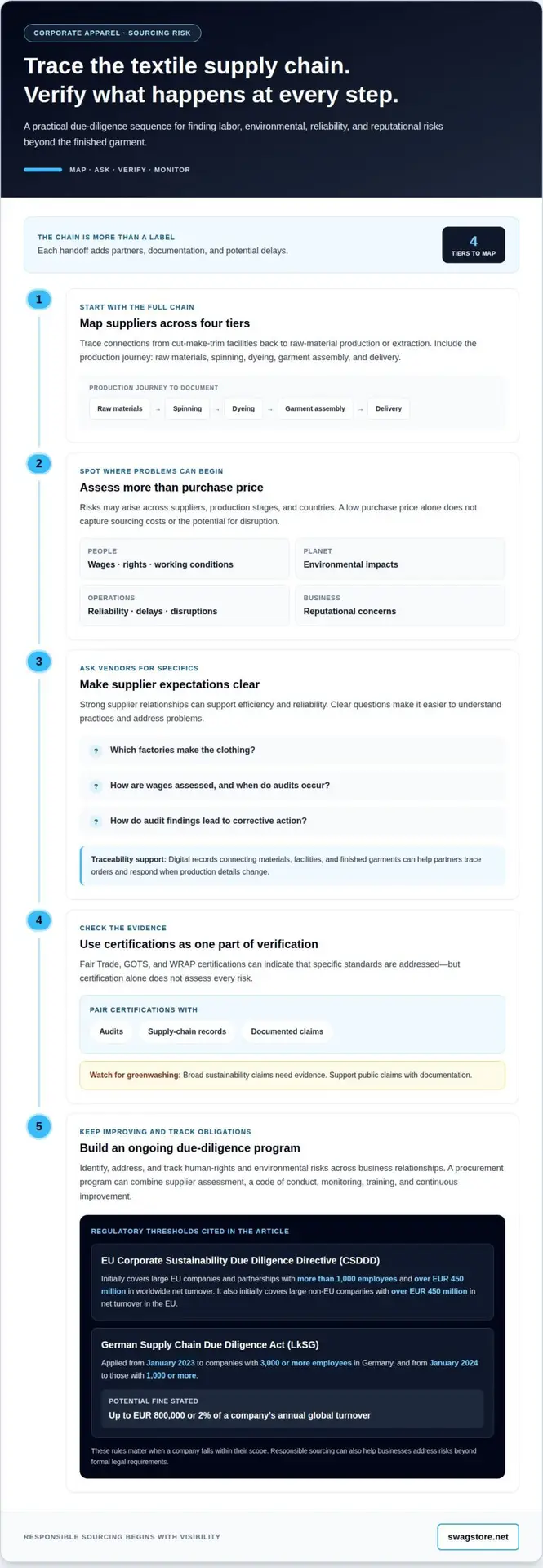
A textile supply chain can extend from raw-material extraction through spinning, dyeing, garment assembly, and delivery. Each handoff adds partners, documentation, and potential delays, so a low purchase price alone does not capture sourcing costs. Mapping four tiers, from cut-make-trim facilities to raw-material production or extraction, helps buyers identify where risks and disruptions may begin.
Strong supplier relationships can support efficiency and reliability, while unclear expectations make problems harder to address. Ask vendors which factories make the clothing, how wages are assessed, when audits occur, and how findings lead to corrective action. Digital records that connect materials, facilities, and finished garments help partners trace orders and respond when production details change.
Due diligence means identifying, addressing, and tracking human-rights and environmental risks across business relationships. The CSDDD extends attention beyond Tier 1 suppliers, including raw-material extraction. According to the European Union, it initially covers large EU companies and partnerships with more than 1,000 employees and over EUR 450 million in worldwide net turnover. It also initially covers large non-EU companies with more than EUR 450 million in net turnover in the EU.
Fair Trade, GOTS, and WRAP certifications can indicate that specific standards are addressed, but certification alone does not assess every risk. Pair certification requirements with audits and supply-chain records. Greenwashing can occur when broad sustainability claims lack evidence, so support public claims with documentation. A procurement program can combine supplier assessment, a code of conduct, monitoring, training, and continuous improvement.
Ethical labor practices include fair wages, dignified treatment, and safe, hygienic working conditions. In the United States, buyers should assess applicable labor and environmental obligations across the jurisdictions involved, rather than assume one rule covers every supplier. The German Supply Chain Due Diligence Act applied from January 2023 to companies with 3,000 or more employees in Germany, and from January 2024 to those with 1,000 or more. The LkSG can impose fines of up to EUR 800,000 or 2% of a company’s annual global turnover. These rules matter when a company falls within their scope, while responsible sourcing also helps businesses address risks beyond formal legal requirements.
Ethical sourcing considers how clothing is made, from fiber production to finished garments. It weighs environmental impacts alongside workers’ rights and responsible production.
Textile responsibility means managing both environmental impacts and social risks throughout production. That matters because fiber production accounts for 49-57% of social risks in the apparel value chain. A responsible approach considers workers, resource use, pollution, and the conditions behind each material. For corporate buyers, this broader view helps connect sustainability goals to the clothing they choose and the evidence supporting their claims.
Fiber choices shape the industry’s demands on land, water, chemicals, and forests. Cotton cultivation occupies 2.5% of global arable land and consumes 16% of global pesticides. Worldwide cotton production also uses around 200,000 tons of pesticides annually and 8 million tons of fertilizers annually. Producing one kilogram of cotton fiber can use up to 4,300 liters of water, depending on climatic conditions; dyeing and finishing can add 125 liters per kilogram. Cellulosic fiber production consumed over 140 million trees in 2018. Renewable, organic, and recycled materials offer alternatives, but their production impacts still deserve consideration.
Fast fashion’s rapid production cycles can intensify pressure on workers and natural resources. Textile factory workers described in industry reporting regularly work 12-hour days with few breaks, while responsible sourcing calls for prohibiting forced labor and child labor. The environmental footprint is also substantial: the global textiles and apparel industry accounts for up to 10% of greenhouse-gas emissions and consumes over 200 trillion litres of water each year. These impacts make production practices and material choices relevant to corporate apparel, not just trend-driven fashion.
Environmental standards give buyers criteria for evaluating impacts such as chemical use, water, and material traceability. Consider apparel made with renewable, organic, or recycled materials, and look for evidence supporting specific environmental claims. OEKO-TEX reduced its permitted Bisphenol A limit in textiles from 100 mg/kg to 10 mg/kg, effective April 1, 2025. For a branded option, embroidered Nike and Under Armour polos can fit into a corporate apparel plan guided by clear material and production criteria.
Apparel manufacturing affects people as well as the finished product. Fair pay, workers’ rights, and safe facilities are central to ethical practices in everyday purchasing decisions.
Fair wages and workers’ rights mean workers receive at least local minimum wages, dignified treatment, and freedom from coercion. A garment’s appearance cannot show whether its makers were treated fairly. Buyers can set expectations for wages, prohibit forced and child labor, and require clear complaint processes in supplier codes of conduct.
Look beyond a written policy. Assess how wages are calculated, whether workers can safely raise concerns, and how suppliers respond to violations. For example, documented corrective actions show whether a factory addresses a wage shortfall rather than simply recording it. This gives apparel buyers a more practical view of workplace practices.
Fast fashion’s quick production cycles can put pressure on factory schedules and working conditions. Consider whether rush orders give suppliers enough time to plan safe production, maintain hygiene, and treat workers with dignity. A lower-cost, rapid order is not responsible if production depends on workers accepting unsafe conditions or losing access to their rights.
Safety includes clean, hygienic work areas, safe equipment, and practical ways to report hazards. The Triangle Shirtwaist Factory fire in New York in 1911 helped lead to laws and regulations protecting U.S. factory workers. That history illustrates why safety standards matter alongside fabric choice, including organic materials. Ethical apparel procurement can make these expectations explicit and review how factories put them into practice.
For corporate buyers, the goal is to connect sourcing expectations with evidence: wage practices, worker protections, and workplace conditions. Ethical production supports workers and gives businesses a clearer basis for responsible decisions. It also keeps sustainability discussions focused on the people involved in manufacturing, not only the environmental impact of materials.
Consumer expectations can influence how brands choose clothing and communicate their sourcing practices. In a 2020 Fashion Revolution report, 75% of consumers wanted fashion brands to do more to improve the lives of people making clothes. Another 69% wanted to know how their clothes were made, up from 59% in 2018. That shift puts transparency at the heart of apparel decisions.
The CGS 2019 U.S. Consumer Sustainability Survey found that more than two-thirds of respondents considered sustainability when making a purchase and were willing to pay more for sustainable products. In the same survey, 68% of Gen Z shoppers had made an eco-friendly purchase in the prior year. These findings show why responsible sourcing can matter to brand perception, even when apparel is selected for employees or events, mirroring the standard set by fashion labels like Martindale that prioritize ethically produced, American-made garments.
For corporate buyers, consumer demand creates a practical communications challenge: sustainability claims need to match the evidence. Claims about ethical sourcing should refer to specific materials, production practices, or supplier expectations, not just broad language. Clear supply-chain information helps consumers understand what a brand means by responsible apparel and reduces the risk of misleading claims about environmental or social impact.
Turn consumer interest into a consistent decision process. Set sourcing criteria before choosing apparel, record the evidence behind each claim, and use precise language in product descriptions and internal communications. If suppliers or materials change, update the explanation. This keeps transparency tied to actual sourcing practices and helps teams communicate responsibly without implying that one product resolves every environmental or labor concern.
Branded apparel is only one way to create a visible brand experience. For a complementary branded item, explore YETI and Stanley tumblers as another option for company merchandise.
SwagStore.NET helps businesses create branded apparel and merchandise for employees, events, and company programs. Once your sourcing criteria are clear, its Custom Screen Printed T-Shirts and Embroidered Nike and Under Armour Polos can support a consistent team look. Branded YETI and Stanley Tumblers, Custom Logo Power Banks and Tech Accessories, and Custom Branded Moleskine Notebooks extend your brand beyond apparel.
Bring your priorities for materials, production information, and branding into the conversation as you choose merchandise. This connects the values behind your sourcing decisions with items people can use and recognize. Contact SwagStore.NET to discuss branded apparel and merchandise for your organization.
Ethical sourcing for corporate apparel works best as an ongoing decision framework, not a one-time statement. Give your team a shared standard for responsible production, then use it to guide future orders and the way your organization talks about them. Consistency helps turn values into recognizable choices.
For your next procurement cycle, decide which priorities matter most, such as worker welfare, material impacts, or clear supply-chain information. Keep those priorities visible from product selection through internal communications. If a sourcing detail changes, update the message. Thoughtful choices do not need grand claims; they need a clear connection between what you value and what you choose.
When you’re ready to explore branded apparel and merchandise for your organization, start a conversation with SwagStore.NET. Bring your goals and creative direction, and take the next step toward merchandise that reflects your brand with purpose.
The goal is to make purchasing decisions that respect people and reduce harm across production. For a company ordering uniforms, that means considering how workers are treated and what impacts materials and manufacturing may create. Ethical sourcing also gives teams a basis for responsible claims: describe the specific practices and evidence behind a product rather than relying on broad promises.
Responsible sourcing is a business approach that considers social, environmental, and governance impacts when selecting goods and suppliers. For example, a procurement team can weigh a material’s origin alongside workplace practices and a supplier’s ability to provide clear information. This turns organizational values into purchasing criteria and helps teams consider more than appearance, delivery needs, or immediate cost.
For corporate apparel, ethical sourcing means considering the people and processes behind garments, not just the logo or fabric. It can shape decisions about materials, supplier expectations, and the evidence used to describe a garment. For example, a team ordering event shirts can set sourcing criteria before approving a design, then keep its public description aligned with the available information.
Companies can evaluate risks by combining factory information with worker-focused evidence. Review wage records, working-hour policies, safety procedures, grievance channels, and how reported concerns are resolved. Confidential worker interviews can add context that documents alone may miss. Audits are more useful when findings lead to corrective actions with clear responsibilities and follow-up, rather than remaining a one-time checklist.
There is no single price difference that applies to every ethical and conventional apparel order. An order’s price depends on factors such as materials, traceability requirements, production practices, decoration, and volume. For a corporate order, pricing depends on the specific requirements and is provided after a quote request. Compare the full sourcing requirements, not just the garment’s initial price.