

What if the success of your 2026 event hinges on a date you haven’t even put on your calendar yet? We’ve all felt that pit in our stomach when an “out of stock” notification hits the inbox two weeks before a major launch, or when a hidden artwork delay turns a routine order into a logistical nightmare. In a landscape where shipping rates have climbed by 5.9% and new import duties are the norm, predicting promotional product lead times is no longer just a logistical task; it’s a strategic advantage. We understand that your branded merchandise isn’t just swag. It’s a tangible representation of your brand’s creativity and commitment to quality.
You deserve to feel confident that your custom tech accessories or embroidered polos will arrive exactly when you need them. We’re here to help you master the variables of production, from decoration complexity to new compliance requirements. This guide provides a reliable framework for calculating your order dates and explains why certain items require more breathing room than others. You’ll gain the clarity needed to manage your 2026 event calendar with total precision and professional flair. Let’s transform your planning process into a seamless, stress-free experience.
Timing isn’t just a detail in brand building; it’s the foundation of a successful experience. When we talk about Lead time in the promotional world, we aren’t just looking at a production window. It’s the total duration from your initial quote approval to the moment your branded merchandise lands at your event or office. Successfully predicting promotional product lead times requires a holistic view of the supply chain, moving beyond the “estimated ship date” to account for every variable in the journey.
We view this process through three essential pillars. First, Sourcing Time involves securing the raw inventory. Second, Production and Decoration Time covers the actual branding process. Finally, Transit Time accounts for the journey from our facility to your doorstep. In 2026, these pillars are more dynamic than ever. With major carriers implementing a 5.9% general rate increase and new import regulations affecting global trade, logistical precision is no longer optional. It’s the difference between a standing ovation at your kickoff and an empty display table.
One of the most frequent points of confusion we see is the distinction between “Ship Date” and “In-Hands Date.” The ship date is simply when the courier picks up the boxes from the decorator. The in-hands date is when you actually open those boxes. Relying on a ship date without a calculated buffer is a high-stakes gamble. For 2026, we recommend a more conservative approach, factoring in potential carrier delays and the new administrative requirements for cross-border shipments.
Every order follows a rhythmic cycle we call the Swag Clock. It starts with Material Lead Time, which is the window needed for blank items, like Nike polos or YETI tumblers, to reach our decoration floor. Once they arrive, we move into Production Lead Time. This is where our craft comes to life through screen printing, embroidery, or laser engraving. The final tick of the clock is Logistics Lead Time, the transit phase that brings your vision to its final destination.
Even the best plans can encounter friction. Seasonal surges, such as the Q4 holiday rush or Q1 corporate kickoffs, can stretch standard windows by several days. We also frequently see the “Artwork Bottleneck.” If logo files aren’t optimized for specific decoration methods, the entire line stops until the proofs are corrected. It’s also vital to remember that cool promotional items often involve more complex supply chains. A high-tech power bank or a bespoke gift kit requires more coordination than a standard tote bag, making early planning your greatest creative asset.
Understanding the internal mechanics of a production facility is the secret to predicting promotional product lead times with surgical precision. While many believe the process begins when the machines start running, the reality is that the administrative and logistical groundwork often consumes the most time. Each order moves through five distinct stages, and a delay in one inevitably cascades into the next. Accounting for unforeseen disruptions and lead time variability at each of these steps is essential for a stress-free launch.
The speed of your project often rests in your inbox. A 24-hour delay in approving a digital proof doesn’t just push the date by one day; it can push it by three or more. Production queues are dynamic. If you miss your scheduled slot, your order may wait until the next opening in the machine schedule. To keep things moving, always provide “Print-Ready” artwork. High-quality vector files, specifically AI or EPS formats, are the gold standard for predicting speed. They allow our designers to move straight to proofing without time-consuming recreations.
If your project involves more than a single item, the timeline shifts. For example, custom employee onboarding kits require an additional 5-7 days for manual assembly. Sourcing items like YETI tumblers, Moleskine notebooks, and power banks from different vendors into a single, beautifully branded box is a complex dance of timing. Each component must arrive at the kitting facility simultaneously to avoid holding up the entire project. If you’re planning a complex rollout, our team at SwagStore.NET can help you map out your specific timeline to ensure every piece of the puzzle fits perfectly.
Choosing the right decoration method is more than an aesthetic decision; it’s a critical factor in predicting promotional product lead times. Every technique has its own rhythm and mechanical requirements. While a digital proof might look the same regardless of the method, the physical reality on the production floor varies wildly. Understanding these nuances allows you to align your creative vision with your deadline without sacrificing the quality of your brand’s first impression.
Material matters just as much as the machine. Sourcing branded YETI and Stanley tumblers involves navigating the inventory levels of premium global brands, which can be more volatile than standard apparel blanks. While custom hoodies might be readily available in a local warehouse, high-demand drinkware often ships from central hubs. This adds several days to your total timeline before decoration even begins, a factor often overlooked in early planning stages.
The scale of your order shifts your position in the production queue. A boutique run of 50 units might fit into a small gap in the schedule, but a 5,000-unit order requires dedicated “Machine Time.” This term refers to the literal hours a project occupies a piece of equipment. When predicting promotional product lead times for large-scale campaigns, you must account for the fact that even the fastest machines have physical limits. A massive screen-printing job can occupy a press for multiple shifts, meaning your start date is just as important as the production speed itself.
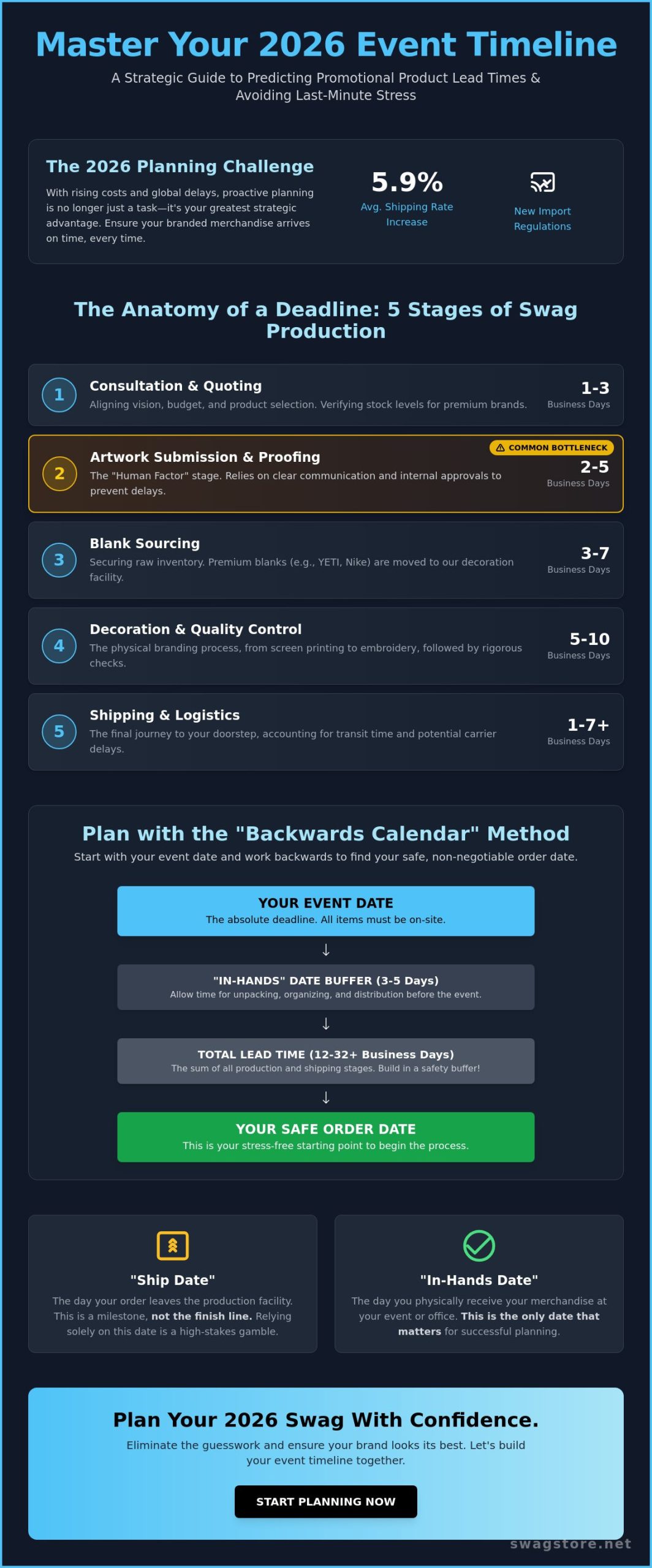
Planning a high-impact brand activation shouldn’t feel like a race against the clock. The most effective way to maintain control over your schedule is by using the “Backwards Calendar” method. Instead of asking when a product can ship, start with the specific date your branded merchandise must be in your hands. Work backward from that event date, subtracting the transit time, the production window, and the proofing phase. When predicting promotional product lead times for 2026, this reverse calculation reveals your true “drop-dead” order date, ensuring you never have to settle for second-best due to a ticking clock.
In 2026, a five-business-day safety buffer has become a non-negotiable standard for professional planners. With major shipping carriers implementing a 5.9% general rate increase and stricter address correction protocols, the margin for logistical error has narrowed significantly. This buffer protects your project from unexpected carrier delays, sudden inventory shifts, or last-minute artwork tweaks. It’s the most effective way to avoid the “rush fee” trap and ensure your promotional items arrive with the quality and precision your brand deserves.
Timing your order around global logistics is vital for success. For example, if you’re eyeing the summer trade show circuit, your “Early Bird” ordering should ideally happen in March. This proactive approach avoids the Q2 congestion and ensures premium inventory is secured before the seasonal rush. You must also account for “Red Flag” dates like Chinese New Year and peak shipping weeks in late Q4. These events can halt global production lines for weeks, creating a ripple effect that impacts domestic availability and transit speeds across the entire industry.
Before you commit to a major marketing campaign, we recommend verifying “Deep Stock” levels for your selected items. Premium brands like Nike, Under Armour, and YETI maintain high standards for their supply chains, but even they face seasonal fluctuations. During the initial quoting phase, it’s a smart strategy to select “Secondary Options.” If your first choice of stainless steel tumblers or tech accessories faces a sudden shortage, having a pre-approved backup ensures your project stays on schedule without the need to restart the entire proofing process. Ready to lock in your 2026 event dates? Connect with our team at SwagStore.NET to build your custom production timeline today.
Managing the “Swag Clock” shouldn’t be a burden on your internal marketing team. Our “Proactive Sourcing” model acts as an early warning system for your brand. We monitor inventory trends across premium labels to identify potential gaps before they ever disrupt your timeline. By the time you begin your project, we’ve already cleared the path. This foresight is the most effective way to ensure your vision moves from concept to reality without the friction of sudden backorders.
Our direct relationships with industry leaders like Nike and YETI give us a distinct edge. We don’t rely on third-party stock data that might be hours or days old. Instead, we maintain a direct line to the source. This level of transparency is the cornerstone of predicting promotional product lead times with the accuracy modern organizations demand. When we give you a date, it’s backed by real-time data and a deep understanding of brand-specific supply chains.
We eliminate the “Artwork Bottleneck” through our streamlined proofing process. Our creative consultants review your files immediately; ensuring they’re ready for the specific mechanical requirements of embroidery or screen printing. We handle the technical heavy lifting, from vectorizing logos to adjusting stitch counts, so your production slot is never lost to a file error. This proactive approach keeps your project at the front of the queue.
Reliable delivery across the United States is our promise. We understand the nuances of the 2026 carrier landscape, including the 5.9% general rate increases and stricter surcharge policies. Our logistics team manages the final leg of the journey to ensure your boxes arrive on time. Whether you’re shipping to a central event hub or distributing to a national network of remote employees, we ensure consistency and quality at every stop.
We act as a seamless extension of your marketing department. Our team understands that trade show giveaways require more than just a logo; they require a strategy that respects your hard deadlines. We manage the entire lifecycle of your project, from the first quote to the final delivery. You get to focus on the creative impact while we handle the logistical precision. It’s a partnership built on trust and high-aesthetic execution.
The best time to secure your 2026 inventory is right now. Early planning is the ultimate tool for predicting promotional product lead times and avoiding the stress of last-minute rushes. Let’s work together to make your next brand activation a resounding success. Contact SwagStore.NET for a custom quote and timeline analysis and let our experts take the weight off your shoulders.
Mastering the “Swag Clock” is about more than just checking a shipping label. It’s about aligning your creative vision with the physical realities of global logistics. By adopting the “Backwards Calendar” method and accounting for the specific demands of different decoration techniques, you transform a potential headache into a strategic victory. Successfully predicting promotional product lead times allows you to focus on the experience you’re creating for your audience rather than the anxiety of an empty display booth.
We’re ready to act as your creative partner throughout this journey. From our direct-to-brand sourcing for Nike, YETI, and Stanley to our meticulous in-house assembly for complex onboarding kits, we handle the technical precision so you can embrace creative freedom. Our expert consultants are here to manage every tick of your production calendar. Don’t wait for the next “out of stock” notification to disrupt your momentum.
Start your 2026 swag project with a professional timeline assessment today. Let’s build something remarkable together.
Standard lead times for bulk orders typically range from 1 to 2 weeks for decorated apparel like screen-printed t-shirts or embroidered polos. Hard goods, including branded tech accessories and drinkware, generally require 2 to 3 weeks for production. These windows represent the time spent on the production floor and do not include the initial consultation or final transit to your destination.
It’s possible to meet tight deadlines, but your product selection and decoration options will be significantly limited. Rush orders require immediate artwork approval and often incur additional fees to prioritize your project in the production queue. To succeed with a one-week turnaround, you must provide print-ready vector files and select items that are currently in stock at a local decoration facility.
Embroidery is a stitch-heavy process that is generally slower than the liquid application used in screen printing. While screen printing is built for high-volume speed once the screens are set, embroidery depends on the total stitch count of your logo and the number of available machine heads. A complex, multi-colored logo will occupy a machine for much longer than a simple text-based design.
Premium brands maintain centralized inventory hubs that often require additional transit time to reach our decoration floor. Sourcing high-demand items like Nike polos or YETI tumblers involves navigating the strict supply chain protocols of global leaders. This “blank sourcing” stage adds a layer of coordination that isn’t present when using generic items, making early planning essential for these sought-after products.
Non-vector files like JPEGs or PNGs will immediately stall your project in the proofing stage. If our creative team has to manually recreate your logo to make it “print-ready,” it adds several days of labor before production can even begin. Providing AI or EPS files is the most effective strategy for predicting promotional product lead times and keeping your project on its original schedule.
Yes, kitting typically adds 5 to 7 business days to your total production window. Each component of your kit, from custom Moleskine notebooks to power banks, must arrive at our assembly facility before the manual kitting process can start. This stage requires a deliberate pace to ensure that every employee onboarding gift or event kit is assembled with professional precision and care.
Lead times are professional estimates based on current machine capacity and carrier performance data. While we strive for total accuracy, 2026 logistical variables like the 5.9% carrier rate increase and new import certification requirements can impact final delivery. We always suggest building a five-day safety buffer into your calendar to protect your brand from unforeseen transit delays or carrier disruptions.
We recommend starting your order at least 6 to 8 weeks before your event date. This window allows for the “Backwards Calendar” method, giving you ample time for sourcing, decoration, and the final transit to the convention center. Proactive planning is the secret to predicting promotional product lead times and ensuring you secure the highest quality inventory for your most important brand activations.