

A swag request is easier to approve when it follows the project scope, not a generic per-person allowance. Presenting a swag budget proposal to your boss means showing who the merchandise is for, what it needs to achieve, and how quantities and fulfillment fit the plan. For event swag, 10-20% of the total event budget is a useful planning benchmark; employee merchandise should have its own budget line.
It’s reasonable to want a clear figure before you make the case. The strongest proposal makes that figure explainable, with separate event and employee costs, realistic quantities, extra fulfillment expenses, and hiring projections. We’ll walk through how to estimate those components, build in a contingency, and connect each requested expense to the project’s purpose. That way, your request gives your boss a focused investment decision, not just a list of branded items.
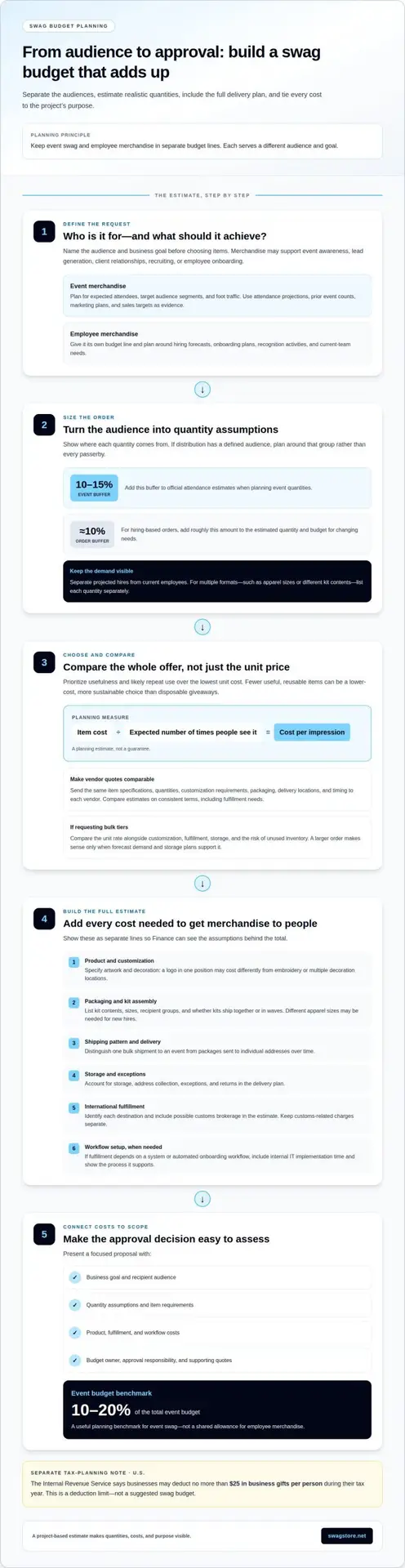
Keep event and employee merchandise in separate budget lines because each serves a different audience and goal. For an event, estimate quantities from expected attendance, target audience segments, and foot traffic; add a 10-15% buffer to official attendance estimates. For employee merchandise, use hiring forecasts, onboarding plans, and recognition activities instead. Separate estimates make it easier to see which project drives each expense.
Build the event estimate from evidence: attendance projections, prior event counts, marketing plans, and sales targets. If Sales expects to reach a defined number of prospects, plan distribution around that audience rather than every passerby. Then group quantities by purpose, such as brand awareness, lead generation, or client gifting. Connecting each item to an outcome gives Finance a clear basis for reviewing the request.
Estimate swag cost per impression by dividing an item’s cost by the number of times people are expected to see it. These are planning examples, not guarantees. Prioritize usefulness and likely repeat use over the lowest unit cost.
To compare swag vendors and request quotes, send each the same item specifications, quantities, customization requirements, packaging, delivery locations, and timing. Compare estimates on consistent terms, including fulfillment needs, rather than comparing item prices alone.
Lower-cost, more sustainable choices can include fewer, useful, reusable items instead of disposable giveaways. Choose based on audience needs and expected use, not novelty alone.
For a proposal, state the business goal, audience, quantity assumptions, item requirements, and fulfillment costs. Branded merchandise can support event awareness, lead generation, client relationships, recruiting, or employee onboarding. For U.S. tax planning, the Internal Revenue Service says businesses may deduct no more than $25 in business gifts per person during their tax year; this is a deduction limit, not a suggested swag budget.
The item itself is only one line in a promotional merchandise estimate. For each order, separate product, customization, packaging, shipping, storage, and fulfillment costs. Request quotes using the same quantity, artwork, delivery plan, and packaging requirements. Then compare quoted totals, not just base item costs. This makes assumptions visible and gives Finance a clearer view of the full investment.
Customization can change production requirements. A logo printed in one position may have different costs from embroidery or multiple decoration locations. Bundling items into kits can also add packaging and assembly steps. Specify the contents, sizes, recipient groups, and whether kits should ship together or in waves. For example, a new-hire kit may need different apparel sizes, while an event giveaway may use one standard package.
Delivery plans affect the estimate. One Bulk shipment to an event differs from sending packages to individual addresses over time. Include storage, address collection, exceptions, and returns in the plan. For international shipping, identify each destination and account for possible customs brokerage in the fulfillment estimate. Keep customs-related charges separate so the total reflects the delivery plan.
Customer Success teams can also budget for automating repeat tasks. A new-customer onboarding workflow might trigger kit preparation after an account milestone. Include the internal IT time needed to implement that workflow, alongside merchandise and fulfillment costs. Automation can reduce repetitive coordination, but the proposal should show the setup work and the process it supports.
Present these assumptions in a simple estimate: item and customization, packaging, shipping pattern, storage, and any workflow setup. If branded notebooks or custom logo power banks fit the purpose, include their specifications in the same quote request. For custom branded merchandise options, clear quantities and delivery details help shape a project-ready request.
Hiring forecasts turn an annual swag program into a quantity plan. Start with the approved hiring projection, then map each expected hire to a recipient item or kit. Add roughly 10% to the estimated order quantity and budget for changing needs. Keep projected hires separate from current employees, so Finance can see which branded items support onboarding and which support existing teams.
Bulk pricing can lower the per-item cost at higher quantities, but the total commitment still matters. Request estimates at the planned quantity and relevant larger order tiers. Compare the unit rate alongside customization, fulfillment, storage, and the risk of unused inventory. A larger order makes sense only when forecast demand and storage plans support it.
For a trade show, estimate quantities from the attendee group and distribution purpose. For employee onboarding, align quantities with start dates and expected roles. If a program uses multiple formats, such as apparel sizes or different kit contents, show each quantity separately. This lets approvers see where demand comes from instead of treating the order as one unexplained total.
Approval is a business decision, not just a purchasing task. Project budget approval means the sponsor or steering committee accepts financial accountability for the investment on the organization’s behalf. Name the budget owner, approval responsibility, business outcome, and assumptions in the request. This gives the sponsor a clear basis for approving the scope and funding.
Employee gift and branded merchandise purchasing policies depend on an organization’s internal approval process. Follow its spending authority, procurement steps, and gift rules, and include the required approvals and supporting quotes in the request.
Include internal IT implementation time when swag fulfillment depends on systems or workflows. For example, an onboarding process may need IT support to connect a new-hire trigger with kit requests. Estimate that work alongside merchandise costs, identify the responsible team, and explain how the workflow supports the program. The budget then covers both the branded items and the operational effort needed to deliver them.
A credible proposal connects each requested expense to a defined business objective. For an employee recognition program, explain who receives merchandise, what moment it supports, and how success will be assessed. For a trade show, tie quantities and delivery timing to the planned activation. When presenting a swag budget proposal to your boss, make the link between requested spending and its intended outcome easy to follow.
Build the scope before finalizing the budget. State the business moment, recipient group, estimated quantity, merchandise requirements, fulfillment needs, delivery pattern, assumptions, and approval responsibility. Then show how each line supports that scope. For example, a company-wide gathering may need one coordinated delivery, while employee onboarding may require kits for different start dates. These distinctions make the estimate easier to explain and expose mismatches early.
Separate essential costs from optional enhancements. A request might identify core merchandise and delivery as the base estimate, then list upgraded packaging or additional recipient groups as alternatives. At project initiation, a contingency of 10 to 15% of a project’s base estimate is described as reasonable for most projects. As risks are resolved or mitigated, reduce the contingency rather than carrying the initial allowance unchanged.
Give the sponsor a clear approval decision. Project budget approval is a formal governance act: the sponsor or steering committee accepts financial accountability for the investment on the organization’s behalf. Present the requested amount, scope boundaries, assumptions, and expected outcome together. A strong approach to presenting a swag budget proposal to your boss also explains how changes to the employee population or delivery pattern affect the approved scope.
After approval, compare planned activations with merchandise in production or fulfillment. Track planned quantities, destinations, and timing against actual delivery. These controls help the team spot scope drift and keep orders aligned with the approved project. Use the same review when a partner requests an additional audience or activation, so the budget reflects the revised scope.
Ready to turn your approved scope into a merchandise plan? Plan your branded merchandise order around the recipients, purpose, and delivery pattern.
SwagStore.NET helps businesses turn a defined swag budget into bulk custom-branded merchandise for events and employee programs. Once your audience, quantity, and purpose are clear, you can choose from Custom Screen Printed T-Shirts, Embroidered Nike and Under Armour Polos, Branded YETI and Stanley Tumblers, and Custom Logo Power Banks and Tech Accessories.
Use these categories to shape a proposal around the experience you want to create, from event visibility to practical employee gifts. A focused merchandise plan is easier to explain when each item connects to a recipient group and project goal. Share your project scope and merchandise needs with SwagStore.NET to discuss a bulk branded merchandise order.
Contact SwagStore.NET to talk through your swag project.
A budget proposal is the starting point, not the finished project. Once your request is approved, use the audience and purpose you defined to choose merchandise that feels intentional and useful. That connection keeps creative choices grounded in the business goal.
When presenting a swag budget proposal to your boss, you’re making a case for a planned investment, not just a collection of items. SwagStore.NET offers Custom Screen Printed T-Shirts, Embroidered Nike and Under Armour Polos, and Branded YETI and Stanley Tumblers for business merchandise programs. Choose options that fit your recipients and the experience you want to create.
Ready to put your plan into motion? Contact SwagStore.NET to plan your swag. Bring your approved scope and audience goals, and take the next step with confidence.
There’s no single spend level that fits every company; budgets depend on audience size, merchandise purpose, and fulfillment needs. For event planning, promotional swag typically represents 10-20% of the total event budget. Use that as a starting benchmark, then build your estimate from the event scope and recipient plan. Employee merchandise is better budgeted against hiring, onboarding, and recognition plans.
A merchandise partner can help translate your project scope into comparable product and fulfillment estimates. Share the intended recipients, quantity assumptions, branding needs, and delivery pattern, then use the details to refine your internal request. For example, a business planning gifts for clients and new hires can separate those audiences and purposes before selecting merchandise. SwagStore.NET specializes in bulk custom-branded merchandise for organizations.
List the fulfillment choices that affect the final order before approving it. Decide whether items go in one shipment, arrive in waves, or ship to individual recipients. Account for packaging, storage, address collection, size variations, exceptions, returns, and possible customs brokerage for international deliveries. For instance, a distributed onboarding program has different handling needs from one delivery to an event venue.
Build the forecast around scheduled business moments rather than a single yearly order. Map planned events, employee onboarding, recognition, recruiting, and client gifting to recipient groups and expected quantities. Review the forecast quarterly, add a pre-production approval gate, and compare delivered orders with the plan afterward. If hiring or event plans change, update future quantities before placing the next order.
Usually, separate budget lines make spending easier to assign and review. An event allocation can track merchandise tied to a specific audience or activation, while an employee allocation can cover onboarding or recognition. If one item serves both groups, record the intended split and the reason for it. This keeps event results distinct from employee program costs during reporting and future planning.
A budget proposal template is a reusable format for presenting an expense request and its rationale. Include fields for the business objective, audience, quantity, merchandise specifications, fulfillment approach, assumptions, requested amount, and approver. Add a status column for planned, approved, ordered, and delivered amounts. For example, a team can reuse the same structure for an event request, then adapt it for employee onboarding.