
Why settle for inconsistent print quality and inflated prices just to avoid a few extra boxes of inventory? Many leaders feel trapped between high per-unit costs on small batches and the desire for premium brands like Nike or Under Armour. We understand that every piece of apparel represents your organization’s standards. That is why mastering the minimum order quantity for custom shirts is no longer just a logistics task; it’s a strategic branding move. In 2026, the practical threshold for professional screen printing typically sits at 24 pieces. This minimum ensures you aren’t just buying clothes, but investing in durable, high-end finishes that “no-minimum” vendors simply cannot replicate.
We believe your team deserves the same quality as a global retail brand. This guide explores how navigating MOQs allows you to maximize your ROI and maintain a cohesive look across your entire organization. You’ll discover the sweet spot where volume meets value, the technical shift between Direct-to-Film and traditional embroidery, and how a slight shift in your ordering strategy can protect your cash flow. Let’s transform your apparel procurement from a recurring expense into a powerful, inspiring asset for your brand identity.
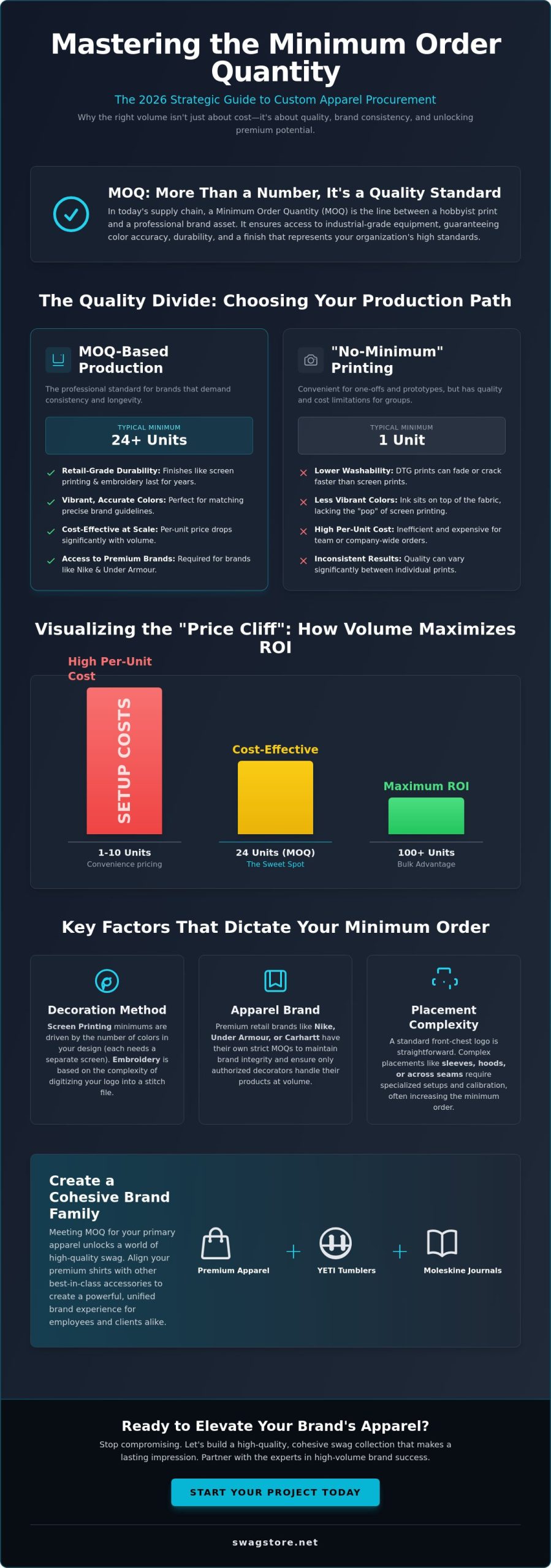
Think of MOQ as more than just a number on a spreadsheet. It’s a commitment to excellence. For high-growth organizations, the minimum order quantity for custom shirts represents the boundary between a “one-off” hobbyist print and a professional-grade brand asset. In the 2026 supply chain, this baseline ensures that every garment leaving the production floor meets rigorous standards for color accuracy and durability. While retail shops cater to single-unit gifts, B2B bulk partners focus on scalability and consistency. This approach relies on the principles of Economic Order Quantity (EOQ), balancing the costs of production setup against the benefits of inventory holding. By meeting these minimums, you unlock access to the same industrial-grade machinery used by global retail giants.
The physical reality of the press dictates the numbers. Professional screen printing requires “burning” a unique mesh screen for every color in your logo. This process, combined with precise ink calibration, takes significant time before the first shirt is even touched. If you have a five-color design, that is five separate screens and five setup phases. This labor-intensive start is why the first 24 units carry the weight of the setup costs. Embroidery follows a similar logic. Digitizing a complex logo into a stitch-ready file is a specialized skill. Spreading these initial fees over a larger run makes each high-end polo or hoodie significantly more affordable.
Choosing a vendor involves a trade-off between convenience and quality. “No-minimum” vendors usually rely on Direct-to-Garment (DTG) printers. While convenient for a single birthday gift, DTG often lacks the vibrant pop and long-term washability of screen printing or the tactile luxury of embroidery. High-volume equipment is designed for repetition and precision. It maintains perfect color consistency from the first unit to the five-hundredth. MOQ is the threshold where professional equipment becomes cost-effective. When you respect the minimum order quantity for custom shirts, you’re prioritizing brand integrity over short-term convenience. You aren’t just buying shirts; you’re securing a uniform that looks as sharp in month twelve as it did on day one. We believe that professional branding deserves a professional foundation.
For individuals or smaller organizations that aren’t yet ready for bulk orders but still want to explore a wide selection of printed apparel and accessories, you can visit their website to see what MoeGolUP has to offer.
Every branding project starts with a vision, but technical realities define the execution. The minimum order quantity for custom shirts isn’t an arbitrary hurdle; it’s a reflection of the precision required for different decoration methods. Whether you’re choosing screen printing for a massive product launch or embroidery for an executive retreat, the machinery involved dictates the baseline. While it’s tempting to look for the lowest possible threshold, academic research on MOQ optimization highlights that fragmented, small-batch ordering often results in hidden logistical costs and inconsistent quality. We focus on a tiered approach that aligns your volume with the prestige of the garment, ensuring your “Economy” event tees and “Executive” gifts both meet our megawatt standards.
Complexity also plays a major role in these calculations. Standard chest placements are straightforward, but moving a logo to a sleeve, a hood, or across a seam requires specialized platens and additional calibration time. These intricate placements often push the minimums higher because the margin for error is slimmer. It’s about protecting your investment. By adhering to strategic minimums, you ensure that every complex detail is captured perfectly across the entire run, preventing the “drift” in quality often seen in low-volume shops.
Screen printing remains the undisputed champion for large-scale impact. The logic is simple: the more you print, the less you pay per unit. This method relies heavily on color count. Each unique hue requires its own screen and setup, which is why a 24-unit minimum is the industry standard for professional results. Meeting this volume unlocks access to specialty finishes that “no-minimum” digital printers can’t touch. Think shimmering metallics, high-density 3D inks, or soft-hand discharges that feel like part of the fabric. These high-end textures require the pressure and ink load only a traditional press can provide.
Elite brands like Nike, Under Armour, and Stanley don’t just sell products; they sell reputations. These manufacturers often require authorized decorators to maintain specific standards, which naturally influences the minimum order quantity for custom shirts and gear. High-performance fabrics, like moisture-wicking polyesters, require specific thread types and heat settings to avoid scorching or puckering. Choosing bulk embroidered Nike polos isn’t just a purchase; it’s a culture-building move that signals quality to your team and your clients alike. If you’re ready to elevate your organization’s look, we can help you optimize your next order to balance premium quality with cost-efficiency.
Let’s look at the math of modern branding. While many small shops promise “no minimums,” they often hide the true cost in inflated per-unit pricing and hidden fees. A Minimum order quantity isn’t a barrier; it’s a doorway to industrial efficiency. When you hit that 24-unit “Price Cliff,” the cost per shirt drops dramatically because the labor of setting up the press is finally amortized. We believe that professional branding requires a professional scale. By committing to a minimum order quantity for custom shirts, you’re not just buying inventory; you’re securing a lower cost-of-entry for high-end finishes that “no-minimum” vendors simply cannot provide.
This consistency extends beyond apparel. By committing to professional volumes, you gain access to cool promotional items like custom YETI tumblers or Moleskine notebooks that simply aren’t available for single-unit customization. It’s about building a brand family. When your shirts, tech accessories, and drinkware all share the same high-end aesthetic, your organization projects a level of stability and success that small-batch orders can’t match.
The financial logic of bulk procurement is undeniable. On small orders, shipping and setup fees can account for up to 40% of your total invoice. Bulk buying protects your marketing budget against inflation by locking in current material prices for your entire year’s needs. It is a surprising reality of the industry that meeting an MOQ of 50 often costs less total than ordering 35 at a retail rate. Consider the scale: a price difference of just $0.50 per shirt on an order of 5,000 units can result in a total savings of $2,500. That’s capital you can reinvest into even higher-quality apparel for your executive team.
Your team’s apparel is a walking billboard. If the logo fades after three washes or the colors don’t match your brand guide, the “savings” of a small order vanish. Using a minimum order quantity for custom shirts allows us to use high-volume equipment that ensures Pantone-perfect logo matching across thousands of units. This reliability is vital for long-term procurement. When you re-order next year, your colors will match perfectly. Strategic bulk promotional items create a unified corporate identity that tells the world your organization doesn’t cut corners. We are here to help you turn your swag into a litmus test for quality that your employees will be proud to wear.
Calculating the right volume isn’t just about counting heads. It’s about data-driven foresight. When you approach the minimum order quantity for custom shirts, you need a framework that accounts for the “Size Bell Curve” of your team. For North American corporate environments, we typically see a heavy concentration in Large and XL sizes. Ordering a standard “Size Run” is far more efficient than chasing down individual requests every time a new project launches. You also need to consider your “Event Buffer.” For a major trade show, we recommend an extra 15 to 20 percent in the middle of the bell curve to account for unexpected traffic and VIP guests. This ensures you never run out of the most popular sizes when a high-value prospect visits your booth.
The storage vs. savings trade-off is where strategy meets logistics. Ordering 500 units offers a better per-piece rate than 100, but only if you have a plan to distribute them within 12 to 18 months. Beyond that, styles can shift and branding might evolve. We suggest looking at your annual turnover and projected growth to hit those higher price breaks without cluttering your storage room with outdated stock. A well-timed bulk order can protect your budget from mid-year price fluctuations in the textile market. It’s about finding the sweet spot where your inventory remains fresh and your per-unit cost stays low.
Standard distribution ratios usually peak at Large (35%) and XL (25%), with Medium following at 20%. Small and XXL usually round out the remaining 20% of the total. Don’t forget to account for women’s cut sizing needs. These often run smaller and have a different silhouette than unisex options. By ordering in these proven ratios, you ensure that no one feels left out when the gear arrives. It’s a small detail that makes a massive difference in how your team perceives the value of the apparel.
Integrating high-quality apparel into custom employee onboarding kits is one of the most effective ways to build culture from day one. When a new hire receives a premium Nike polo or a soft-touch screen-printed tee on their first morning, the psychological impact is immediate. It signals that your organization values quality and detail. By projecting your hiring needs for the full fiscal year, you can easily meet the minimum order quantity for custom shirts required for these premium brands while securing a lower unit cost. Ready to build your team’s perfect inventory? Consult with our experts to map out your sizing needs and optimize your bulk order today.
Great brands aren’t built on accidents. They’re built on intentional, high-quality choices that reflect a company’s core values. At SwagStore.NET, we’ve refined our process to ensure that navigating the minimum order quantity for custom shirts is a seamless, strategic experience for your leadership team. We don’t believe in generic giveaways that end up forgotten. Instead, we focus on vibrant, creative solutions that your employees and clients will actually treasure. By combining professional precision with an innovative spirit, we help you secure premium apparel from brands like Nike and Under Armour while optimizing your volume for maximum ROI. Our national fulfillment capabilities mean we can manage complex distribution for large organizations, ensuring every branch of your company receives the same high-standard gear without the logistical headache.
Choosing the right partner means finding a team that respects your vision as much as your budget. While the minimum order quantity for custom shirts might seem like a technical requirement, we treat it as a quality guarantee. It’s the threshold that allows us to use the best equipment, the most durable inks, and the most precise embroidery techniques in the industry. We are here to act as your creative consultants, taking the weight of procurement off your shoulders so you can focus on growing your business. From initial brainstorming to final delivery, we ensure your brand’s visibility is handled with the authority it deserves.
Impact doesn’t stop at the hemline. We believe in a multi-layered approach that creates a complete brand experience for your team. This often involves bundling your high-volume apparel with monogrammed gifts or laser-engraved metal pens to create a sense of executive exclusivity. Our curated kits are designed to impress, replacing the “junk drawer” swag of the past with items people actually value, like branded YETI tumblers or Moleskine notebooks. We manage the entire lifecycle of your project, ensuring that your national corporate gifting strategy is executed with flawless consistency across every time zone.
It’s time to stop settling for “no-minimum” mediocrity that fades after the first wash. When you’re ready to invest in the future of your organization, our team is standing by to help you optimize your order volumes. We’ll start with a detailed consultation to understand your goals, followed by a creative design phase where we bring your vision to life with technical accuracy. You’ll see exactly how your logo translates to premium fabrics before a single press is set up. Let’s create something that inspires your team and commands attention in your industry. Build your custom corporate apparel strategy with SwagStore.NET and experience the difference of a true branding partner.
Your brand deserves to stand out in a sea of generic, low-quality alternatives. By mastering the minimum order quantity for custom shirts, you’re choosing to invest in the long-term visibility and professional reputation of your organization. We have explored how meeting these thresholds unlocks access to elite brands like Nike and Under Armour, ensures Pantone-perfect consistency, and significantly slashes your per-unit costs. It is about moving from a reactive, one-off mindset to a proactive, high-impact branding strategy that resonates with your team and your clients.
Our team at SwagStore.NET is ready to help you turn these logistical insights into a powerful culture-building tool. We specialize in Nike and Under Armour bulk apparel, providing national distribution for corporate onboarding kits and expert design consultation. We bring the professional precision you need to scale your identity with confidence. Don’t settle for less when you can achieve professional-grade results that your employees will actually be proud to wear. Let’s build a remarkable brand family that lasts.
Start Your High-Volume Custom Apparel Quote
We’re excited to help you transform your vision into a high-end reality that inspires everyone who sees it.
The standard minimum order quantity for custom shirts using professional screen printing is typically 24 pieces per design. This threshold ensures that the labor-intensive process of burning screens and calibrating ink colors is spread across enough units to keep your per-shirt cost economical. While digital “no-minimum” alternatives exist, they don’t offer the same industrial-grade durability or vibrant color matching that a traditional press provides for your corporate brand.
You can absolutely mix various garment sizes within a single order to meet your minimum requirements. Most professional partners also allow you to vary the shirt colors, provided the ink color and the design dimensions remain exactly the same across the entire run. If your logo requires an ink change, such as switching from black ink on a grey shirt to white ink on a navy shirt, it may trigger additional setup fees or separate minimums.
Embroidered Nike and Under Armour polos often have lower minimums than screen-printed tees, frequently starting at just 12 units. This is because embroidery setup involves digital file preparation rather than physical screen creation. However, we recommend ordering at least 24 pieces to better absorb the initial digitizing fees. This volume also allows you to access better price breaks, ensuring your executive apparel remains a high-ROI asset for your organization.
We provide detailed digital mockups and can ship blank garment samples so you can feel the fabric quality and verify sizing before you commit. While a “spec sample” featuring your actual logo is possible, it usually carries a high cost because it requires a full production setup for a single item. Most organizations find that reviewing a physical blank alongside a high-resolution digital proof provides the confidence needed to move forward with a bulk order.
Premium brands like Nike and Under Armour enforce stricter rules to protect their retail reputation and ensure that every decorated piece meets their elite standards. These brands only work with authorized decorators who utilize industrial-grade equipment and specific thread types. By maintaining a consistent minimum order quantity for custom shirts and polos, they ensure that your corporate gear reflects the same high-performance quality and prestige found in their global retail collections.
Setup fees are fixed costs, meaning their impact on your budget diminishes as your order volume grows. When you scale your order to 100 or 500 units, these initial charges are spread so thin that the per-unit cost becomes negligible. Many high-volume partners even waive these fees entirely on large-scale runs. This efficiency is why bulk ordering is the most effective way to maximize your branding budget while securing premium apparel for your entire team.
You can often combine different apparel styles, such as t-shirts and hoodies, to reach your minimum order quantity for custom shirts and gear. The key requirement is that the design, ink color, and print size must remain identical across all items. Keep in mind that the artwork must be sized to fit the smallest garment in your order. This strategy is an excellent way to provide your team with seasonal variety without sacrificing bulk pricing benefits.
Re-orders are generally subject to the same minimum requirements because the physical setup process must be repeated for every new run. We suggest adding a 10% to 15% buffer to your initial bulk order to account for new hires or trade show needs. This proactive approach is much more cost-effective than placing a small “fill-in” order later, which would carry higher per-unit costs and potentially different production timelines.