


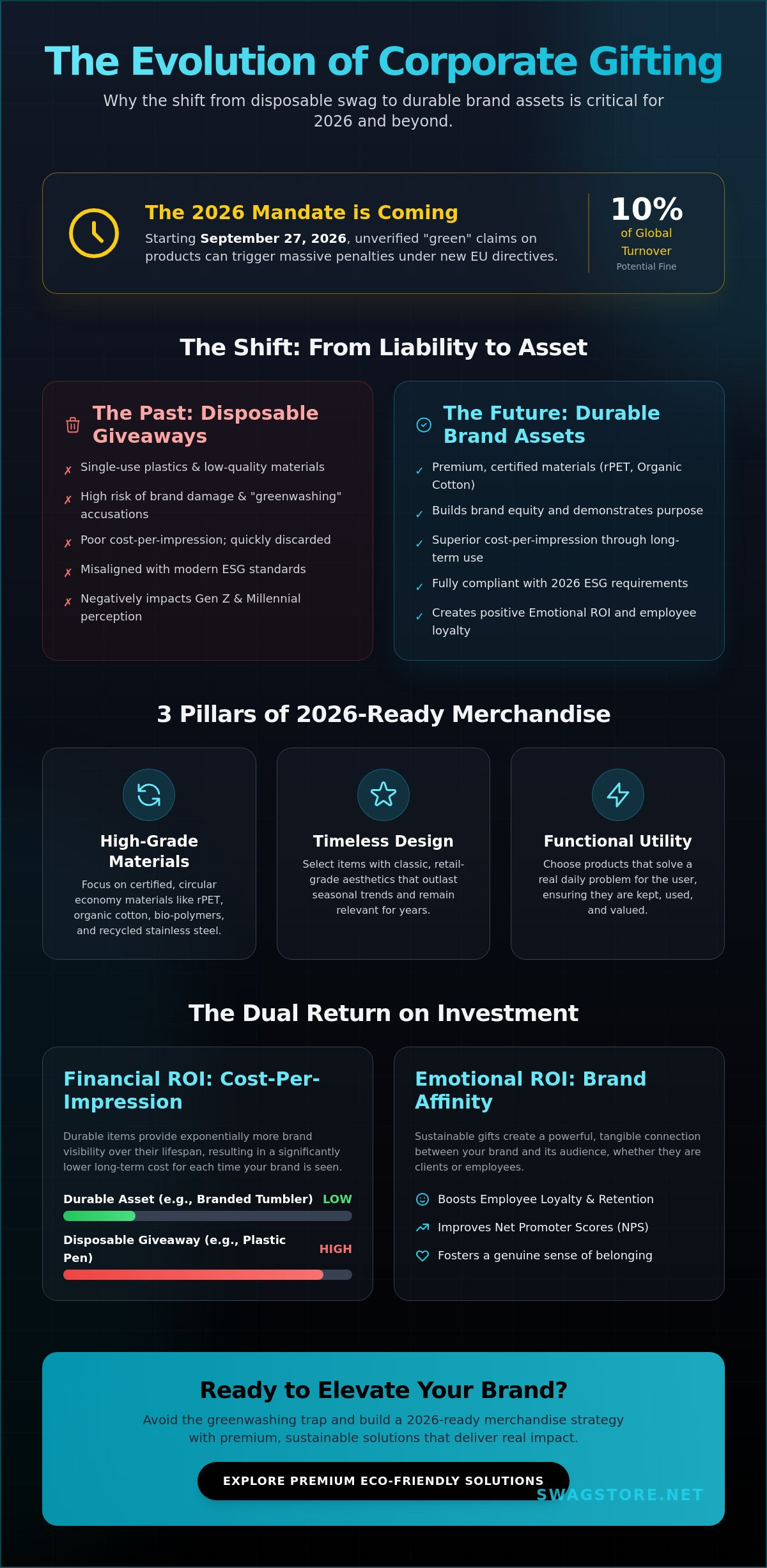
Starting September 27, 2026, a simple “green” label could cost your company up to 10% of its global turnover if it isn’t backed by verified proof. The era of vague sustainability is over. Today, the eco-friendly promotional products impact is defined by radical transparency and premium durability rather than just a recycled logo. You likely want to lead with purpose, but the fear of brand backlash or the perception that sustainable means “low quality” can feel like a major roadblock.
We’re here to bridge that gap. Your brand deserves merchandise that reflects a commitment to excellence without compromising on style or functionality. This guide reveals how high-end sustainable items, from recycled tote bags to laser-engraved metal pens, transform corporate identity and drive measurable ROI. We’ll provide a clear framework for selecting products like embroidered Nike polos or branded YETI tumblers that meet the 2026 standard. You’ll discover how to navigate new EU directives while building a legacy of quality that your clients and employees will actually want to keep.
The era of the “throwaway giveaway” is officially behind us. In 2026, your choice of Promotional merchandise acts as a direct reflection of your corporate soul. We’ve seen a massive shift where the eco-friendly promotional products impact is no longer measured by how many items you distribute, but by how many stay in use. Today, eco-friendly items are defined by their alignment with strict ESG (Environmental, Social, and Governance) standards, requiring third-party verification and a clear carbon footprint narrative. It’s a move away from clutter and toward meaningful, high-utility brand assets.
Your brand needs a silent ambassador. When you hand a client a laser engraved metal pen or a branded Stanley tumbler, you aren’t just giving them a tool. You’re signaling that your company values quality and longevity over quick, plastic-filled wins. This is particularly critical for Gen Z and Millennial demographics. These groups view physical objects as extensions of their identity. If your swag doesn’t align with their environmental ethics, it doesn’t just end up in the bin; it actively damages your brand equity. For organizations looking to align with specific ethical niches, seeing how mission-driven retailers like VEGAN TRIBE use apparel to communicate core values can serve as a blueprint for impactful corporate gifting. We help you choose items that recipients are proud to carry, turning every recycled tote bag into a statement of shared values.
Single-use plastic swag has become a professional liability. In modern boardrooms and remote offices, a cheap plastic bottle is often seen as a lack of foresight. Longevity has emerged as the primary metric for sustainability in 2026. We focus on durable brand assets because they offer a superior cost-per-impression. A high-quality item might be used hundreds of times over several years. Contrast this with a thin, disposable alternative that breaks after two uses. The durable item wins on visibility, utility, and environmental responsibility every single time. Durable assets in 2026 share three key traits:
Eco-conscious gifting does more than just lower your carbon footprint. It significantly improves Net Promoter Scores (NPS) by creating a positive psychological bridge between the brand and the recipient. In our remote-first culture, physical items are often the only tangible connection an employee has to their company. Receiving a thoughtfully curated onboarding kit with organic cotton apparel fosters a genuine sense of belonging that digital perks simply can’t match. Understanding the eco-friendly promotional products impact on employee retention is key to a modern HR strategy. We define Emotional ROI as the measurable increase in brand affinity and employee loyalty generated when a company’s physical gifts align perfectly with the recipient’s personal environmental values. It’s about making people feel good about the brand they represent.
Choosing the right materials is the foundation of any modern branding strategy. In 2026, the eco-friendly promotional products impact is largely determined by the lifecycle of the materials used. We’ve moved beyond simple “recycled” labels to a sophisticated mix of rPET, organic cotton, and advanced bio-polymers. For instance, according to a landmark study on promotional products’ carbon footprint, well-chosen physical merchandise can actually deliver a lower environmental impact per impression than many digital advertising channels. It’s about making every gram of material count.
Recycled stainless steel has become the gold standard for premium drinkware like our branded YETI and Stanley tumblers. While virgin aluminum requires massive energy for extraction and refining, recycled steel utilizes existing resources, significantly cutting carbon emissions. Similarly, water-saving manufacturing in apparel production is now a non-negotiable requirement. Traditional cotton t-shirts can require thousands of liters of water. The organic cotton and rPET blends we use in our custom screen printed t-shirts slash that consumption by up to 90%, ensuring your brand remains a responsible steward of natural resources.
Regenerative materials are taking center stage. Bamboo and cork don’t just provide a modern, tactile aesthetic; they act as carbon sinks. Bamboo grows at an incredible rate, sequestering carbon faster than almost any other plant. We’re also seeing a surge in mushroom-based packaging and bio-acetate for tech accessories. These bio-polymers offer the same sleek finish as traditional plastics but are designed to break down without leaving microplastic residues. They’re just as durable for daily use but far kinder to the planet at the end of their life. It’s the perfect blend of technical performance and ecological awareness.
True sustainability requires a circular mindset. This means designing products that are either built to last a decade or can be easily disassembled for recycling. Monomaterial design is a key trend here. When a notebook or a tote bag is made from a single material type, it’s much easier for facilities to process. We always recommend choosing Cool Promotional Items for 2026 that prioritize this high-utility, low-waste philosophy. If you’re ready to elevate your brand with these advanced materials, our team at SwagStore.NET can help you curate a selection that balances premium quality with circular logistics.
Greenwashing isn’t just a marketing faux pas anymore; in 2026, it’s a significant legal liability. With the UK government now empowering the CMA to issue fines of up to 10% of global turnover for misleading environmental claims, the stakes have never been higher. Vague terms like “green” or “eco-conscious” are high-risk without specific, third-party data to back them up. The true eco-friendly promotional products impact is found in the hard data of a product’s lifecycle, not in the buzzwords on a hangtag. To protect your brand equity, you must look past the surface and demand transparency in every bulk order.
Supply chain transparency is the new corporate currency. Under the 2026 rollout of the EU Digital Product Passport, companies are increasingly expected to provide comprehensive data on material composition and recyclability. When you source items like laser engraved metal pens or custom logo power banks, you need to know exactly where the components originated. A lack of transparency in your national bulk orders doesn’t just look bad; it suggests a lack of control over your brand’s environmental footprint. We help you vet every item to ensure your corporate gifts stand up to the most rigorous reporting standards.
Don’t take a supplier’s word for it. Look for the “Big Three” certifications that provide a verified paper trail for your sustainability claims. GOTS (Global Organic Textile Standard) remains the gold standard for corporate branded apparel, ensuring that your embroidered Nike or Under Armour polos meet strict ecological and social criteria. For paper-based goods, FSC certification for your custom Moleskine notebooks is essential to prove your gifting supports global reforestation. Finally, distinguish between “carbon neutral” products, which involve actual emission reductions during manufacturing, and simple carbon offsets for shipping. In 2026, the market prioritizes the former for genuine impact.
A product that breaks in a week is the ultimate environmental failure, regardless of what it’s made of. Cheap “eco” items often have a higher total footprint because their short lifespan requires constant replacement. High-quality construction is the most effective way to lower the eco-friendly promotional products impact over time. Look for hallmarks like reinforced stitching in recycled tote bags and premium powder coating on branded YETI or Stanley tumblers. These details ensure the item stays in the recipient’s hand and out of the landfill. We define the “Quality-Sustainability Paradox” as the mistake of choosing lower-grade materials to save on unit costs, only to have the resulting waste damage the brand’s reputation more than the “green” label helped it. Real sustainability requires retail-grade durability.
Strategic kitting is where your sustainability vision meets operational reality. Scaling a custom employee onboarding kit requires more than just picking “green” items. It’s about creating a cohesive, high-value experience that feels intentional. When you curate sets in bulk, the eco-friendly promotional products impact is amplified by every choice you make, from the source of the material to the box it arrives in. We focus on zero-waste goals by eliminating unnecessary plastic wraps and choosing items that serve a distinct purpose in the recipient’s daily life. A well-planned kit doesn’t just welcome a new hire; it reinforces your company’s ESG commitments from day one.
Balance is key to a successful gift set. We recommend the “Rule of Three” for high-impact kits: something to wear, something to drink, and something to write. Imagine an embroidered Under Armour polo, a branded Stanley tumbler, and a laser engraved metal pen. This combination ensures your brand is present in the office, the gym, and the commute. Pairing high-utility tech, like custom logo power banks with bamboo accents, adds a modern edge while maintaining sustainable integrity. Additionally, monogrammed gifts significantly increase retention rates because people rarely discard an item that bears their own name. It’s a simple way to elevate a bulk order into a personal connection that lasts for years.
Shipping miles matter. Sending thousands of kits from a single central warehouse to the other side of the country creates a massive carbon footprint that can negate your sustainable product choices. We utilize regional kitting strategies to minimize transit emissions and get your gear to its destination faster. Optimizing your logistics is the final step in maximizing the eco-friendly promotional products impact for your organization. The packaging itself must be part of the story. Use 100% recyclable shipping boxes secured with water-activated tape instead of plastic adhesive. Replace bubble wrap with plastic-free void fill like honeycomb paper or cornstarch-based peanuts. Don’t forget to communicate these choices. A small note inside the box explaining the sustainable shipping process turns a simple delivery into a brand-building moment that your clients and employees will appreciate. Ready to build your next zero-waste campaign? Explore our Employee Onboarding Gift Kits and start your sustainable journey with us today.
Premium quality is the ultimate sustainability strategy. At SwagStore.NET, we believe the most significant eco-friendly promotional products impact comes from items that never see a landfill. We bridge the gap between high-end retail brands and environmental responsibility to help you build brand equity that resonates in 2026. Our team doesn’t just provide products. We offer a curated experience that aligns your corporate identity with the highest standards of the circular economy. By focusing on durability and aesthetic excellence, we ensure your message stays in the hands of your audience for years, not days.
Sustainability doesn’t mean sacrificing the prestige of your brand. Branded YETI and Stanley tumblers represent a “built-for-life” philosophy that is inherently eco-friendly. When a recipient uses the same premium tumbler for a decade, the environmental savings are massive compared to the constant replacement of lower-quality alternatives. We also specialize in custom Nike and Under Armour polos crafted from recycled polyester. These retail-grade promotional items elevate your brand’s perceived value while proving that high performance and recycled materials belong together. It’s a powerful way to demonstrate that your organization values excellence and the planet in equal measure.
Scaling a sustainable vision across a national organization requires more than just a catalog. Our “Bulk-Only” philosophy is a strategic choice designed to reduce the per-unit environmental overhead of shipping, packaging, and production. We meticulously vet our suppliers to ensure every item, including your trade show giveaways, meets the 2026 green event standards. This rigorous process removes the guesswork and protects your brand from the risks of greenwashing. We act as your creative consultants, helping you navigate the complexities of sustainable procurement at scale.
The eco-friendly promotional products impact of your next campaign depends on strategic foresight. Whether you need recycled tote bags for a conference or custom Moleskine notebooks for a national sales meeting, we provide the technical expertise to make it happen. We invite you to collaborate with us on a custom, national-scale sustainable swag strategy that reflects your unique values. Start your journey with a professional strategy session and discover how high-quality, eco-conscious merchandise can become your most effective brand-building tool. Let’s create something remarkable together.
Transitioning from disposable giveaways to durable brand assets is no longer a choice; it’s a regulatory and cultural mandate. We’ve explored how retail-grade materials like rPET and organic cotton, paired with circular design, protect your brand from the greenwashing trap while meeting 2026 standards. The true eco-friendly promotional products impact lies in the intersection of high-end quality and radical transparency. When you choose items that recipients truly value, you aren’t just reducing waste. You’re building lasting brand equity through every purposeful gift.
Success in this new era requires a partner who understands the complexities of national-scale distribution and ESG reporting. We specialize in high-volume corporate accounts, providing the supply chain transparency you need to report with confidence. Our expert curation of retail-grade eco-brands ensures your message is delivered on products that reflect your commitment to excellence. It’s time to transform your physical touchpoints into powerful statements of purpose. Build your high-impact sustainable swag strategy with SwagStore.NET. Let’s lead the way toward a more responsible and inspiring future together.
In 2026, an eco-friendly product must be backed by verifiable data and third-party certifications like GOTS or FSC. It’s not just about recycled content; it’s about the entire lifecycle, from water-saving production to end-of-life recyclability. The eco-friendly promotional products impact is now defined by transparency and the ability to prove environmental claims under strict new regulations like the EU’s ECGT Directive.
Sustainable items often have a higher initial unit price, but they offer a superior long-term ROI through extreme durability. When you invest in high-quality items like branded Stanley tumblers, you’re paying for a product that stays in use for years rather than days. Cheap, disposable giveaways break quickly, leading to more waste and a much higher cost-per-impression over the product’s lifespan.
Avoid generic terms like “green” or “sustainable” unless you can provide specific, verified proof of environmental performance. Look for Digital Product Passports and certifications that meet the 2026 standards for substantiated claims. We vet every supplier in our network to ensure your custom Moleskine notebooks or tech accessories are backed by legitimate, third-party documentation.
Organic cotton and recycled polyester (rPET) are the top choices for professional apparel in 2026. These materials, featured in our embroidered Nike and Under Armour polos, significantly reduce water consumption and carbon emissions during production. They provide the same premium feel and technical performance as virgin fabrics but with a significantly lower environmental footprint.
You can measure impact by analyzing the lifecycle assessment (LCA) of the materials and the estimated usage life of the product. Tracking the eco-friendly promotional products impact involves calculating carbon savings from recycled materials versus virgin ones and monitoring recipient retention rates. High-utility items like custom logo power banks ensure your brand stays visible while minimizing the total volume of waste produced.
Eco-friendly recycled tote bags and laser engraved metal pens remain the most popular choices for high-volume events. These items are practical, durable, and offer a large surface area for your branding. They meet the 2026 standard for high-utility giveaways that recipients actually keep, which is the most effective way to ensure your event presence is both memorable and responsible.
Yes, premium brands like YETI and Stanley are considered eco-friendly because of their “built-for-life” philosophy. Their extreme durability directly combats the culture of disposability. By providing a branded YETI tumbler that lasts a lifetime, you’re helping your clients or employees eliminate thousands of single-use plastic bottles and cups over the coming years.
Bulk ordering reduces the environmental overhead of logistics by consolidating shipments into fewer, larger deliveries. This strategy slashes the carbon footprint associated with transit miles and minimizes the amount of individual packaging material required. We utilize regional kitting centers to further optimize these routes, ensuring your national corporate accounts are handled with maximum efficiency and minimal emissions.