
Your brand is your most valuable asset, yet it’s only as strong as the last physical item an employee or client receives. In 2026, a blurry logo on a bulk order of Nike polos isn’t just a minor production error. It’s a direct hit to your reputation that leads to wasted budgets and lost trust. Mastering quality control for custom merchandise has evolved from a back-office task into a vital strategic shield for your brand equity. We know how frustrating it is to deal with inconsistent colors across tumblers and shirts or to worry about new PFAS regulations and the rollout of Digital Product Passports.
We agree that your high-volume orders should reflect the same premium standard as your core business services. You’ll learn how to implement the gold standard of quality control to ensure every Moleskine notebook or tech accessory is flawless. We’ll walk you through the essential AQL standards, the 4-Point fabric inspection system, and the latest compliance shifts to keep your brand’s visibility sharp and professional. It’s time to turn your custom merchandise into a powerful, consistent experience that people actually want to keep.
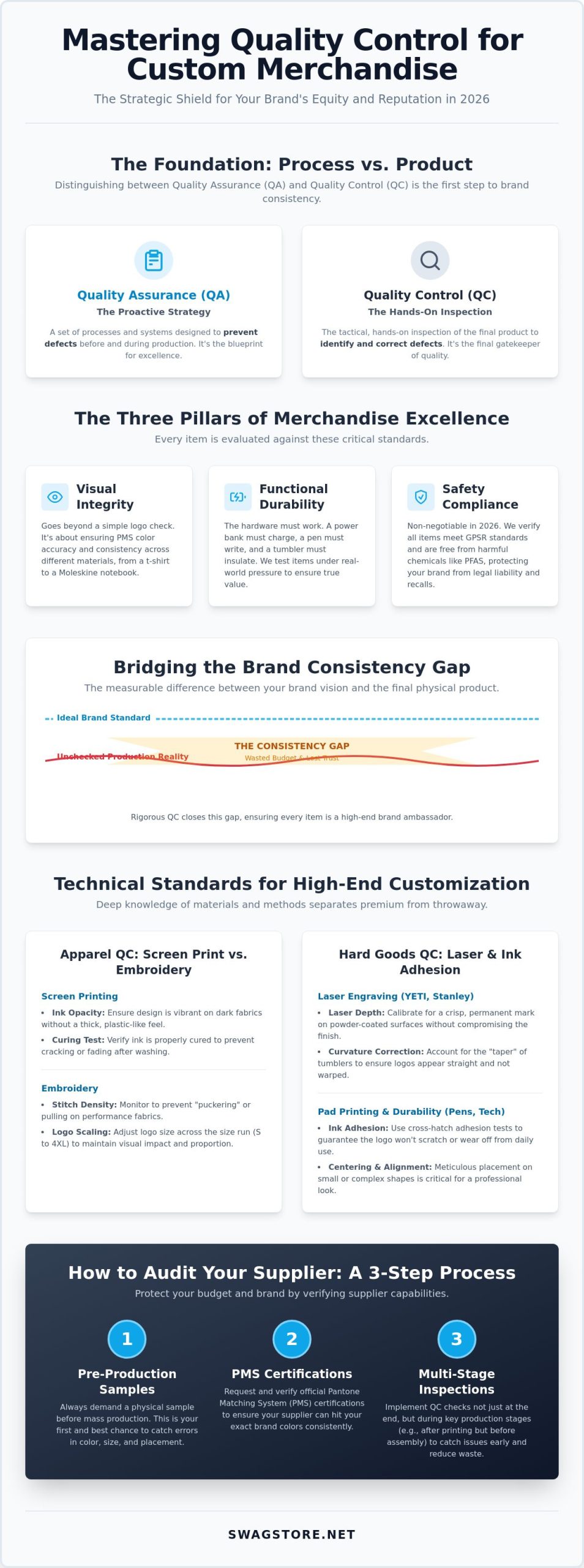
Precision is the heartbeat of your brand. When we talk about quality control for custom merchandise, we aren’t just checking for typos. We’re protecting the emotional connection your clients have with your company. To build a successful strategy, we need to clarify a common question: What is Quality Control? In our world, Quality Assurance (QA) is the set of processes we use to prevent defects before they happen. Quality Control (QC) is the tactical, hands-on inspection that ensures the final product matches your vision perfectly.
Think of QA as the blueprint and QC as the site inspector. For high-volume projects, QC acts as the final gatekeeper that prevents a “good enough” mentality from eroding your brand equity. Accepting subpar items is a massive risk. It tells your partners that you’re willing to cut corners. Investing in rigorous QC doesn’t just save your reputation; it boosts your ROI by reducing expensive waste and ensuring your items, like laser engraved metal pens or branded YETI tumblers, stay in use for years.
Maintaining 100% accuracy across 5,000 units is a monumental challenge that requires technical mastery. A single defective item in an employee onboarding gift kit can ruin a new hire’s first impression. It suggests a lack of care. We aim for the industry standard AQL of 0% for critical defects because your brand deserves zero compromises. The Brand Consistency Gap is the measurable discrepancy between a digital brand manual and the physical reality of a finished product when production standards fluctuate. By bridging this gap, we transform simple objects into high-end brand ambassadors that command respect, a standard mirrored by 24Trav in Direct-to-consumer retail sales of apparel and accessories.
High-level technical execution is what separates a premium corporate gift from a throwaway item. Real quality control for custom merchandise requires deep knowledge of how different materials react to ink, thread, and lasers. You need to verify suppliers based on their ability to handle these nuances, especially when working with high-performance fabrics or powder-coated steel. We don’t just look for a logo; we look for the chemical and mechanical integrity of the bond between the brand and the product.
Screen printing relies on more than just ink. We check for opacity on dark fabrics and ensure proper curing so the design doesn’t crack after the first wash. For our Custom Screen Printed T-Shirts, the “hand feel” should be soft, not plastic-like. Embroidery presents different challenges. On thin, performance fabrics like Embroidered Nike and Under Armour Polos, we monitor stitch density to prevent “puckering” around the logo. It’s also vital to standardize logo size across the entire size run. What looks great on a Small might look lost on a 4XL; a professional QC process adjusts the scale to maintain visual impact. If you’re ready to see this precision in action, check out our curated apparel collections.
Branded YETI and Stanley Tumblers are iconic, but their powder-coated surfaces require precise laser depth to achieve a crisp, permanent bond. Centering a logo on a curved surface is a mathematical challenge. We account for the “taper” of the vessel to ensure the logo doesn’t appear warped or stretched. For high-touch items like Laser Engraved Metal Pens, ink durability and engraving precision are the metrics that matter most. We use cross-hatch adhesion tests to ensure that your logo stays put, even after months of daily use. This level of detail ensures that the premium price point of the base product isn’t undermined by poor customization.
Don’t overlook the functional side of tech. For Custom Logo Power Banks and Tech Accessories, QC must include battery safety checks and port functionality tests. A power bank that fails to charge or overheats is a liability, not a gift. We treat every tech item with the same scrutiny as our apparel, ensuring that high-volume orders meet the rigorous GPSR safety standards we discussed earlier. This level of technical oversight ensures your brand remains a symbol of reliability and innovation, rather than a source of frustration for your clients.
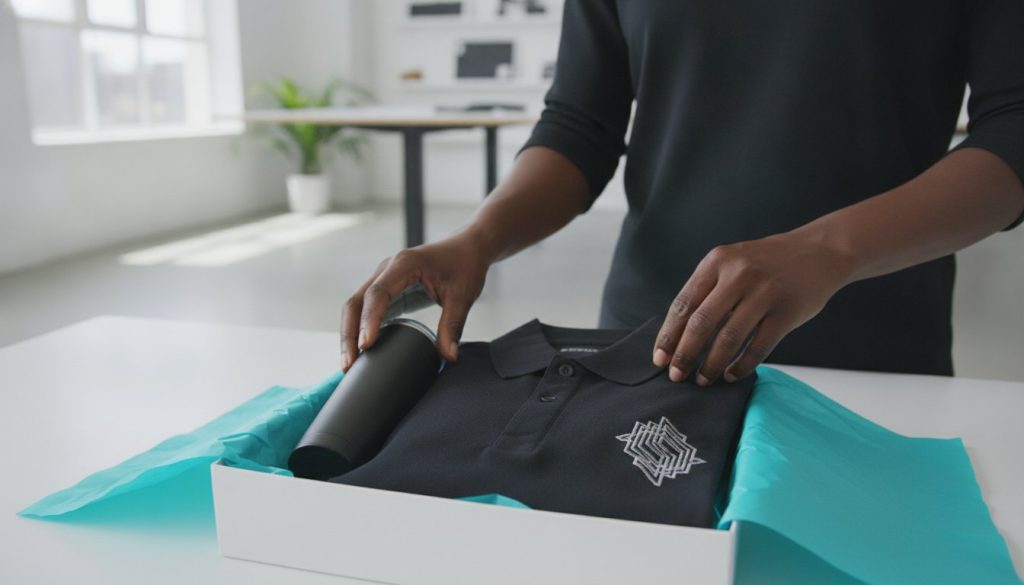
A single branded item is a product. A curated gift kit is a story. When you combine multiple pieces of quality control for custom merchandise into one experience, the complexity of maintaining brand standards increases exponentially. It isn’t just about the individual items anymore; it’s about how they interact within the box. We believe the unboxing experience is a primary quality metric. If a new hire opens their package to find a disorganized mess, the premium value of the items inside is immediately diminished. Presentation isn’t just an extra detail. It’s the final layer of your brand’s promise.
Item cohesion is our biggest focus during the kitting process. We ensure that the navy blue on your custom screen printed t-shirts matches the navy on your embroidered Nike and Under Armour polos. Achieving this across different vendors and substrates requires a sharp eye and a refusal to settle for “close enough.” We audit every component to ensure they feel like they belong to the same family. This level of detail transforms a collection of objects into a unified, professional statement that reinforces your corporate culture.
We don’t leave placement to chance. Every kit follows a strict blueprint, standardizing exactly where each item sits within custom foam or eco-friendly recycled tote bags used as packaging. This consistency ensures that the first thing the recipient sees is your primary logo, perfectly centered and upright. We pay special attention to personalized elements, such as custom branded Moleskine notebooks featuring individual names. Our team performs a final “seal of approval” inspection on every box to verify that every personalized detail is accurate before the lid is closed.
Logistics is where many high-volume orders fail. We use weight verification as a secondary check; if a box is even a few grams off, it’s flagged for manual inspection to prevent missing items. Packaging durability is another critical pillar. We stress-test our boxes for national shipping to ensure they can withstand the rigors of transit without crushing. This is especially vital for custom employee onboarding kits, where the first physical interaction with your company must be flawless. We also perform transit-testing for tech accessories and drinkware to guarantee that everything arrives in pristine condition, ready to impress.
Trust is good. Verification is better. Choosing a production partner is a strategic decision that directly impacts your brand’s physical footprint. You need an audit framework that moves beyond surface-level promises. Effective quality control for custom merchandise starts with a rigorous evaluation of your supplier’s technical mastery and their willingness to be transparent about the manufacturing process. Don’t settle for a portfolio of pretty pictures; demand proof of their ability to execute at scale while maintaining your specific brand standards.
Your contract should clearly define the Acceptable Quality Limit (AQL) to avoid disputes later. In 2026, the industry standard for high-end production is typically 0% for critical defects, 2.5% for major defects, and 4.0% for minor defects. If a supplier hesitates to commit to these numbers, it’s a clear signal to look elsewhere. You should also verify their Pantone Matching System (PMS) certifications and request their latest social compliance and material safety data sheets. This ensures your items, like eco-friendly recycled tote bags, meet both your aesthetic and ethical requirements.
A digital mockup is merely a suggestion, not a guarantee. For premium brands, a physical PPS is non-negotiable for high-value orders. This sample allows you to test the “washability” of custom screen printed t-shirts before the full run begins. You can also evaluate the tactile feel of cool promotional items to ensure the weight and texture align with your brand’s premium positioning. Check the final artwork carefully; look at vector line thickness and traps to ensure the design won’t bleed or lose detail during the printing or embroidery process.
Technical skill means nothing without proactive communication. A high-quality partner will flag potential issues early, such as a logo being too intricate for embroidery on performance polos or a color choice that might not bond well with powder-coated tumblers. They should provide total transparency regarding lead times and any necessary material substitutions. Proactive “red-flagging” of design flaws is the hallmark of a partner who values your brand equity as much as you do. They aren’t just order-takers; they are creative consultants ensuring your success.
Ready to work with a partner who prioritizes precision at every step? Connect with our expert team today to start building your next high-impact merchandise collection with total confidence.
We don’t just deliver products; we deliver peace of mind. At SwagStore.NET, our approach to quality control for custom merchandise is built on a foundation of relentless precision and creative passion. Every bulk order we handle undergoes a rigorous, multi-stage inspection process that starts the moment raw goods arrive and doesn’t end until the final package is sealed. We’ve refined this system to meet the exacting demands of national corporate accounts, ensuring that your brand shines in every city and every office. Our goal is to remove the stress of production so you can focus on the impact of your message.
Our white-glove service isn’t just a buzzword. It’s a commitment to being your eyes and ears on the factory floor. We’ve developed strategic partnerships with top-tier brands like Stanley, Nike, and YETI because they trust our ability to maintain their prestige. By combining our technical expertise with these world-class products, we offer a level of reliability that few can match. Whether we’re inspecting a batch of custom logo power banks or verifying the registration on a thousand screen printed shirts, our team treats every unit as if it were the only one that mattered.
Protecting the integrity of your brand is a responsibility we take seriously. We adhere to the strictest logo guidelines, ensuring that your visual identity is never compromised by poor execution or technical limitations. We invest in state-of-the-art engraving and printing technology to provide high-quality promotional items that drive a genuine return on your investment. It isn’t just about the item; it’s about the standard it sets for your company. We understand that a laser engraved metal pen or a custom branded Moleskine notebook is a physical extension of your values, and we treat it with the respect it deserves.
We act as your creative consultants throughout the entire brand-building journey. From the initial concept phase to national delivery, we provide a seamless, high-QC experience that scales with your growth. Our customized kitting solutions boast a 99.9% accuracy rate, which is why the world’s most innovative organizations trust us with their high-volume onboarding sets. Whether you need 100 units for a VIP event or 100,000 units for a global campaign, our scalable solutions ensure that quality never dips as quantity rises. We handle the complexity of logistics and assembly so that your recipients receive a flawless experience every time. Experience Premium Quality Control with SwagStore.NET and see how we can elevate your brand’s physical presence to the gold standard.
Your brand deserves to be represented by items that people actually keep. We’ve explored how technical standards like ink opacity and stitch density prevent waste. We’ve also highlighted why a rigorous audit of your supply chain is the only way to navigate the complex regulations of 2026. Mastering quality control for custom merchandise ensures that every branded YETI tumbler or Nike polo becomes a lasting ambassador for your values. Since 2010, we’ve specialized in bringing this level of precision to world-class brands like Moleskine and Stanley. Our dedicated kitting and fulfillment center uses a multi-stage assembly QC process to guarantee that your high-volume orders are flawless from the first box to the last. It’s time to stop worrying about blurry logos and start focusing on the creative possibilities of your next campaign. Your partners and employees will notice the difference that true craftsmanship makes. Elevate Your Brand with High-Quality Bulk Merchandise today. Let’s build something extraordinary together and turn your vision into a premium reality.
A digital proof is a two dimensional rendering on a screen, while a pre-production sample is a physical, finished item. Digital proofs are perfect for confirming layout and general color, but a physical sample allows you to feel the texture of a custom branded Moleskine notebook or see the depth of engraving on a metal pen. It’s the ultimate insurance policy for your brand before we begin a full production run.
We use the Pantone Matching System (PMS) to standardize colors across various substrates like fabric, metal, and paper. Achieving consistency between an embroidered Under Armour polo and a branded YETI tumbler is challenging because different materials reflect light differently. We calibrate our equipment for each specific material to bridge this gap and maintain your brand’s visual identity across your entire collection.
We follow the Acceptable Quality Level (AQL) standards mentioned earlier, typically aiming for 0% critical defects. If a defect exceeds the agreed upon threshold, we immediately offer replacements or credits to rectify the situation. Our multi-stage quality control for custom merchandise is designed to catch these issues before they leave our facility, ensuring your reputation remains intact when the shipment arrives at its destination.
Vector files are necessary because they use mathematical paths rather than pixels, allowing for infinite scaling without any loss in sharpness. This is critical for high-volume orders where the same logo must be sized for small metal pens and large recycled tote bags. Using vectors prevents blurry edges and ensures that printing screens are burned with absolute precision, regardless of the product size.
The most frequent issues include puckering, thread breaks, and poor registration. Puckering often happens on thin performance fabrics if the stabilizer isn’t chosen correctly for that specific weight. We monitor stitch density and tension to ensure your logo on a Nike polo stays crisp and flat. We also check for loose threads on the underside of the garment to ensure long term comfort and durability.
Rigorous QC typically adds two to four business days to the total production schedule, but it prevents weeks of delay caused by potential reprints. We build these inspection windows into our initial lead times so there are no surprises for your team. This proactive approach to quality control for custom merchandise is what allows us to maintain our high accuracy rates for complex employee onboarding gift kits.
Yes, but the process requires specialized knowledge since recycled fibers can have inconsistent textures. For eco-friendly recycled tote bags, we perform extra tension tests and ink adhesion checks to ensure the print doesn’t flake over time. We also verify the material certifications to ensure the product meets the environmental claims your brand is making to its clients and employees during the gifting process.
We use standardized wash tests and crock tests to evaluate ink adhesion and colorfastness. This involves laundering the custom screen printed t-shirts multiple times at specific temperatures to see if the design cracks or fades. We also perform a stretch test on the print area to ensure the ink has cured properly and won’t peel under normal wear and tear, guaranteeing a long life for the garment.