
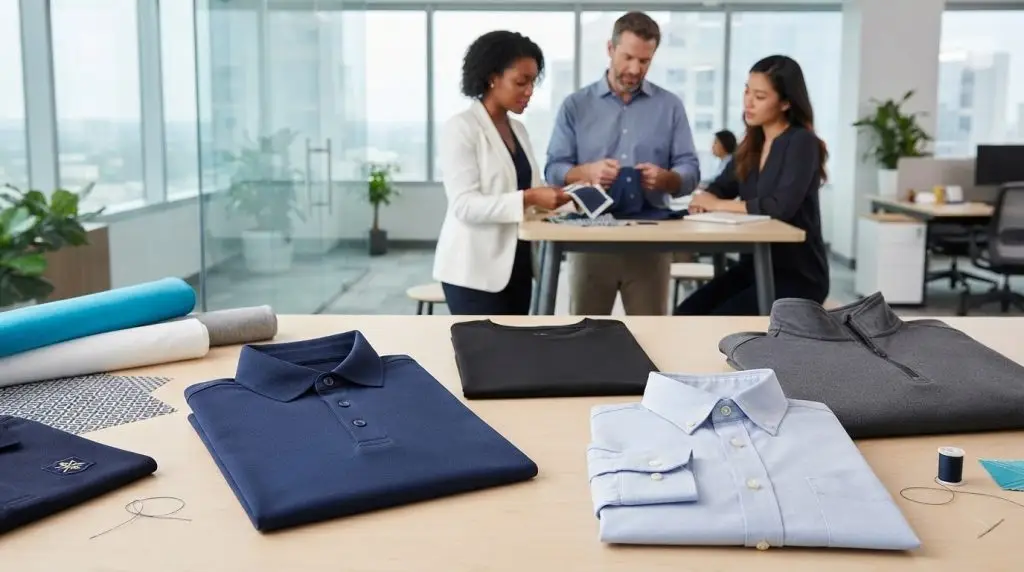
The best-known label isn’t automatically the best choice for a branded uniform. A respected name can catch the eye, but fabric, fit, stitching, and logo decoration determine whether employees reach for the garment again after the first wear. That’s the difference between choosing the best corporate apparel brands for quality and choosing a brand name alone.
You’re right to look beyond labels. A polished polo, a comfortable team tee, and a performance shirt each have different demands, and decoration affects how the finished garment looks. This guide compares corporate apparel using practical quality criteria, so you can match a specific garment to your team, workplace, and artwork. Use the checklists to weigh fabric, construction, fit, printing, and embroidery, then review artwork proofs before production. You’ll have a clearer way to choose apparel employees will want to wear, with branding that looks intentional and professional.
Quality isn’t a logo on a hangtag. It’s how well a specific garment’s materials, construction, fit, and decoration suit the people who’ll wear it and the work they’ll do in it. A recognizable brand can help narrow the search, but its name alone can’t tell you whether a particular shirt feels comfortable, fits your team, or suits a full workday.
Quality corporate apparel combines suitable materials, reliable construction, a wearable fit, and decoration that complements the garment. Consider each element together. A well-made shirt with an awkward fit may stay unworn, while a comfortable garment can still look unprofessional if the logo is poorly placed or hard to read.
Start with the garment model, not assumptions about the brand. Product descriptions and care labels can help you assess the fabric, while photos may show details such as seams, collars, and cuffs. Match those details to the intended setting: a team working in warm conditions may prefer a lightweight, breathable feel, while a more structured garment may better suit a polished office or client-facing role.
Use the same checks for every candidate. A brand may offer garments with different fabrics, silhouettes, and construction, so don’t assume every item under a familiar label will feel or perform the same way.
Screen printing and embroidery create different visual effects, and neither is automatically right for every order. The artwork, fabric, logo placement, and intended use all shape the result. A bold graphic may call for a different treatment than a compact chest logo, and the decoration should suit the garment so the design looks intentional.
Assess the garment and the logo separately. Fabric and seams determine the garment’s feel and construction; decoration affects how clearly the logo reads and how polished the finished piece appears. Consider placement, scale, and how the artwork will sit on the chosen garment. For embroidery, stitch count and balanced stitch density matter. More stitches per inch, together with balanced stitch density, help the embroidery stay flat and smooth even after repeated washing.
This garment-by-garment approach makes comparisons more useful than broad brand rankings. As you weigh the best corporate apparel brands for quality, focus on the specific model, how it fits your team’s work, and whether the decoration supports the impression you want to make.
Compare garments side by side, not just brand names. Product descriptions, fabric details, and care labels offer practical clues about how a specific shirt or polo may suit your team’s routine. When a listing makes a performance claim, such as moisture management or color retention, treat it as specific to that model rather than assuming it applies to every garment from the brand.
Start with the material description and fabric weight, if provided, then consider how the garment may feel through a typical shift. Lightweight, breathable fabric may suit active roles, warm settings, or long hours of wear. A heavier fabric can offer a more substantial feel and may work better for cooler conditions or a more structured appearance. Neither is automatically higher quality; the right choice depends on the use.
For industry context, the American Apparel & Footwear Association (AAFA) represents companies across apparel and footwear. For your purchase comparison, focus on the particular garment’s specifications and care details.
Keep your comparison consistent by recording the same details for each candidate model. A brand may offer several fabric types and constructions, so reputation alone won’t tell you what a particular item is made to do.
A team order needs to work for different bodies and preferences while meeting your dress standard. Compare each garment’s fit description and size range, and use its sizing guidance rather than assuming the same size will fit identically across brands or styles. A relaxed cut may suit movement and layering, while a more tailored silhouette can create a neater look for customer-facing roles.
Care matters, too. Corporate apparel may be laundered regularly, so read the product’s care instructions before settling on a style. Consider whether the recommended washing and drying routine is realistic for the people wearing it. Clear guidance helps employees care for their garments properly.
Build a shortlist by recording model, fabric, weight, fit, size range, and care instructions. Then match the strongest candidates to your team’s working conditions. For a bulk order, compare custom screen-printed shirts and embroidered polos against those criteria before choosing an apparel direction.
Nike and Under Armour are both recognizable choices for branded corporate polos, but a familiar logo doesn’t settle which garment suits your team. Each brand offers different apparel models, and fabric, fit, construction, care instructions, and suitability for decoration can vary from one model to another.
Assess the specific garment model before choosing by brand. Use current product information to compare like with like, rather than treating either label as a guarantee of a particular feel, performance, or level of durability. Apparel manufacturing quality also involves choices made at the garment level, as explored in Fibre2Fashion’s Ensuring Quality in Apparel Manufacturing.
A polo can create a coordinated, polished look for client-facing work, events, or everyday team apparel. Its collar offers a different visual register from a T-shirt, while the specific model determines its fit and feel. Compare the actual Nike and Under Armour polo descriptions, not assumptions based on either brand’s wider range.
For embroidery, consider whether the intended logo size and placement suit the polo’s fabric and design. The finished impression depends on both the garment and the application. SwagStore.NET offers embroidered Nike and Under Armour polos, so teams can consider both labels in the same buying decision.
Use the same checklist for each candidate. Review the product’s description and care guidance, and avoid transferring claims from one model to another. This keeps the comparison grounded in garments your team could actually wear.
| Comparison point | Nike polo | Under Armour polo |
|---|---|---|
| Fit and sizing | Compare the selected model’s fit description and size guidance. | Compare the selected model’s fit description and size guidance. |
| Fabric and construction | Review the model’s material details, structure, and listed features. | Review the model’s material details, structure, and listed features. |
| Use and care | Match its documented features and care instructions to the team’s routine. | Match its documented features and care instructions to the team’s routine. |
| Decoration | Consider how the logo’s size and placement work with the garment. | Consider how the logo’s size and placement work with the garment. |
The table is a comparison framework, not a claim that the two brands’ garments share specifications. Fill it with details for the exact models under consideration. If one polo is described as lightweight and another has a different construction, evaluate each against the team’s setting and dress expectations rather than treating a difference as an automatic win.
There’s no universal winner. The best corporate apparel brands for quality are the ones whose specific garments align with your team’s fit preferences, intended use, care routine, and decoration plan. Keep the comparison model-specific, and let practical needs lead the decision.
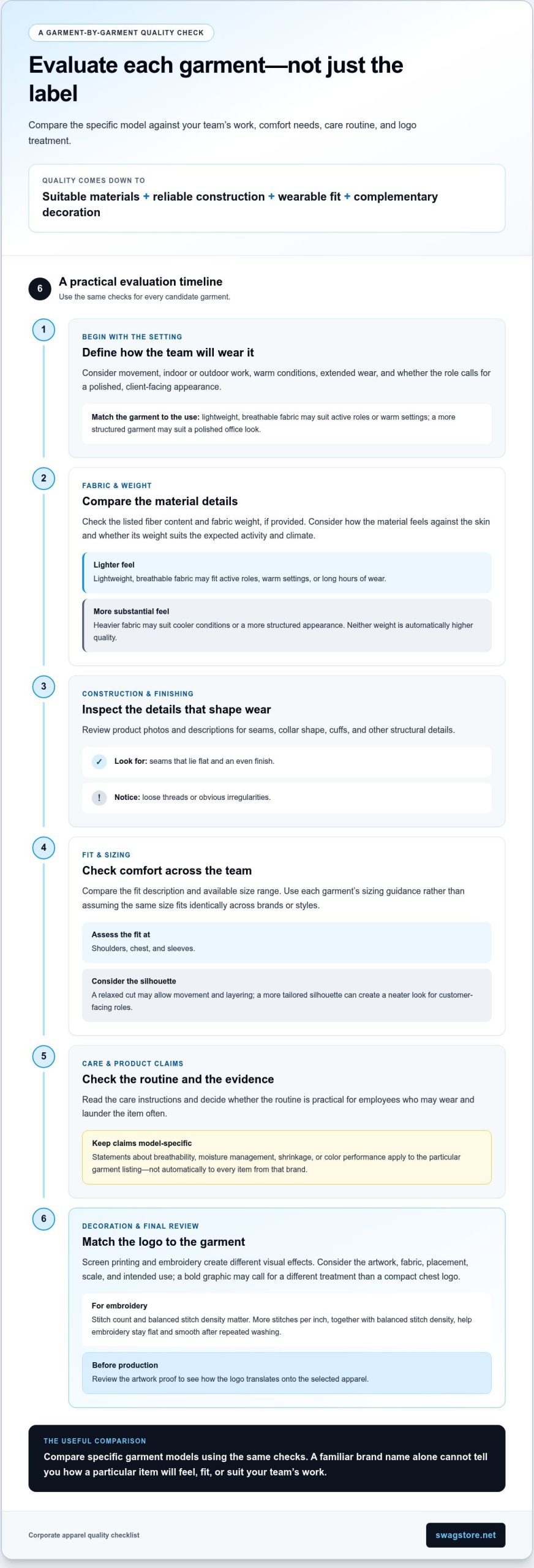
The right branded garment should make sense for its wearer, setting, and purpose. An event shirt, an everyday team tee, and a more polished polo can each work well when the garment and logo treatment fit the job. Use these steps to turn quality criteria into a clear order plan.
Event apparel can also work alongside other useful promotional items. If you’re planning a coordinated presence, connect the apparel decision to your broader event goals and the items in your trade show giveaways guide. For new employees, apparel can contribute to a consistent welcome experience alongside employee onboarding kits.
Judge the best corporate apparel brands for quality by the garments and decoration your team will actually receive. Compare the options, review the proof, and plan your custom branded apparel order with those decisions in place.
Turn your garment shortlist into a coordinated team order with SwagStore.NET. We provide bulk custom screen-printed shirts and embroidered branded apparel, including Nike and Under Armour polos. Professional decoration and a proof review help bring your logo to life on apparel selected for your team and its setting.
Professional printing and embroidery each create a distinct finish. For printed shirts, consider how the artwork’s size, colors, and placement work with the garment’s feel and fit, as well as its care instructions. Review the design with the garment’s intended use in mind so the decoration suits the way employees will wear it.
Embroidery quality depends on the stitching, not just the complexity of the logo. More stitches per inch and balanced stitch density help the embroidery stay flat and smooth even after repeated washing. Thicker fabrics work best for embroidery; thin or stretchy fabrics receive backing to help prevent warping. Embroidery can suggest shading with different thread colors and stitch directions, but it can’t reproduce exact gradients.
Before production, SwagStore.NET’s in-house art department provides proofs so your team can review the logo artwork and placement. Use the proof to check details and make sure the design feels balanced on the chosen garment. Free setup is included on most products.
Bring your garment choice and logo goals together by exploring bulk custom branded apparel for your team.
Most embroidery services have a one-dozen minimum order. Plan quantities across the team before finalizing your order, including sizes and any additional pieces needed for new employees or future use. Keep the minimum in mind when selecting decorated apparel, and finalize the garment choice and artwork direction together for a consistent team look.
For printed artwork, review the logo’s size, placement, and readability against the garment. For embroidery, remember that color transitions are represented through thread colors and stitch direction rather than exact gradients. These distinctions help set realistic expectations for the final appearance.
SwagStore.NET is a bulk-order partner for branded apparel, recognized as a five-time National Winner of the Promotional Products International Association and holding a 5-star Google rating. Our team also offers live assistance with apparel and artwork questions. Start planning a bulk apparel order around your team’s needs and logo direction.
Choose the garments, review the proof, and move ahead with a clear picture of the finished order. Start your bulk branded apparel order with SwagStore.NET.
Choose apparel as part of the experience you want employees and customers to remember. A thoughtful garment can help a team feel connected, make a shared identity visible, and turn everyday wear into a natural extension of your brand. The strongest choice isn’t necessarily the most recognizable label. It’s the garment your people feel good wearing, with decoration that reflects your brand clearly.
Use the criteria in this guide to shape a brief before you order: who will wear the apparel, where it will be worn, and what impression should it create? That clarity makes it easier to compare the best corporate apparel brands for quality and move from broad ideas to a confident selection.
Ready to bring your team’s look together? Explore custom corporate apparel at SwagStore.NET and start planning branded apparel that feels considered from garment to final logo.
No single brand is best for every team; compare the specific garment against your needs. The best corporate apparel brands for quality offer models that suit the intended setting, wearer preferences, and logo treatment. For example, a team choosing apparel for a warm outdoor event may prioritize a different fabric and fit than staff dressing for a client meeting. Use product-level details to guide the decision, not the label alone.
Neither brand is automatically better for every corporate order. Compare the exact polos under consideration for fit, fabric description, care guidance, and how the logo will look on the garment. A team with a defined dress standard may favor the model whose silhouette best matches it, while staff who move throughout the day may prioritize ease of movement. Choose based on actual use, not brand prestige.
Small text can be difficult to read when embroidered, so use a bold typeface and keep lettering at least one-quarter inch tall. Thin strokes and tightly packed words can lose definition when translated into stitches. A short department name is more likely to remain legible than a long slogan set in delicate lettering. Review the artwork proof at its intended size before approving it for production.
No, embroidery can’t reproduce a gradient exactly because thread uses distinct colors rather than a continuous color transition. Shading can be suggested with different thread colors and stitch directions, but the result is an interpretation of the artwork. If the gradient is central to the logo, consider simplifying that area or choosing a design with clearer color blocks. Review the proof to understand how the thread version will appear.
The minimum order for most embroidery services is one dozen. Plan quantities across the team before finalizing your order, including sizes and any additional pieces needed for new employees or future use. Keep the minimum in mind when comparing decorated apparel options, and finalize the garment choice and artwork direction together for a consistent team look.
It can, but thin or stretchy fabric needs backing during embroidery to help prevent warping. Thicker fabrics generally work best because they provide a more stable base for the stitches. If your chosen garment is lightweight or flexible, account for its material when planning logo size and placement. Review the proof and garment together to see how the embroidered design will sit on the fabric.