

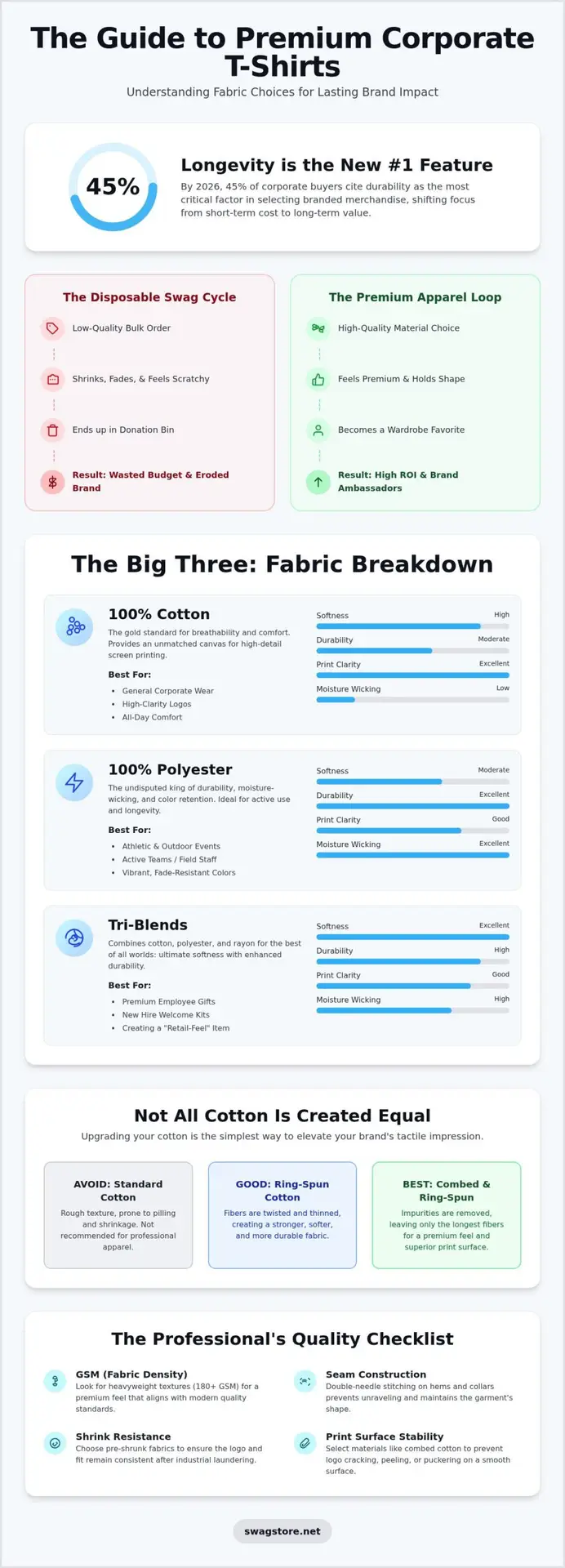
Did you know that 45% of corporate buyers in 2026 now cite longevity as the most important feature when selecting branded merchandise? The era of disposable, scratchy giveaways is officially over. Your team deserves apparel that feels like a retail favorite rather than a stiff, one-time uniform. Success starts with choosing the right t-shirt material, a decision that defines whether your brand ends up in an employee’s weekly rotation or at the bottom of a donation bin.
You’ve likely felt the frustration of a bulk order that looks sharp in the box but shrinks significantly or feels too thin for a professional environment. It’s exhausting to decode terms like ring-spun, combed cotton, or the new GOTS 8.0 standards while trying to protect your budget. We believe your corporate apparel should be a high-impact brand asset, not a source of stress. It’s about creating a lasting impression that aligns with your premium identity.
This guide will help you master the science of modern fabrics to ensure your gear looks premium and lasts for years. We’ll explore the 2026 shift toward heavyweight textures, the latest OEKO-TEX updates, and which specific blends offer the most durable canvas for your logo.
Your brand’s reputation isn’t just seen; it’s felt. When an employee pulls a new corporate shirt from its packaging, their first instinct isn’t to look at the logo. They feel the fabric between their fingers. This tactile moment is where your brand’s story truly begins. If the material feels thin, scratchy, or cheap, the message is clear: the organization doesn’t value quality. Choosing the right t-shirt material is the first step in ensuring your message actually sticks.
We’ve all seen the “Swag Cycle” in action. A company spends thousands on bulk shirts, only to see them used as car-wash rags or pajama tops two weeks later. Low-quality materials that end up in the trash don’t just waste your budget. They actively erode your brand’s prestige. High-quality natural and synthetic fibers act as a foundation for your corporate identity. When you invest in premium materials, you’re buying more than a garment. You’re buying years of mobile advertising and a professional image that survives the daily grind.
Softness acts as a direct proxy for brand appreciation. In modern HR departments, premium apparel has become a vital retention tool. It signals that the organization values the person, not just the role. A shirt that someone chooses to wear on their day off represents the ultimate marketing ROI. It moves your brand from a “promotional item” to a “lifestyle choice.” By avoiding the disposable reputation of cheap promotional items, you foster a culture of excellence and belonging.
Fabric stability is non-negotiable for professional screen printing and embroidery. If a material stretches or shrinks unevenly after the first wash, the logo will crack, peel, or pucker. This destroys visibility. By choosing the right t-shirt material, you ensure the fabric doesn’t warp under the stress of industrial laundering. If they can’t wear it, they won’t show it. Your logo is only as durable as the surface it’s printed on.
Brand Equity in apparel is the cumulative value generated when a high-quality garment ensures your logo remains visible, respected, and worn in public spaces over several years.
Choosing premium fabrics isn’t an expense; it’s a strategic investment in how the world perceives your business. When the material lasts, your message stays in the spotlight. Let’s move beyond the basic label and build something that truly represents your standards.
Mastering the fabric trifecta is essential for any successful bulk order. 100% cotton remains the gold standard for pure breathability and unmatched screen printing clarity. It provides a natural canvas where inks can settle deeply into the fibers for a vibrant, long-lasting finish. However, for active teams or outdoor branding, polyester is the undisputed king of durability. Research into the performance attributes of cotton and polyester shows that while cotton excels in initial comfort, polyester dominates in moisture management and color retention over time.
If you want the best of both worlds, tri-blends are the retail-feel favorite. These shirts typically combine cotton, polyester, and rayon to create a vintage, ultra-soft texture that employees never want to take off. When choosing the right t-shirt material, you must weigh the crispness of the print against the daily utility of the garment. A high-clarity logo on a shirt that stays in the closet is a wasted opportunity.
Professional corporate wear starts with ring-spun cotton. Unlike standard “open-end” cotton, which feels rough and pills easily, ring-spun fibers are twisted and thinned for a much stronger, softer result. For a truly premium upgrade, we recommend combed cotton. This process removes short, prickly fibers and impurities, leaving only the longest, smoothest strands. This creates a superior print surface that prevents the “fuzz” that can often blur fine logo details during high-volume production. Avoiding open-end cotton is the simplest way to protect your brand’s professional image.
Polyester has evolved far beyond the shiny, plastic-feeling fabrics of the past. Modern performance polyester is essential for moisture management during outdoor corporate events or team-building activities. We’re seeing a massive surge in recycled polyester (rPET) as companies align their swag with 2026 sustainability goals. It’s vital to remember that synthetics require specialized screen printing inks with “low-bleed” properties to prevent the fabric dye from migrating into your logo. If you are unsure which blend fits your next event, our team can help you curate custom screen printed t-shirts that match your technical needs perfectly.
Let’s look at the trade-offs objectively. Cotton offers the best printability but can shrink if not handled correctly. Polyester offers the best durability but lacks that soft, organic feel. Tri-blends offer the best comfort but often come at a higher price point. Success lies in choosing the right t-shirt material that balances these technical demands with your brand’s specific goals for the year ahead.
Your event’s success depends on how your team feels in their gear. A trade show floor is a high-pressure environment. If your staff is sweating in heavy cotton, their energy drops. Choosing the right t-shirt material for specific scenarios ensures your brand looks sharp regardless of the setting. Strategy isn’t just about the logo; it’s about the environment where that logo will live. We see a clear shift in 2026 toward purpose-driven fabric selection that prioritizes the wearer’s experience.
Trade shows demand resilience. We recommend lightweight, wrinkle-resistant CVC blends that survive being packed in a suitcase and worn for 10-hour shifts. These fabrics maintain their shape and vibrant color, ensuring your corporate Pantone stays consistent under harsh convention center lights. CVC blends (typically 60% cotton and 40% polyester) are particularly effective because they offer the breathability of natural fibers with the structural integrity of synthetics. This prevents the sagging effect often seen in cheaper shirts after a few hours of movement. For more on maximizing your impact, check out The Ultimate Guide to Trade Show Giveaways.
First impressions matter. When assembling The Ultimate Guide to Custom Employee Onboarding Kits, we found that comfort is the leading factor in “swag adoption.” If a shirt isn’t soft, it won’t be worn. Tri-blends are the gold standard here. They offer a retail-ready stretch that accommodates diverse body types while feeling like a high-end gift. They don’t just sit in a drawer; they become the “Friday shirt” your employees actually love.
For outdoor volunteering or company retreats, switch to performance poly-blends. These offer essential sun protection and moisture-wicking properties to keep your team cool during physical activity. Conversely, executive gifts in 2026 are moving toward a “streetwear” aesthetic. This involves choosing the right t-shirt material with a heavyweight profile, typically between 180-220 GSM. This weight creates a professional drape that looks expensive and substantial, bridging the gap between casual wear and business attire. Matching the fabric to the moment isn’t just a detail. It’s the difference between a forgotten giveaway and a lasting brand asset.
Choosing the right t-shirt material requires more than a quick look at a digital catalog. You need a physical framework to evaluate quality before committing your budget to a bulk order. Since 45% of corporate buyers now prioritize longevity, your inspection process must focus on technical durability and fit. A shirt that fails after three washes isn’t a gift; it’s a liability to your brand’s reputation.
Grams per Square Meter (GSM) is the industry standard for measuring fabric density. This number tells you exactly how much material is packed into the garment. When you’re choosing the right t-shirt material, use these ranges to match your goals:
The way a shirt is put together determines how it looks after twenty laundry cycles. Look for side-seamed construction. Unlike “tubular” shirts, which are just fabric cylinders, side-seamed garments are cut to follow the natural lines of the human body. This ensures a professional fit for all body types and prevents the shirt from twisting over time. If the seams aren’t straight, your logo won’t be either.
Check the stress points. Quality bulk apparel features shoulder-to-shoulder taping, which is a thin strip of fabric sewn over the seams to prevent stretching. You should also look for double-needle stitching on the collar and sleeves. This reinforced sewing ensures the hem doesn’t unravel under the pressure of industrial washing. If you’re ready to see how these technical details look in practice, you can explore our curated range of custom screen printed t-shirts for your next project.
Finally, always confirm the “hand feel” and pre-shrunk status. A premium shirt should feel smooth, not fuzzy. Combed cotton will always have a superior hand feel compared to basic open-end cotton. Ensure your supplier guarantees pre-shrunk fabrics. This prevents the “post-laundry surprise” where a Large suddenly fits like a Small. By checking these four boxes, you transform a simple purchase into a strategic brand investment.
Every technical specification we’ve discussed leads to this final step: flawless execution. Choosing the right t-shirt material is a brilliant start, but your brand deserves a partner that understands how those fibers interact with ink and thread at scale. We don’t just process orders; we curate experiences. SwagStore.NET focuses exclusively on professional corporate solutions, ensuring that whether you need 50 units for a leadership retreat or 5,000 for a global launch, the quality remains identical from the first shirt to the last.
Our approach leverages the research and development of world-class brands. By offering embroidered Nike and Under Armour polos alongside our custom screen printed t-shirts, we give you access to fabrics that have already passed the most rigorous durability tests in the industry. These high-end brands have mastered the science of performance and fit. When you align your logo with these names, you aren’t just giving away a shirt. You’re providing a retail-quality garment that employees will wear with pride for years.
We believe that expert guidance is the bridge between a good idea and a premium product. Our team doesn’t just take your file and hit print. We analyze your logo design against your chosen fabric texture to prevent issues like ink bleeding on polyesters or “fuzzing” on standard cotton. This precision ensures your brand image remains sharp and professional. Our curated approach also integrates perfectly with other high-end branding efforts, such as those found in The 2026 Guide to Bulk Monogrammed Gifts. We’re here to take the technical burden off your shoulders so you can focus on the bigger picture.
The transition from “disposable swag” to “premium brand asset” starts with a single conversation. Professional consultation is vital when choosing the right t-shirt material because the 2026 landscape is more complex than ever with new GOTS and OEKO-TEX standards. We help you navigate these technicalities to find the perfect weight, blend, and brand for your specific goals. Don’t settle for generic solutions that end up in the donation bin. It’s time to build a wardrobe your team actually wants. You can build your premium bulk apparel order at SwagStore.NET today and experience the difference that professional curation makes.
Mastering the science of fabrics is the most effective way to protect your marketing budget and boost employee morale. By prioritizing technical details like GSM density and side-seamed construction, you ensure your gear remains a retail-quality favorite for years. Choosing the right t-shirt material is no longer just a procurement task; it’s a strategic move to align your physical presence with your premium brand values. We’ve seen how the right blend can turn a simple giveaway into a coveted lifestyle piece that employees actually keep.
At SwagStore.NET, we simplify this complex process through professional curation and dedicated account managers for high-volume corporate orders. We offer exclusive bulk pricing on elite brands like Nike and Under Armour, paired with screen printing processes optimized for every specific fabric blend. It’s time to move beyond disposable swag and invest in products that survive industrial laundering and daily wear. Browse our premium bulk t-shirt catalog and get a custom quote today. Let’s build something your team will actually want to wear.
Polyester and cotton blends, particularly the 60/40 CVC blend, provide the highest level of durability for daily employee uniforms. These fabrics are engineered to withstand the rigors of industrial laundering while resisting pilling and color fading. By combining the natural comfort of cotton with the synthetic strength of polyester, you ensure your team looks professional for the long term.
100% cotton garments naturally shrink more than polyester blends, especially when exposed to high heat in dryers. While a standard cotton shirt can shrink up to 5%, polyester fibers are heat-resistant and maintain their original dimensions. When placing a bulk order, it’s essential to verify if the cotton is pre-shrunk or choose a blend to guarantee consistent sizing for your team.
100% combed and ring-spun cotton is the superior choice for high-detail screen printing. The combing process removes impurities and short fibers, creating a smooth, flat surface that allows inks to bond with surgical precision. This ensures that intricate logos and fine typography stay crisp, avoiding the blurred edges often seen on rougher, low-quality fabrics.
Weight doesn’t always equal quality. While a heavyweight shirt (200+ GSM) offers a trendy, structured look, a midweight combed cotton shirt can be more durable and comfortable for daily wear. True quality is found in technical construction details, such as side seams and double-needle stitching, rather than just the thickness of the fabric itself. Always prioritize fiber grade over simple grams per square meter.
Tri-blend shirts combine cotton, polyester, and rayon to create an exceptionally soft, breathable fabric with a slight stretch. They are the gold standard for corporate swag because they offer a high-end retail feel that employees genuinely love to wear. This comfort drives brand visibility, as a shirt that feels great is far more likely to be worn outside of office hours.
You can certainly mix materials within a single bulk order to suit different roles within your organization. Choosing the right t-shirt material for each department, such as performance polyester for technicians and tri-blends for executives, allows you to meet specific needs while keeping your branding unified. We ensure that your logo looks consistent across every different fabric type in your order.
Retail-quality apparel is defined by its fit, finish, and feel. Look for side-seamed construction, which provides a tailored fit, and shoulder-to-shoulder taping for shape retention. Brands like Nike and Under Armour set the standard for this category. If a garment feels smooth to the touch and maintains its structure after multiple washes, it meets the premium retail-quality threshold your brand deserves.
Open-end cotton should be avoided because its rough, uneven fibers create a scratchy feel and a poor surface for printing. This material pills easily and often loses its shape after the first wash, which can make your brand look cheap. Choosing the right t-shirt material, like ring-spun or combed cotton, ensures a smooth canvas for your logo and a professional image that lasts.