


What if the strongest case for a new swag program starts with a business goal, not a product? If you’re figuring out how to get buy-in for a new swag program, you already know the challenge: leaders may see branded merchandise as a discretionary expense unless its purpose and value are clear. A compelling proposal connects swag to a specific need, whether that’s creating a more consistent onboarding experience, supporting an event, or giving employees a thoughtful recognition item.
You don’t need to promise a dramatic return to make the case. Build a focused plan: define the audience, explain how the program supports an organizational priority, set a manageable pilot scope, and choose measures that will help you assess what worked. Identify the stakeholders who need to weigh in, and prepare for their questions about budget, branding, logistics, and impact.
This guide will help you build a concise business case, address common concerns with practical safeguards, and launch a measurable pilot. It also covers how to move from approval to a cohesive rollout, with professionally branded merchandise selected for the people and moment it’s meant to serve.
Start with the gap your organization needs to address, not a catalog of products. New hires may receive inconsistent welcome materials, recognition may feel impersonal, or an event may need a more memorable branded experience. A strong proposal explains how a planned use of branded merchandise relates to that need. As a neutral starting point, Promotional merchandise describes the category; your business case should explain why a specific audience should receive it at a specific moment.
Keep the scope focused. Identify who the program is for, when they’ll receive the merchandise, and which organizational priority it supports. A set of branded notebooks and drinkware for incoming employees, for example, could support a more consistent onboarding experience. The items can help deliver that experience, but shouldn’t be presented as the sole cause of improved engagement or retention.
Choose one primary use case for the initial proposal. Onboarding welcomes new employees; recognition acknowledges contributions; customer gifting supports client relationships; and event merchandise helps create a branded interaction with attendees. Each serves a different audience and moment, so combining them in one request can make the purpose and approval criteria harder to assess. If onboarding is the focus, explore this guide to custom employee onboarding kits.
Define a swag program plainly: “A swag program is a planned use of branded merchandise for a specific audience and organizational goal.” Then give decision-makers the essentials without burying them in product detail:
Separate facts from expectations. You may know that onboarding materials vary across teams; you may expect a consistent kit to make the welcome experience feel more cohesive. Label the first as an observed problem and the second as a hypothesis to examine.
For a concise opening, use this template: “To address [need] for [audience] at [occasion], we propose a [pilot concept] aligned with [organizational priority], then will review [measures] to decide whether to refine or expand it.” This gives leaders a clear reason to consider the idea and a defined next step, rather than asking them to approve swag in the abstract.
A proposal can have one clear objective and still need several people to approve it. The sponsor champions the idea, the budget owner evaluates spending, brand reviewers protect visual standards, HR partners consider the employee experience, and operational stakeholders assess what it takes to order, store, and distribute merchandise. Map these roles early. Approval is easier to pursue when each person understands their part in the decision.
Keep the core goal consistent, but make its relevance clear to each stakeholder. For an onboarding pilot, for example, the proposal might emphasize a more consistent welcome for HR, a defined spending scope for finance, brand-aligned decoration for marketing, and a clear distribution process for operations. Those are different perspectives on one initiative, not competing reasons to run it.
Give each team the information it needs to assess the proposal. Finance needs a defined pilot scope, transparent assumptions, approval limits, and a review point before any expansion. HR needs a clear employee moment the program will support, such as a new hire’s first day, without a promise that merchandise will improve retention. Marketing needs to understand how product selection, decoration, and distribution will keep the experience aligned with brand standards.
Make the handoffs visible, too. Identify who approves the design, who coordinates ordering, and who manages distribution and reporting. That clarity helps answer operational questions before they become reasons to delay a decision.
Answer concerns with practical safeguards rather than broad claims. If leaders call swag a nice-to-have, return to the specific organizational need and audience in the proposal. If they worry about waste, suggest a limited pilot, select items for their intended audience and occasion, and collect feedback before recommending another order. If workload is the concern, assign an owner to each step so the process doesn’t default to an already busy team.
This stakeholder plan is central to how to get buy-in for a new swag program: make approval feel like a considered business decision, not a request to spend on merchandise without a plan. Once you’ve aligned the audience, goal, and practical constraints, explore bulk branded merchandise options that fit the initiative.
Swag isn’t automatically frivolous, but a box of products without a clear audience or purpose can be hard to justify. The investment case depends on fit: the right item, for the right people, at a meaningful moment, with a plan to understand how the program performs. Compare formats against the need you’ve identified, rather than asking leaders to approve merchandise in the abstract.
A one-time campaign suits a defined event audience, provided you plan how items will be distributed. A recurring recognition program needs repeatable occasions, a clear owner, and a consistent brand approach. Curated employee kits work well when the proposal centers on a planned onboarding or recognition moment. Use this comparison to show what each format asks of the organization.
| Program format | Audience | Objective | Product approach | Operational effort | Useful measures |
|---|---|---|---|---|---|
| One-time campaign | Event attendees | Support a specific event experience | Items selected for the audience and occasion | Plan ordering, event delivery, and distribution | Items distributed, recipient feedback, and event engagement observations |
| Recurring recognition | Employees recognized at defined moments | Make recognition feel thoughtful and consistent | Branded items suited to the occasion | Set repeatable approval, ordering, and fulfillment steps | Recognition participation, feedback, and process consistency |
| Curated onboarding initiative | New employees | Support a coordinated welcome | A cohesive kit, such as branded drinkware and a notebook | Coordinate with onboarding workflows and distribution | Kits delivered, recipient feedback, and completion of the planned process |
Ground the comparison in your organization’s own budget assumptions. Define the proposed audience, quantity, item direction, branding approach, distribution plan, and review point. Then distinguish direct program spending from staff time and operational considerations, such as coordinating approvals, handling inventory, and delivering items. A format with fewer product types may still require substantial coordination; show the work, not just the merchandise.
Separate what you can count from what you hope to influence. Distribution completion, recipient feedback, and participation are measurable activities. Stronger engagement, improved brand recall, or better customer relationships are possible longer-term outcomes, not guaranteed results of a product order. Frame them as hypotheses for the pilot to explore.
A credible investment case is specific about both its limits and its learning value. That’s how to get buy-in for a new swag program without promising a return you can’t yet demonstrate: recommend a format that fits the need, explain its full scope, and define what evidence will inform the next decision.
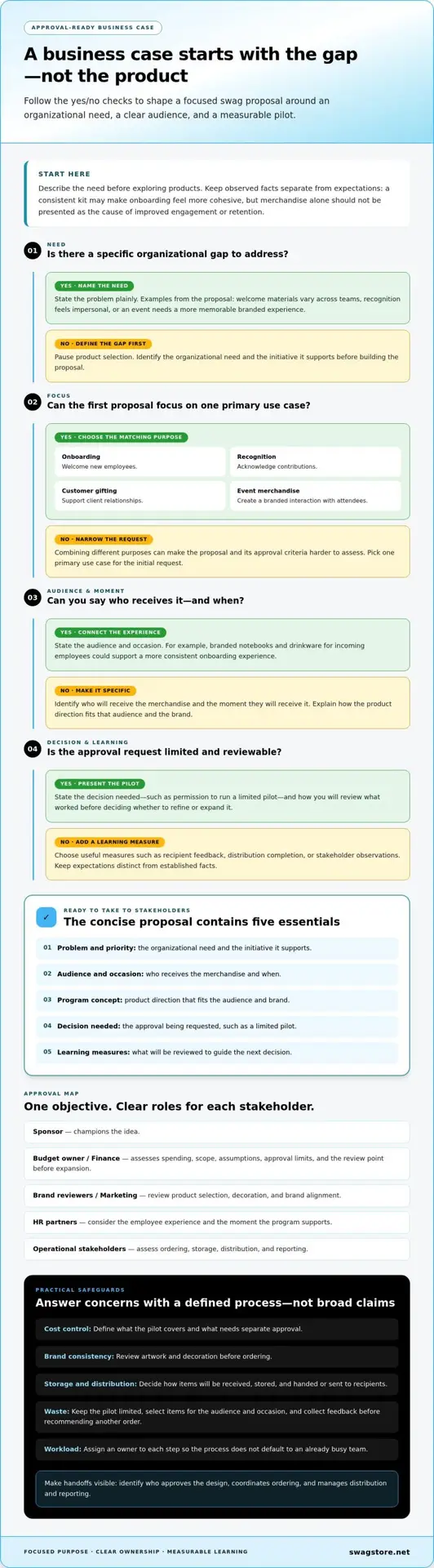
A pilot is a controlled way to learn, not proof that every swag initiative will succeed. Keep the test narrow enough to manage and specific enough to evaluate. Before ordering, document the audience, occasion, product direction, owner, approval path, and review date. For example, an onboarding pilot might focus on a defined group of incoming employees, use a cohesive selection of branded items, and follow an agreed process for design approval and distribution.
That structure makes how to get buy-in for a new swag program a practical question: what can your organization test, learn, and decide with a clearly bounded initiative?
Move from the business question to a reviewable test, then assess the result against the original objective.
Set the review date before launch, and make sure the person responsible for reporting can access the information needed to evaluate the pilot. That keeps the review from becoming an informal impression after the fact.
Choose a small set of measures that reflect both the recipient experience and the work required to deliver it. The right mix depends on the goal, but useful starting points include:
These measures show what took place and where the process could improve. They don’t prove that merchandise alone caused a broader business outcome. For added measurement context, see this guide to measuring marketing swag ROI, and treat longer-term benefits as hypotheses rather than guaranteed returns.
Once the pilot scope and approval path are clear, plan your bulk branded merchandise around the audience, occasion, and learning goals.
Approval is a milestone, not the finish line. Close the loop by sharing what the pilot showed, what recipients and stakeholders said, and what you recommend next. Be specific: continue the same approach, adjust the product mix or distribution process, expand to a defined audience, or stop. Scale only the elements supported by the evidence, and keep the original business objective visible so growth doesn’t turn the program into merchandise without a purpose.
Turn what worked into a repeatable process before increasing the scope. Document who selects products, approves branding, places orders, manages inventory, distributes items, and reports results. Capture practical details such as how recipients are identified and how feedback will be collected. Clear handoffs help teams maintain accountability as participation grows.
Keep the experience cohesive. For an approved onboarding initiative, for example, branded apparel, drinkware, tech accessories, or an employee kit can be selected to fit the occasion and presented with consistent branding. Bulk customization can bring products together through methods such as screen printing, embroidery, or laser engraving, helping the approved concept translate into a polished, on-brand experience.
Put the decision in writing before moving into production. Confirm the audience, purpose, approved scope, owner, and evaluation date, along with the people responsible for each approval and delivery step. Then develop the product and presentation direction around the recipient and the moment the program is designed to support. This gives everyone a shared reference point if questions arise during execution.
After the rollout, report against the measures set for the pilot. Note what was delivered, how recipients responded, what the process required, and what you recommend changing or retaining. That evidence creates a more useful basis for the next decision than simply asking whether the program felt successful.
Strong execution turns how to get buy-in for a new swag program into a practical path from approved idea to considered rollout. SwagStore.NET supports bulk branded merchandise and curated corporate gifts, including apparel, drinkware, tech accessories, and employee onboarding gift kits. Discuss a branded merchandise program with SwagStore.NET to translate your approved goals and scope into a cohesive merchandise direction.
A compelling swag proposal starts with a real organizational need, names the audience and occasion, and connects the program to an existing priority. Make approval easier by showing stakeholders how the same initiative serves their responsibilities, then compare program formats against the goal instead of assuming one approach fits every need.
A focused pilot gives your team a practical way to learn. Define what you’ll test, assign ownership, collect recipient feedback, and review the operational effort before recommending whether to refine or scale the program. That’s the heart of how to get buy-in for a new swag program: offer a clear rationale and a measured next step, not an unsupported promise of results.
Once the direction is approved, bring it to life with merchandise that feels cohesive and useful. SwagStore.NET offers bulk custom branding through screen printing, embroidery, and laser engraving, along with employee onboarding gift kits and premium branded merchandise. Build a branded merchandise program with SwagStore.NET and take your approved idea toward a polished rollout. Your next thoughtful brand experience can start with one well-chosen step.
Connect the program to a specific organizational need, then ask leadership to approve a clearly scoped pilot. Explain who the merchandise is for, when they’ll receive it, which priority it supports, and what you’ll learn. Identify the decision-makers early, including budget owners and brand reviewers, and address their concerns about spending, workload, and distribution. A focused request gives leaders a concrete decision instead of an open-ended commitment.
Start by defining what you can measure and avoid presenting merchandise as the sole cause of a business outcome. Track practical indicators such as participation, distribution completion, recipient feedback, and the effort required to run the program. Compare these findings with the original objective. If you’re exploring outcomes like stronger engagement or brand recall, frame them as hypotheses to investigate over time, not guaranteed financial returns.
Include the organizational problem, intended audience, occasion, program concept, decision you’re requesting, and measures you’ll use to review the pilot. Clarify who owns approvals, ordering, and distribution, and state your assumptions separately from established facts. For example, describe inconsistent onboarding as an observed challenge, while treating the expectation that a coordinated welcome kit may improve the experience as something the pilot will assess.
There’s no single budget that suits every program. Set a scope that fits your organization’s priorities and budget process, then estimate the full effort for the chosen format. Consider the audience, merchandise selection, branding, ordering, storage, distribution, and staff time. A one-time event campaign and a recurring employee program have different operational needs. Ask for approval of a defined pilot, with any expansion subject to review.
Give finance a controlled proposal with clear assumptions, a defined audience, an approval limit, and a review point. Explain the organizational need and why the merchandise fits the occasion, then distinguish direct program spending from staff time and distribution work. Agree on measures before launch, such as successful delivery and recipient feedback. This makes the request assessable without relying on an unsupported ROI promise.
Choose measures that reflect the pilot’s objective and the experience of delivering it. Track whether items reached the intended audience and note participation where relevant. Ask recipients focused questions about usefulness, relevance, presentation, and their experience. Also record administrative effort, including approval coordination and distribution tasks. Review these findings against the original goal to decide whether to continue, adjust the approach, or close the pilot.
Reduce waste by choosing useful merchandise that fits the recipient and occasion, then order for a clearly defined audience rather than distributing items indiscriminately. A limited pilot can reveal whether the selection resonates before you scale it. Consider options such as eco-friendly recycled tote bags, plan how remaining inventory will be handled, and collect feedback to guide future product choices. Prioritize thoughtful selection over quantity.