


Did you know that 72% of consumers report that receiving a promotional product positively changed their perception of the brand? In a global market projected to reach $30 billion in 2026, you can’t afford to waste your budget on items that end up in the trash. This marketing manager’s guide to buying swag is designed to help you navigate the common pitfalls of bulk procurement. You’ve likely dealt with high shipping costs, poor imprint quality, and the stress of missing event deadlines. We understand that “cheap swag” often does more harm than good to your professional reputation.
For businesses seeking expert assistance in this selection process, BRAND NEW Promotions provides full-service custom branding solutions that help translate your strategic goals into high-quality physical products.
We promise to help you master the art of corporate gifting with a strategic framework that turns merchandise into brand equity. You’ll learn how to navigate the $25 IRS gift deduction limit while choosing high-ROI products that recipients actually use. We’ll preview the specific logistics and selection criteria needed to streamline your procurement process for 2026. It’s time to stop just ordering “stuff” and start building a tangible extension of your brand’s quality and values.
The era of the “disposable giveaway” has officially ended. In 2026, we’re seeing a fundamental shift where marketing budgets are moving away from mass-produced plastic and toward high-value lifestyle gear. This isn’t just about handing out items; it’s about building brand equity. We define “Brand Equity Swag” as merchandise that your recipients value as much as their own retail purchases. This marketing manager’s guide to buying swag highlights why savvy leaders now choose to distribute fewer, higher-quality units that people actually keep and use daily.
There’s a deep psychological link between product quality and brand trust. When you give a client a premium insulated tumbler that keeps their coffee hot for twelve hours, they subconsciously project that reliability onto your services. High-quality items like YETI or Stanley products create a positive feedback loop. Every time the recipient uses the item, your brand’s perceived value increases. This strategy explains why 72% of consumers reported a positive change in brand perception after receiving a promotional product in April 2026.
Low-quality swag is a liability. Industry data suggests that millions of tons of cheap promotional merchandise end up in landfills every year, which is a disaster for your brand’s sustainability goals. Beyond the environmental impact, cheap giveaways can actually damage your Net Promoter Score (NPS). If a branded power bank fails after one charge, the recipient associates that failure with your company’s core values. Strategic Swag is a high-utility brand touchpoint that provides ongoing value while reinforcing a premium brand presence. With 46% of buyers now demanding sustainable options, the shift toward longevity is both a moral and a financial imperative.
Merchandise has evolved into a powerful tool for lowering employee churn and winning new business. Premium apparel, such as embroidered Nike or Under Armour polos, serves as a walking billboard for your company culture. It transforms employees into brand ambassadors who are proud to wear your logo outside of the office. This sense of belonging is vital for modern team retention. For a deeper look at how these items drive growth, check out The Ultimate Guide to Promotional Items. By choosing high-end products like custom Moleskine notebooks or tech accessories, you’re investing in a relationship rather than just a transaction. You aren’t just buying gear; you’re securing long-term loyalty through quality and style.
Selecting the right merchandise isn’t a guessing game; it’s a strategic calculation. To move beyond the junk stigma discussed earlier, you need a filter that ensures every dollar spent contributes to your brand’s narrative. This marketing manager’s guide to buying swag introduces a four pillar framework designed to maximize impact and minimize waste. By evaluating every potential item through these lenses, you ensure your brand lives in the hands of your audience rather than in a trash bin. It’s about being intentional with your physical presence.
Utility is the cornerstone of a modern strategy. If a product doesn’t solve a daily problem, it won’t be kept. This is why high-performance tech accessories like custom logo power banks are dominating corporate orders in 2026. They provide immediate value in our mobile-first professional world. When an item is useful, it naturally passes the longevity test.
We use the “Desk Real Estate” test to determine an item’s true worth. Ask yourself: will this product still be on the recipient’s workspace 24 months from now? Items like custom Moleskine notebooks or laser engraved metal pens often win this battle. They provide repeated brand impressions every single day. Academic research into the effectiveness and ROI of promotional products confirms that items kept for longer periods significantly drive down the cost per impression while building deep-seated brand familiarity.
The build quality of your swag acts as a silent ambassador for your company’s market position. If you’re a premium service provider, a flimsy plastic bottle contradicts your message. Co-branding with retail giants like Nike, Stanley, or YETI allows you to borrow their established reputation for excellence. It’s a shortcut to trust. When you put your logo next to a brand people already love, that prestige rubs off on you.
Brand alignment also requires a nuanced approach to aesthetics. For 2026, we recommend subtle logo placement. A small, tonal embroidery on an Under Armour polo is often more effective for long term wearability than a massive, loud print. You must also match the item’s vibe to your specific industry. A tech startup might find success with eco-friendly recycled tote bags, while a finance firm might prefer the classic elegance of a branded stainless steel tumbler. If you’re ready to see how these pillars look in practice, browse our curated 2026 collection to find your brand’s perfect match.
Measuring the success of your promotional spend requires looking past the initial unit price on an invoice. In this marketing manager’s guide to buying swag, we advocate for the “Cost Per Impression” (CPI) model. Consider the difference between a premium hoodie and a basic t-shirt. While the upfront cost of high-end apparel is higher, its lifespan is significantly longer. If a recipient wears a high-quality hoodie 100 times over two years, the CPI drops to fractions of a cent. A thin t-shirt that shrinks or fades after one wash carries a much higher cost per actual use. Quality is a math-driven decision for building long-term brand equity.
Hidden expenses often lurk beneath the surface of budget-friendly options. Shipping heavy, low-value items creates a logistics nightmare where freight costs can eventually exceed the value of the goods themselves. High defect rates are another silent budget killer. A batch of cheap pens with a 15% failure rate doesn’t just waste money; it creates a frustrating brand experience. Brand dilution is the ultimate hidden cost. When your logo is attached to something that breaks, you’re telling your audience that your own standards are low. Practical applications show that quality swag drives measurable business outcomes. For instance, custom employee onboarding kits have proven to reduce 90-day turnover by creating an immediate sense of belonging and value.
A $2 plastic pen that runs out of ink or snaps in a week is far more expensive than a $10 laser-engraved metal pen that stays on a client’s desk for years. Beyond the financial waste, there’s a growing environmental expectation from your audience. As of May 2026, 46% of buyers prefer sustainable promotional options. Gen Z and Millennial audiences view low-quality, disposable merch as a sign of corporate irresponsibility. Choosing durable, eco-friendly materials is now a baseline requirement for maintaining brand trust and relevance.
Tracking ROI is more precise than ever with integrated technology. By adding unique QR codes to product packaging or hangtags, you can track exactly how many recipients engage with your digital content after receiving their gift. Social proof is another vital metric for 2026. When a recipient posts a photo of their new Nike polo or Stanley tumbler on LinkedIn or Instagram, they provide an authentic endorsement. Monitor these organic social mentions to gauge the emotional impact and reach of your campaign. This type of earned media is often the highest-value return on your swag investment.
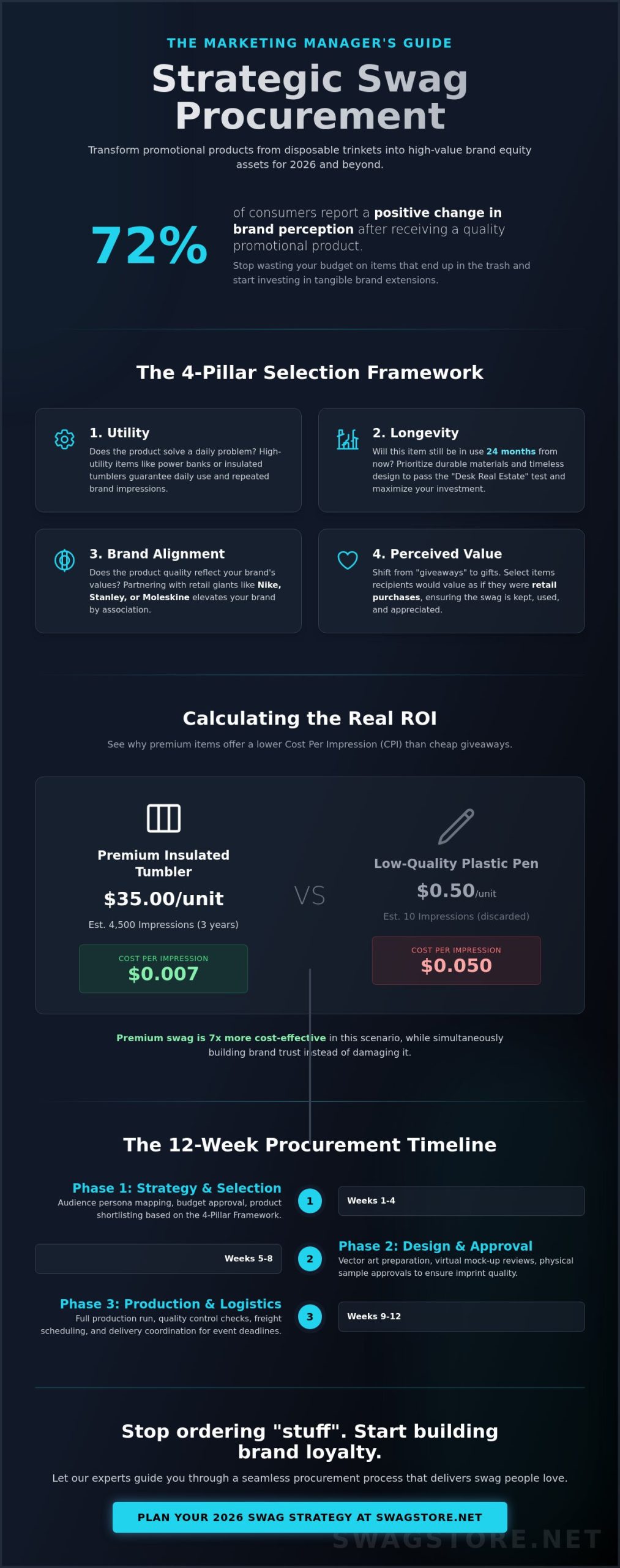
High-impact branding isn’t accidental; it’s the result of rigorous planning. While many vendors promise “fast turnarounds,” complex projects involving premium co-branding or custom kitting require a disciplined approach. If you want to avoid the “cheap swag” stigma and high defect rates discussed earlier, you must respect the production clock. This marketing manager’s guide to buying swag provides a proven 12-week roadmap to ensure your premium items arrive on time, every time. Planning ahead allows us to focus on quality control rather than panic control.
Art file preparation is the primary bottleneck in bulk procurement. Screen printing and embroidery are physical crafts that don’t tolerate pixelated JPEGs. To avoid production delays, always provide your logos in AI, EPS, or high-resolution PDF formats. Converting these files late in the process often leads to “rush order” fees that can inflate your budget by 20% or more. Proper file preparation ensures your brand colors stay vibrant and your lines stay crisp across every unit.
Centralized fulfillment is essential for maintaining brand consistency across national or international campaigns. Instead of shipping loose items to ten different offices, we recommend a streamlined kitting process where every recipient receives a curated, professional package. Specialized handling is particularly vital for high-precision work. For example, bulk monogrammed gifts require a higher level of attention to detail to ensure individual names are laser-engraved or embroidered without error. If you’re ready to start your 12-week clock with a partner who understands these complexities, explore our professional fulfillment services to see how we take the logistical weight off your shoulders.
Success in corporate gifting isn’t just about what you give; it’s about who you partner with to deliver that message. This marketing manager’s guide to buying swag has outlined the shift toward quality and the rigors of 2026 logistics. At SwagStore.NET, we’ve built our entire model around these high standards. We focus exclusively on bulk, premium brand partnerships because we believe your logo deserves to be associated with excellence. We don’t just supply products; we curate experiences that reinforce your brand equity with every touchpoint.
Our 2026 catalog features the retail giants your audience already loves. We offer branded YETI and Stanley tumblers for those who value durability, along with embroidered Nike and Under Armour polos that define modern professional style. For the tech-conscious, our custom logo power banks and laser-engraved metal pens provide daily utility. We also offer a “White Glove” kitting service designed specifically for employee onboarding and executive gifting. We handle the assembly and multi-location distribution so you can focus on the bigger picture of your campaign.
Sustainability isn’t a buzzword for us; it’s a core commitment. As we noted earlier, nearly half of all buyers now prioritize eco-friendly options. We’ve expanded our range of recycled tote bags and ethically sourced Moleskine notebooks to meet this demand. We ensure that your bulk orders meet the highest environmental and ethical standards, helping you appeal to the values of Gen Z and Millennial recipients who demand corporate responsibility and long-term product life.
Our professional design team treats every project as a piece of art. Whether it’s complex screen printing on t-shirts or high-precision laser engraving on tech accessories, we prioritize aesthetic integrity. We specifically avoid single-unit customization to focus our energy on high-volume corporate excellence. This specialization allows us to maintain strict quality control and offer the reliability that modern marketing managers require for national product launches and global events. We understand that in bulk procurement, precision is the only path to success.
Don’t leave your brand’s physical presence to chance. Our creative team is ready to consult with you on curated gift kits and strategic product selection that aligns with your specific industry goals. We’ll help you navigate the 12-week procurement timeline and ensure your art files are production-ready from day one. Start your bulk premium swag order today and turn your promotional spend into a lasting brand asset. Let’s build something exceptional together.
We’ve explored how the shift from disposable trinkets to high-utility lifestyle gear is reshaping the corporate world. By applying the 4-Pillar Selection Framework and mastering the 12-week procurement timeline, you’re no longer just buying items; you’re investing in long-term relationships. This marketing manager’s guide to buying swag provides the necessary roadmap to ensure every tumbler or polo reflects your company’s prestige and commitment to quality. It’s about making a lasting impression that survives long after the event ends.
SwagStore.NET is ready to help you execute this vision with professional precision. As national fulfillment and kitting specialists, we’ve been trusted by Fortune 500 Marketing Teams since 2010. Our expert laser engraving and embroidery on retail-grade brands like Nike and YETI ensure your logo is handled with the care it deserves. We’ve seen how the right strategy turns a simple gift into a powerful retention tool that stays in use for years. It’s time to move beyond the “cheap swag” stigma and embrace a strategy that delivers real ROI through quality and style.
Design Your Premium Bulk Swag Strategy with SwagStore.NET and let’s create a brand experience that your recipients will truly value.
Budgeting should be based on the Cost Per Impression (CPI) rather than just the total invoice amount. For client gifts, remember the IRS limits the business gift deduction to $25 per recipient per year as of May 2026. For employees, non-cash gifts under $100 are typically considered de minimis fringe benefits and aren’t taxable. This approach ensures you’re investing in quality that lasts while remaining tax compliant.
You should start the procurement process at least 12 weeks before your event date to ensure absolute precision. This timeline allows for audience persona mapping, physical sample approvals, and quality control checkpoints. Following a structured marketing manager’s guide to buying swag helps you avoid the high costs of rush orders and potential shipping delays that can ruin a product launch.
The most frequent error is prioritizing a low unit price over long-term product utility and brand alignment. Marketing managers often ignore the hidden costs of shipping heavy, low-value items or fail to provide vector art files in AI or EPS formats. These mistakes lead to poor imprint quality and high defect rates that ultimately damage brand trust and waste valuable marketing spend.
Professional results depend entirely on using high-resolution vector files and choosing the right application method for the material. Laser engraving is the superior choice for metal tumblers and pens because it won’t peel or fade over time. For apparel like Nike polos, embroidery provides a textured, premium look that withstands repeated washing much better than standard screen printing or heat transfers.
Modern eco-friendly products often exceed the durability and finish of traditional options while meeting 2026 sustainability standards. With 46% of buyers now preferring sustainable options, items made from recycled rPET or organic cotton are no longer niche choices. These materials are engineered for longevity, ensuring your brand stays visible without contributing to the millions of tons of waste that end up in landfills annually.
Bulk ordering reduces the per-unit cost by spreading fixed setup fees and art preparation costs across a larger volume of products. For premium brands like YETI or Nike, Minimum Order Quantities (MOQs) typically start between 24 and 48 units. Ordering in larger quantities also allows for more efficient multi-location distribution and centralized quality control, which is essential for maintaining consistency in national campaigns.