
What if your smallest marketing investment became your most frequent brand touchpoint? You’ve likely seen it happen: a potential lead tosses a flimsy pen into the nearest bin before even leaving the trade show floor. It’s a frustrating sight. We agree that budget constraints shouldn’t force you to choose between reach and your professional reputation. According to 2023 PPAI industry data, 72% of consumers link a gift’s quality directly to a brand’s reputation, making the stakes higher than ever for your marketing spend. Finding high-quality, inexpensive promotional products is about smart strategy, not just looking for the lowest price tag.
In this guide, we’ll show you how to curate a swag collection that feels premium while staying cost-effective. You’ll learn to select items that stick around and generate real brand equity for your business. We’re going to break down the best categories for high-visibility impressions and share our framework for deploying budget-friendly items that actually get used. Let’s turn your fixed marketing budget into a powerhouse of visibility and create a brand experience that lasts.
Smart marketing doesn’t always require a massive budget, it requires precision. We define inexpensive promotional products as high-utility items that maintain a low per-unit cost while maximizing brand exposure. These aren’t just trinkets. They’re calculated touchpoints designed to stay in a customer’s hand, pocket, or desk for months. According to the 2023 ASI Global Ad Impressions Study, Promotional merchandise generates a higher return on investment than almost any other form of advertising, specifically because the items provide ongoing value to the recipient.
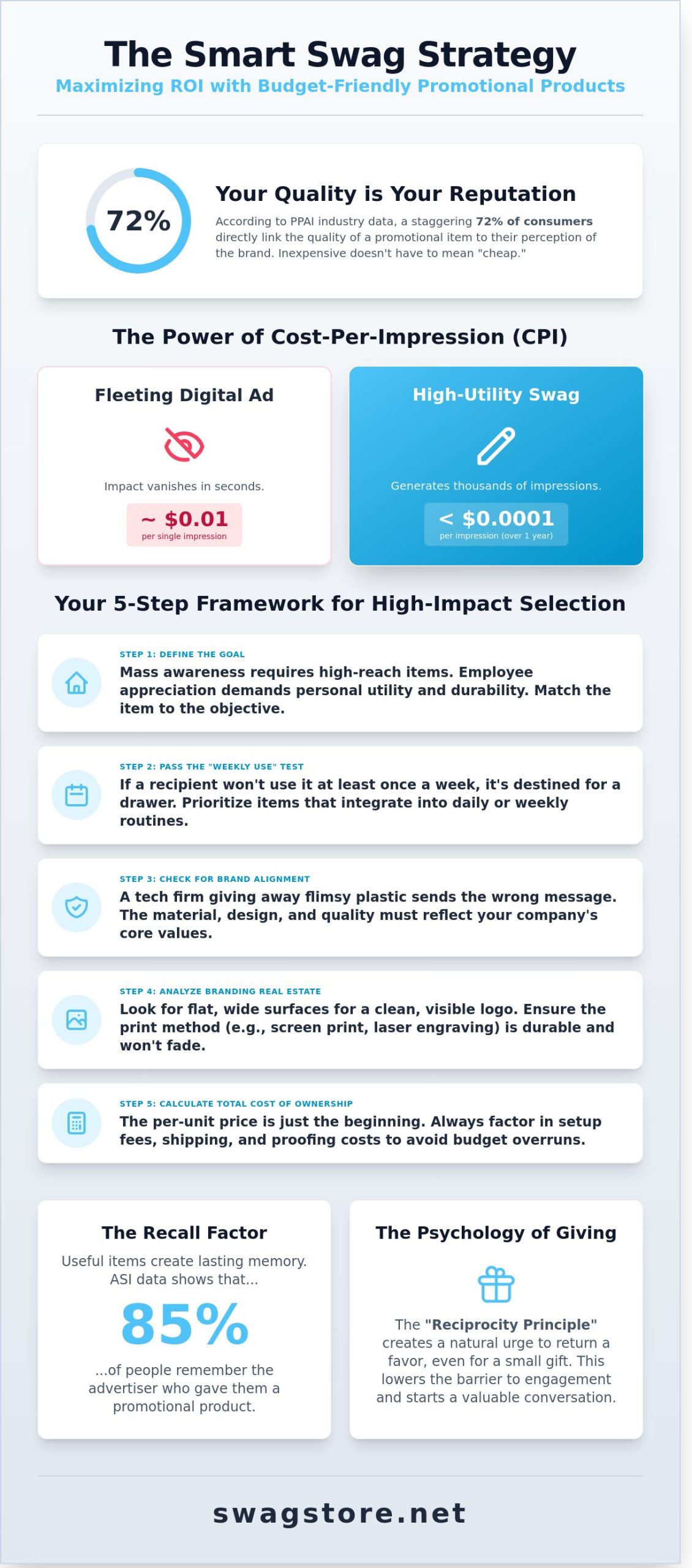
The real power of these items lies in the Cost-Per-Impression (CPI) metric. While a digital ad might cost pennies per click, its impact vanishes the moment the user scrolls past. A branded pen or a microfiber cloth costs less than a dollar but generates thousands of impressions over its lifespan. If a $0.80 item is used daily for a year, the cost per view becomes statistically negligible. This efficiency makes budget-friendly swag a cornerstone of modern visibility strategies.
High-volume events like trade shows demand a different approach than executive gifting. When you’re facing 5,000 attendees, you need scale. Large-scale distribution ensures your logo leaves the event hall and enters the homes of potential leads. Data from 2024 industry reports shows that 85% of people remember the advertiser who gave them a useful promotional item. We don’t believe inexpensive means low quality. A well-designed, durable item reflects your brand’s reliability, regardless of its price tag.
Large corporations use these items to dominate the top-of-funnel stage. They understand that wide-reaching visibility creates a sense of ubiquity. Useful, disposable items like branded hand sanitizers or tech stickers serve as low-friction entry points for new customers. To maximize impact, brands use specific giveaway ideas to turn passive observers into active booth visitors. By offering something small yet functional, you lower the barrier to engagement and start a conversation without the pressure of a high-stakes sales pitch.
The “Reciprocity Principle” is a powerful psychological trigger. When you give someone a gift, even a small one, they feel a natural urge to return the favor. This is why a $1 pen that writes smoothly is infinitely more valuable than a $5 plastic gadget that breaks after two uses. Longevity is the goal. Items like tote bags and basic office supplies often stay with a user for over 11 months. We focus on these “workhorse” products because they build trust through consistent performance. When your inexpensive promotional products work every time the customer needs them, that reliability transfers directly to your brand’s reputation.
Choosing the right items requires more than just browsing a catalog. You need a strategy that turns every cent into brand equity. We use a five-step framework to ensure your selection resonates with your audience while keeping costs low. Every choice should be intentional, focusing on the long-term impression rather than the short-term hand-out.
Gimmicks fade fast. A 2023 industry study found that 72% of consumers believe an item’s quality directly reflects the company’s reputation. Skip the plastic puzzles or seasonal fads. Focus on staples like soft-touch notebooks or microfiber cleaning cloths. These items have stayed popular for decades because they solve small, daily problems. Before you commit to a bulk order of inexpensive promotional products, run this durability check:
Investing in high-utility staples ensures your brand stays in their hands, not in the trash. It’s about being useful, not just being there.
Think of your promotional items as mobile billboards. The best real estate is on desks, laptop lids, or commute bags. These locations offer constant exposure to the user and their entire professional circle. To make inexpensive promotional products look premium, play with color psychology. Matte black or deep navy finishes often mask the texture of affordable plastics better than bright, glossy neon. High-contrast colors ensure your logo pops even from a distance. If you’re ready to elevate your brand presence without breaking the bank, consult with our creative experts for a custom curation that fits your budget perfectly.
Budget constraints shouldn’t stifle your brand’s creativity. Some of the most effective marketing campaigns rely on high-utility items that cost less than a cup of coffee. The secret lies in selecting items that solve daily problems or integrate seamlessly into a user’s routine. High-impact inexpensive promotional products succeed because they offer genuine utility, ensuring your logo stays visible for months. It’s about finding that sweet spot where a low price point meets high perceived value.
Tote bags are the undisputed champions of the swag world. Data from the Advertising Specialty Institute (ASI) shows that a single promotional bag generates approximately 3,300 impressions over its lifetime. This high visibility costs fractions of a cent per view, making it a powerhouse for brand awareness. You can choose non-woven polypropylene for maximum savings or opt for recycled PET (rPET) to align with modern sustainability goals. These bags also serve a brilliant secondary purpose. Instead of using disposable cardboard boxes, use these durable totes as the primary packaging for your employee onboarding gift kits. It’s a clever way to reduce waste while immediately increasing the utility of the entire package.
The average office worker spends roughly 1,900 hours a year at their desk. This makes “desk real estate” the most valuable territory for B2B marketing. Items like custom sticky notes, basic notebooks, and metal pens provide constant brand reinforcement. While plastic pens are the most common inexpensive promotional products, a sleek metal pen with laser engraving offers a premium feel that surprises the recipient. Laser engraving is often superior for budget items because it doesn’t chip or fade like screen printing can.
Small tech accessories also dominate this category. Consider these high-value options:
Focusing on the tactile experience is vital. A pen that glides smoothly across paper or a notebook with a soft-touch finish will be kept and used. When you prioritize the user’s experience over the lowest possible price, you transform a simple giveaway into a tool they’ll reach for every single morning.
Low price points shouldn’t translate to low value. When you source inexpensive promotional products, the goal is to maximize your brand’s perceived worth without overextending your budget. A flimsy pen that leaks or a t-shirt that shrinks after one wash does more than waste money; it damages your reputation. Professional agencies act as a shield against these risks, providing a layer of accountability that unvetted marketplaces lack. We’ve seen that 22% of products ordered from discount-only sites fail to meet basic safety or durability standards once they arrive.
Mastering the technical side of product specifications is your best defense. Don’t just look at the photo. Analyze the data:
Choosing the right partner is a strategic decision. When you evaluate promotional products suppliers, look for transparency in their supply chain. Red flags include pricing that sits 30% or more below the industry average, as this often indicates “ghost factories” where labor conditions aren’t monitored. High-volume purchasing remains the smartest strategy for securing inexpensive promotional products that still feel like luxury gifts. Buying in bulk is the key to unlocking premium brands at lower price points, allowing you to put a retail-grade logo on items that recipients will actually keep.
Timing is as important as the product itself. In 2026, standard production cycles average 15 to 22 business days. If you wait until the last minute, rush fees and air shipping can double your total spend. Planning your campaign 90 days in advance allows you to utilize sea freight, which reduces logistics costs by approximately 40% compared to air express. Bulk ordering is the most effective way to reduce unit costs for high-end items. For national distribution, consider a partner who offers split-shipment options. This keeps your inventory centralized while ensuring each regional office receives fresh stock exactly when they need it.
At SwagStore.NET, we’ve replaced the concept of “cheap” with what we call Curated Value. It’s a precise methodology where we select items that offer a high perceived value without the premium price tag. We help our partners find the sweet spot between fiscal responsibility and a high-end brand feel. According to the 2023 ASI Ad Impressions Study, 85% of people remember the advertiser who gave them a promotional item. We ensure that memory is positive by choosing inexpensive promotional products that don’t feel disposable or low-quality.
Our infrastructure supports this vision through national distribution and massive bulk customization capabilities. We handle the heavy lifting of logistics so you can focus on your message. Many of our clients are transitioning from disorganized, one-off giveaways to a unified merchandise strategy. This shift ensures every pen, tote, or shirt works together to tell a single, powerful brand story. We provide the tools to build a professional merch line that scales with your growth. We offer:
The secret to making a budget item feel like a luxury gift lies in the execution. Professional screen printing can transform a standard cotton tee into a piece of merch your employees actually want to wear on the weekend. We use high-grade inks and modern techniques that prevent cracking or fading. Laser engraving is another tool we use to add weight to your brand. A metal pen instantly feels like a premium executive gift when it features a crisp, permanent laser-etched logo. Our commitment to quality means we inspect every unit. We treat a 10,000-unit run with the same precision as a boutique batch.
Success in branding isn’t about how much you spend, but how wisely you invest. Strategy will always outperform a large budget if the products don’t resonate with the audience. We’ve seen companies increase their brand recall by 40% simply by switching to more functional, well-designed inexpensive promotional products. It’s time to stop guessing and start growing your visibility. Contact our branding experts today to plan your next bulk order. We’ll help you design a professional swag collection that captures attention and builds lasting loyalty without breaking your marketing budget.
Strategy always beats sheer volume. By 2026, the most successful brands will prioritize functional design and rigorous quality control over mindless bulk. You’ve learned that selecting inexpensive promotional products requires a structured five-step framework to avoid the trap of low-quality items that end up in landfills. Real impact comes from items that people actually use and keep. We’ve spent over 15 years perfecting the art of corporate branding, helping partners navigate the delicate balance between cost and quality. Our national bulk distribution network ensures your vision arrives on time, anywhere in the country. We don’t just provide items; we build brand experiences through premium partnerships with global leaders like Nike, YETI, and Moleskine. It’s time to stop ordering generic “stuff” and start building a movement. Your budget is a powerful tool when backed by the right expertise and a vibrant creative vision. Let’s make your brand unforgettable and turn every giveaway into a lasting connection.
Start your high-impact bulk order at SwagStore.NET today
Functional items like microfiber cloths and tech stickers work best because they offer high daily utility. According to the 2023 PPAI Consumer Study, 72% of recipients remember the brand on a functional item. We recommend items that solve a specific problem, like a webcam cover or a branded phone stand. These objects stay on a desk for 8 months on average, providing constant brand visibility for your team.
Allocate between $1 and $5 per unit for high-volume event giveaways to balance reach and quality. Industry data from the Advertising Specialty Institute indicates that 85% of people remember the advertiser that gave them a shirt or hat. If you’re targeting 1,000 attendees, a $2 per unit budget ensures you capture 100% of the foot traffic without draining your marketing fund for the entire year.
You can certainly find durable and stylish inexpensive promotional products like recycled plastic pens or cotton tote bags for under $2 per unit. Quality isn’t always tied to price; it’s about material choice and finishing. For example, a 5-ounce cotton tote provides a large branding area and lasts through 30 or more grocery trips. This offers repeated exposure for a fraction of a dollar per impression.
Choose more inexpensive promotional products for broad brand awareness and fewer premium items for high-value lead conversion. A 2022 study by the Promotional Products Association International found that 80% of consumers own between 1 and 10 promotional items. Use budget items to cast a wide net during the initial contact phase. You can then reserve high-end swag for closing deals or rewarding loyalty.
Use vector files and simplify your design to ensure clarity on small surfaces like lip balms or pens. We recommend a minimum font size of 6 points for legibility on most budget items. If your logo is complex, consider using a simplified icon-only version for items with a print area smaller than 1 square inch. This prevents ink bleeding and keeps your brand looking sharp and professional during every interaction.
Traditional budget items can contribute to plastic waste, but switching to RPET or bamboo reduces carbon footprints by 30% or more. The 2023 Global Ad Impressions Study shows that 46% of consumers have a more favorable opinion of an advertiser if the promo product is environmentally friendly. Focus on biodegradable materials or items with a clear second life to minimize landfill contributions and improve your brand’s public perception.
Calculate ROI by dividing the total campaign cost by the number of impressions generated over the product’s entire lifespan. According to the Advertising Specialty Institute, a single branded pen generates 3,000 impressions over its lifetime. If a pen costs $0.50, your cost per impression is $0.00016. Compare this to digital ads where the average cost per thousand impressions often exceeds $10 in competitive business markets.