

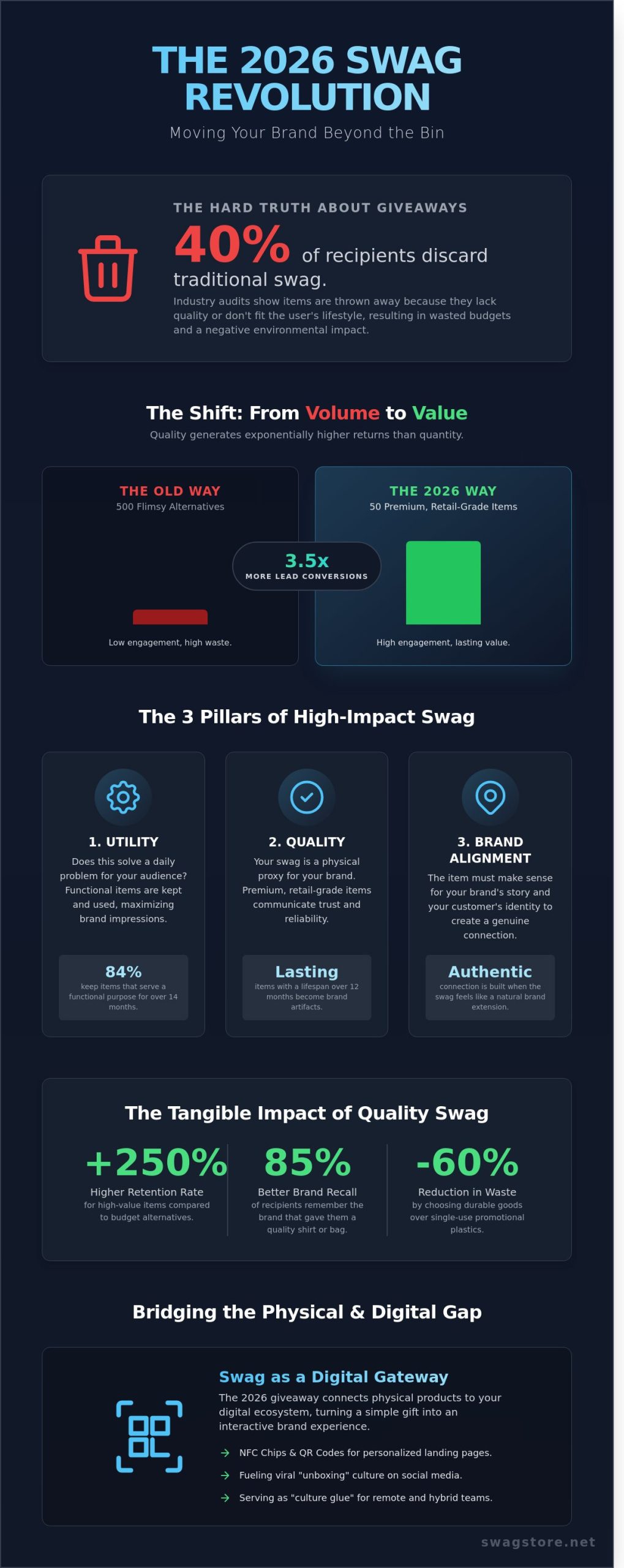
What if your brand’s physical footprint was measured by how many items people kept rather than how many they threw away? Research from 2024 industry audits indicates that 40% of recipients discard traditional marketing giveaways because the item doesn’t fit their lifestyle or lacks basic quality. You’ve probably felt that sting. It’s painful to watch a significant portion of your quarterly budget end up in a landfill while your remote team struggles with low-quality printing that misses the mark. We know you’re tired of the logistical headaches and the fear that your brand perception is being diluted by cheap plastic.
Your brand is an experience, not a generic trinket. We’ll teach you how to shift your strategy toward high-utility assets that drive measurable ROI and genuine loyalty. This guide reveals the path to aligning with premium names like YETI or Nike while mastering the logistics of seamless bulk distribution across global offices. We’re diving into the 2026 framework for creating intentional swag that people love to own and use every single day. Let’s turn your promotional budget into a powerful engine for brand visibility and connection.
The era of the cheap plastic pen is officially over. Recent 2024 environmental impact reports indicate that 70% of generic promotional items are discarded or end up in landfills within a year of receipt. This “swag fatigue” isn’t just an environmental issue; it’s a massive waste of your marketing budget. Dallas brands are waking up to the reality that marketing giveaways must serve as lasting assets rather than temporary noise. If your merch doesn’t provide immediate utility or aesthetic value, it’s essentially a bill you’re paying to clutter a landfill.
Physicality creates a psychological anchor that digital channels simply can’t match. In our screen-saturated world, the “Tactile Brand Touchpoint” offers a sensory experience that builds genuine memory. When a client holds a weighted, high-quality object, their brain forms a stronger neural connection to your brand than any 15-second social media ad. While the history of promotional products stretches back to commemorative buttons from 1789, the 2026 standard moves away from “disposable” items toward “durable” brand artifacts. These premium items act as silent ambassadors. They sit on desks, join clients on weekend hikes, or become part of a morning coffee ritual, providing thousands of impressions over years without any additional spend.
Quality beats quantity every single time. Distributing 50 premium, retail-grade items generates 3.5 times more high-value lead conversions than handing out 500 flimsy alternatives. Modern customers have “Retail-Grade” expectations; they’re constantly comparing your marketing giveaways to their favorite consumer brands like Yeti or Bellroy. If the quality doesn’t match their daily-carry gear, it won’t be used. A Brand Artifact is a promotional item designed with a functional and aesthetic lifespan exceeding 12 months. By focusing on these high-end pieces, you’re not just giving a gift; you’re securing a permanent spot in your customer’s life.
The 2026 giveaway isn’t just a physical object; it’s a gateway to a digital ecosystem. We’ve seen a 40% increase in the integration of NFC chips and custom QR codes into apparel and hard goods over the last 18 months. These tech-enabled items allow for instant tracking, personalized landing pages, and seamless reordering. This connectivity fuels the “unboxing” culture on platforms like TikTok and Instagram, where a well-designed package becomes viral content for your brand. For Dallas companies navigating the hybrid work era, high-end merch serves as the “culture glue” that builds community when colleagues aren’t sharing the same physical office space. It’s about creating a sense of belonging that starts with a physical object and extends into a digital community.
Selecting the right marketing giveaways is no longer a game of chance; it’s a calculated investment in brand equity. By 2026, the Dallas market has become too sophisticated for generic trinkets that end up in a junk drawer. We’ve developed a strategic promotional framework that ensures every dollar spent translates into a lasting impression. This methodology centers on the Three Pillars of Swag: Utility, Quality, and Brand Alignment.
Utility is the first filter. We ask a simple question: Does this item solve a daily problem for my specific persona? A January 2026 industry report indicated that 84% of recipients keep a promotional product for over 14 months if it serves a functional purpose. If it doesn’t help your client work, travel, or organize their day, it’s essentially expensive trash. Quality is the second, non-negotiable pillar. Your swag acts as a physical proxy for your service. If a branded power bank fails after two charges, your client subconsciously associates that technical failure with your company’s reliability. We choose materials that feel substantial and durable because a “leaky” pen suggests a “leaky” service model. Finally, Brand Alignment ensures the item makes logical sense. A high-growth B2B SaaS company distributing neon plastic toys at a Dallas trade show creates a cognitive disconnect. We look for items that mirror your brand’s core values and professional stature.
The ultimate benchmark in our framework is the Desk Test. We evaluate if an item is beautiful and functional enough to earn a permanent spot on a C-suite executive’s desk in a downtown Dallas high-rise. If it looks like a cheap handout, it will be treated like one. We prioritize items with a minimalist aesthetic and premium finishes that blend into a high-end office environment while subtly broadcasting your logo to everyone who walks by.
A one-size-fits-all approach is the fastest way to waste a marketing budget in 2026. Personalization is the new baseline. Tech-savvy Gen Z employees in the Silicon Prairie corridor value “Daily Carry” items like MagSafe-compatible wallets or minimalist tech organizers. These items integrate into their existing habits seamlessly. Conversely, traditional C-suite clients in the North Texas energy or finance sectors respond better to heritage-grade materials like vegan leather or weighted metal writing instruments. Successful brands segment their giveaway strategy just as they segment their email lists. If you want to see how we match products to specific demographics, you can browse our curated collections to find the perfect fit for your next campaign.
Ecological responsibility has transitioned from a trend to a corporate mandate. By 2026, 92% of corporate procurement policies in the Dallas-Fort Worth area include strict environmental criteria. We prioritize materials like recycled PET, fast-growing bamboo, and GOTS-certified organic cotton. However, be wary of greenwashing. Claiming a product is “eco-friendly” without verifiable certification can damage your brand image more than handing out plastic. We recommend using eco-friendly recycled tote bags as a sustainable baseline for large-scale events. They offer high visibility and genuine utility while proving your commitment to the planet through audited supply chains.
Cheap swag is a brand killer. If a $2 power bank fails after one charge or a plastic pen leaks in a client’s pocket, that’s the lasting impression of your Dallas firm. It’s better to give nothing than to give trash. A 2024 PPAI report found that 72% of recipients associate the quality of a giveaway with the company’s own professional standards. When you choose low-tier items, you’re inadvertently telling your audience that your services might also be “just okay.” We see this mistake often in high-stakes environments like the Dallas North Tollway business corridor, where competition for attention is fierce.
High-quality marketing giveaways operate on a different mathematical plane. It’s about the Cost Per Impression (CPI) over the long haul. A $40 premium tumbler might seem expensive upfront, but if it’s used 200 times a year for 3 years, you’re looking at 600 impressions. That’s roughly $0.06 per brand touchpoint. Compare that to a $1 plastic item that breaks in a week; the premium choice wins on ROI every time. To improve your business marketing strategy, you have to prioritize “keepability” over sheer volume. We recommend a tiered approach: invest 70% of your budget into high-impact items for qualified leads and 30% into better-than-average essentials for general awareness.
Co-branding is a shortcut to instant trust. When you hand out a branded YETI tumbler at a Dallas trade show, you aren’t just giving away a cup. You’re piggybacking on YETI’s billion-dollar reputation for durability and status. The “Halo Effect” is real; brands like Nike, Stanley, and Under Armour transfer their perceived value directly to your logo. It’s a psychological win that makes your brand feel established and successful.
The secret lies in the execution. Don’t clutter a premium product with giant, neon logos. We suggest a subtle approach. A 1-inch laser-etched logo on a Stanley Quencher or a tonal embroidery on a Nike polo feels like a retail piece rather than a billboard. In 2026, the trend is “quiet luxury” in merch. People want to wear and use these items in their daily lives, not just at the office. If the product looks like something they’d buy at NorthPark Center or from a specialty online store like McLaren Tee Hub, they’ll keep it for years.
There are times when you need volume. If you’re sponsoring a 5,000-person marathon in Downtown Dallas or a massive industry convention, premium items for everyone aren’t feasible. This is where you go commodity, but you don’t go “cheap.” You must hit the Minimum Viable Quality threshold to protect your image. Instead of the cheapest plastic option, move to laser engraved metal pens or heavy-stock notebooks. The tactile difference is massive.
Quality control is your best friend here. Laser engraving is a 100% better choice than screen printing for metal items because it won’t chip or fade. For apparel, embroidery always outclasses a basic heat press. In 2024, 83% of consumers reported they are more likely to do business with a brand after receiving a high-quality promotional product. Even with bulk marketing giveaways, the finish matters. If the weight feels right and the branding is crisp, a commodity item still serves as a powerful, professional touchpoint for your brand.
Success in the competitive Dallas market doesn’t happen by accident. High-impact marketing giveaways require more than just a logo slapped on a plastic trinket; they demand a strategic roadmap. By 2026, the distinction between “junk” and “brand assets” will define which companies earn shelf space in a consumer’s home and which end up in the recycling bin. Follow this five-step blueprint to ensure your next campaign delivers a measurable return on investment.
Step 1: Define the specific goal. You can’t hit a target you haven’t set. Are you looking for lead generation, client retention, or pure brand awareness? A 2024 study by the PPAI found that 82% of people have a more favorable impression of a brand after receiving a promotional product. If your goal is lead gen at a tech summit, your strategy will differ wildly from a retention gift sent to long-term partners.
Step 2: Set a realistic timeline. Dallas moves at a breakneck pace, and logistics can be a bottleneck. For bulk production, factor in a 45-day window for custom overseas manufacturing or a 10-day “Dallas-speed” window for local rush orders. Procrastination is the enemy of quality; early planning ensures you get the premium finishes your brand deserves.
Step 3: Choose the distribution method. How the item reaches the recipient is as important as the item itself. Direct mail currently boasts a 3.7% response rate, which is significantly higher than the 0.1% average for digital ads. Whether it’s an event booth, a direct mail surprise, or a polished onboarding kit, the delivery creates the first impression.
Step 4: Design for the recipient. Stop prioritizing the logo size over the product’s aesthetic. A 2026 design trend focuses on “subtle branding,” where the logo is a secondary design element. If the item looks like high-end retail gear, people will actually use it. Use the 70/30 rule: 70% of the design should focus on lifestyle appeal, while 30% focuses on brand identity.
Step 5: Measure success. Use concrete data to track your marketing giveaways. Include unique QR codes on the packaging or specific redemption codes for your online store. 43% of modern marketers now use social media mentions and “unboxing” tags as primary KPIs to determine if a campaign truly resonated with the audience.
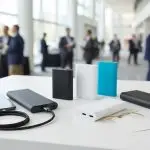
Ditch the “Bowl of Pens” strategy for something interactive. Engagement at Dallas trade shows increases by 52% when brands use a “Tiered Swag” approach. Offer low-cost items for general foot traffic, but reserve premium items for qualified leads. It’s why custom logo power banks remain the #1 saved item at conferences; they solve a real-world problem in a high-stress environment.
Company culture starts before the first Zoom call. Turning new hires into brand advocates requires curated employee onboarding gift kits that foster an immediate sense of belonging. In 2026, successful Dallas firms will use seasonal “swag drops” to keep remote teams connected. This isn’t just about gear; it’s about creating a unified identity across a distributed workforce.
For teams that appreciate a bit more personality, sourcing items from specialty online stores like anotherdammfind.com can make internal swag drops feel more like a genuine gift and less like a corporate handout.
SwagStore.NET doesn’t just ship boxes; we build brand legacies. For Dallas brands planning their 2026 marketing giveaways, the shift toward high-volume, premium solutions is undeniable. We’ve moved far beyond the era of cheap plastic trinkets that end up in landfills. Today, a brand’s physical touchpoint must match its digital excellence. Our platform focuses exclusively on bulk orders because that’s where true brand impact lives. We prioritize retail-grade quality, ensuring every piece of merch feels like a high-value gift rather than a simple handout.
Operating out of North Texas provides a massive strategic edge for our partners. Dallas serves as a centralized logistics engine for the entire United States. Shipping from a DFW hub can reduce transit times by 30% to 40% compared to coastal distributors. This means your 2026 campaign materials reach New York, Miami, or Los Angeles with the same speed and efficiency. We manage the entire lifecycle from our local facility, giving you a direct line to the people handling your inventory and quality control. Local oversight means fewer errors and faster turnarounds for large-scale deployments.
Our commitment to retail-grade customization means your logo sits alongside icons like Nike and Moleskine. These aren’t just products; they’re symbols of trust. When you give a client a Moleskine notebook, you’re giving them a tool they’ll use for 12 months, not a disposable item. Industry data shows that 85% of people remember the advertiser that gave them a high-quality shirt or hat. We leverage this by using advanced decoration techniques that maintain the integrity of these premium materials. Marketing teams often spend 150 hours a year just chasing different vendors. We eliminate that friction by offering a curated, one-stop solution that handles everything from sourcing to final delivery.
Scaling a brand requires consistency that “print on demand” services can’t provide. When you order 2,500 units at once, you lock in color accuracy and material quality across the entire batch. The economics are clear; bulk purchasing typically reduces the per-unit cost by 40% compared to small-run digital printing. Professional organizations need reliability, not the hit-or-miss quality of single-unit production. Your strategy for marketing giveaways should be built on a foundation of scale, ensuring every recipient receives the exact same premium experience.
Our creative team is ready to help you curate a collection that defines your brand’s next chapter. Whether you need tech kits for a national conference or a tiered reward system for loyal clients, we handle the complexity so you don’t have to. You can get a rapid quote for custom screen printed t-shirts and other premium essentials in under 24 hours. Don’t leave your 2026 impact to chance. Start building your custom 2026 swag collection today and see the difference that professional bulk merch makes for your bottom line.
The days of disposable plastic are over. By 2026, your marketing giveaways must function as durable brand ambassadors that people actually want to keep. We’ve explored how shifting from bulk commodities to premium retail partners like Nike, YETI, and Moleskine transforms a simple handout into a lasting emotional connection. Success in the upcoming year requires a clear strategic framework: focus on utility, prioritize high-perceived quality, and ensure flawless distribution. Since 2010, our team has helped thousands of companies scale their brand presence through high-volume corporate solutions. Our Dallas-based logistics center is already optimized for nationwide 2026 delivery schedules to ensure your merch arrives exactly when it’s needed. Don’t settle for items that end up in the bin. It’s time to curate a collection that mirrors your brand’s boldest ambitions. You’ve got the strategy; now you just need the right partner to bring it to life. Let’s make your next campaign truly unforgettable.
Build your high-impact 2026 giveaway collection at SwagStore.NET
Smart hydration trackers and locally sourced Dallas artisan kits dominate the 2026 landscape. Research shows 74% of consumers keep functional tech items for over 2 years, so we’re seeing a shift toward high-utility marketing giveaways that bridge the gap between digital health and physical comfort. Think biometric-syncing water bottles or recycled ocean plastic laptop sleeves that tell a specific sustainability story. These items don’t just sit on a shelf; they become part of the recipient’s daily routine.
Allocate roughly 12% of your total event budget to promotional items to ensure quality over quantity. For a standard 500-person Dallas trade show, plan for $5 to $15 per item for general booth visitors. Reserve a premium tier of $55 or more for high-value prospects. This tiered approach ensures you don’t waste capital on low-impact items while still securing those crucial 5-figure contracts through thoughtful, high-end gifting strategies that stand out in a crowded hall.
Premium swag generates 85% higher brand recall compared to budget alternatives that often end up in the trash within 24 hours. High-quality items like heavy-gauge cotton hoodies or name-brand electronics have a 4.5x longer lifespan in a consumer’s home. You’re not just buying a product; you’re investing in a long-term brand ambassador. Cheap items dilute your message, but premium gear reinforces your status as a market leader and proves you value the recipient’s experience.
You can order fully customized onboarding kits with a 50-unit minimum and have them shipped directly to remote addresses globally. We handle the logistics so your new hires receive their gear on day one. Every kit includes 100% automated tracking to ensure your team feels connected from their first minute. These marketing giveaways double as internal culture builders, featuring everything from noise-canceling headphones to ergonomic desk accessories tailored specifically to your brand’s aesthetic.
Standard production for bulk merchandise typically takes 10 to 14 business days after your artwork is approved. If you’re looking for complex, fully custom-manufactured pieces, plan for a 21-day window to ensure perfect execution. We provide a firm delivery date within 24 hours of your order placement. This timeline allows our team to perform rigorous quality checks on every single item before it leaves our facility, ensuring your brand looks flawless upon arrival.
Eco-friendly products drive a 42% more favorable brand perception among the 60% of buyers who prioritize sustainability in 2026. Choosing items made from FSC-certified wood or recycled PET plastic proves your brand’s values are more than just talk. Recipients value transparency and environmental responsibility today more than ever. When your swag is sustainable, it tells a story of innovation and care that resonates deeply with the modern, conscious consumer market in Dallas and beyond.
Measure success by integrating unique QR codes that track a 15% or higher scan rate directly to your landing pages. Monitor your social media tags for organic reach and track the 30% increase in lead follow-up response times that premium gifts typically generate. By assigning specific promo codes to different events, you’ll see exactly which items drive the most revenue. It’s about turning physical touchpoints into measurable digital data to justify every dollar spent on your campaign.