
Your branded t-shirts are cracking, peeling, and showing up in the wrong sizes — and your next company event is six weeks away. If that scenario feels uncomfortably familiar, you’re not alone. Ordering bulk custom screen printed t-shirts for business should be a strategic win, but for too many procurement and marketing teams, it turns into a logistical nightmare of inconsistent colors, late shipments, and garments that fall apart after the third wash.
Here’s what most guides won’t tell you: a bulk t-shirt order isn’t a commodity purchase. Done right, it’s one of the highest-visibility brand investments your organization can make. Every employee who actually wants to wear their shirt becomes a walking ambassador for your brand. Every crisp, color-accurate logo builds trust. Every on-time delivery to a national event reinforces your team’s credibility internally and externally.
This 2026 strategic guide cuts through the noise. You’ll learn how to select premium garments built for durability, lock in Pantone-accurate colors that honor your brand guidelines, and build a procurement process that scales smoothly across hundreds or thousands of units. Let’s build something worth wearing.
Let’s define the playing field first. Bulk screen printing, in a professional context, means ordering 50 or more units through a structured production process where screens are created, colors are separated, and ink is applied with industrial precision. This isn’t a weekend craft project. It’s a professional-grade manufacturing solution designed to deliver consistent, durable results across hundreds or thousands of identical garments — and that distinction matters enormously for how you plan, budget, and measure success.
T-shirts remain the single highest-ROI promotional product in corporate branding, and the reason is straightforward: wearability. Unlike branded pens that sit in a drawer or lanyards that vanish after a conference, a well-made t-shirt enters a person’s regular wardrobe rotation. Every wear is an impression. Every impression is brand exposure that cost you nothing beyond the original investment.
Something meaningful has shifted in corporate culture heading into 2026. The era of “disposable swag” — the scratchy, boxy shirt stuffed into a bag at a trade show — is over. Employees and event attendees now expect apparel that functions as lifestyle wear. Soft hand-feel fabrics, contemporary fits, and thoughtful design have become non-negotiable. Organizations that invest in quality bulk custom screen printed t-shirts for business aren’t just distributing merchandise; they’re creating garments people genuinely want to wear on weekends, at the gym, and on casual Fridays.
A national sales team wearing consistent, sharp-looking branded apparel projects a unified identity that no slide deck can replicate. It signals organizational coherence to clients and prospects before a single word is spoken. Internally, quality apparel builds a sense of belonging — employees who feel proud of what they’re wearing are more likely to wear it, which compounds your brand’s visibility organically. Every shirt becomes a walking billboard operating in neighborhoods, gyms, airports, and coffee shops your paid media budget will never reach.
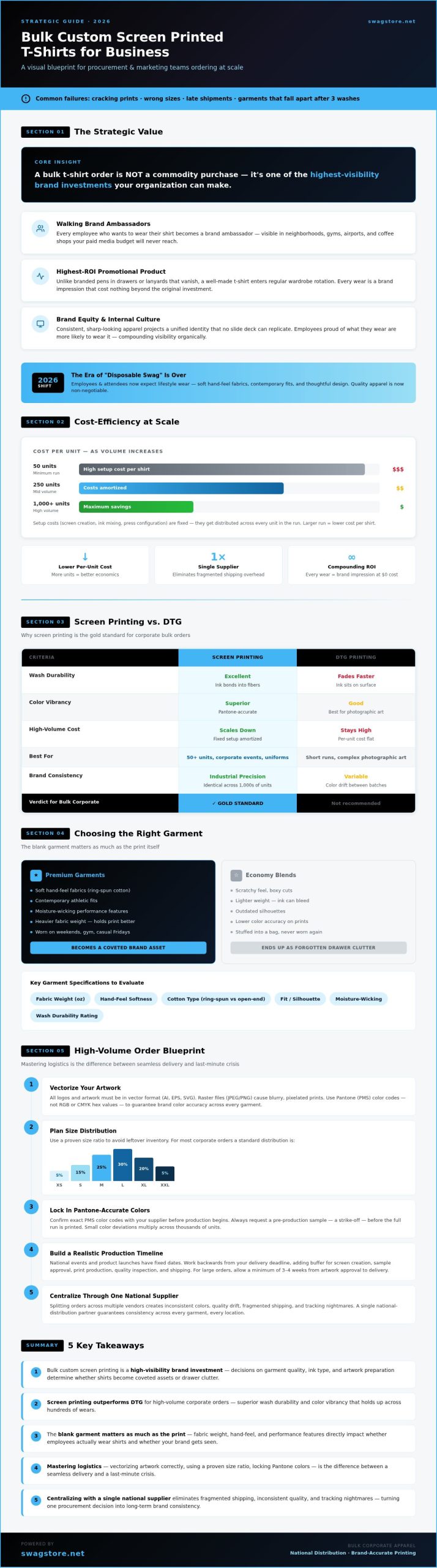
The economics of bulk ordering reward decisiveness. Screen printing involves fixed setup costs — screen creation, ink mixing, press configuration — that get amortized across every unit in the run. The larger the run, the lower those setup costs per shirt. Centralizing your order through a single national supplier like SwagStore.NET also eliminates the fragmented shipping overhead and inconsistent quality that comes from splitting orders across multiple vendors. High-quality prints that hold their vibrancy through dozens of washes reduce the frequency of re-orders, turning a single well-executed procurement decision into long-term brand consistency.
The math is simple: ordering bulk custom screen printed t-shirts for business at scale isn’t just cheaper per unit — it’s a compounding investment in every impression your brand makes from that point forward.
Screen printing isn’t just one decoration method among many. It’s a fundamentally different manufacturing process, and understanding why it outperforms alternatives is the first step toward making a procurement decision you won’t regret six months down the line.
Direct-to-garment printing works by essentially inkjet-printing onto fabric. It’s excellent for short runs and complex photographic artwork, but the ink sits on top of the fabric fibers rather than bonding into them. Wash after wash, that bond weakens. For bulk custom screen printed t-shirts for business that need to survive a year of weekly wears and industrial laundering cycles, DTG simply can’t compete. Screen printing forces ink through a mesh stencil directly into the fabric structure, creating a bond that’s mechanically superior from the first wash to the fiftieth.
The ink you choose shapes everything from color vibrancy to how the shirt feels against skin. Two options dominate professional corporate orders:
Neither is universally superior. The right choice depends on your garment color, design complexity, and how your employees will wear the shirt. A professional print partner will help you match ink chemistry to your specific brief rather than defaulting to one option for every order.
Brand color accuracy isn’t negotiable. The Pantone Matching System (PMS) gives your print team a universal color language, translating your corporate guidelines into exact ink formulations that reproduce consistently across every unit in a run of five hundred or five thousand. Without PMS references, you’re relying on a press operator’s judgment, and that’s where brand drift begins.
Mesh count matters equally for edge definition. Higher mesh counts (around 230 threads per inch) are used for fine detail work and halftone gradients; lower counts (around 110) allow more ink deposit for bold, solid fills. Proper screen tension ensures the mesh snaps back cleanly after each impression, keeping logo edges crisp rather than feathered. These aren’t minor technical details. They’re the difference between a logo that looks professionally manufactured and one that looks like it was printed in a garage.
Curing is the critical step where heat is applied to freshly printed ink, triggering a chemical reaction that permanently bonds the pigment to the fabric. Under-cured prints crack and peel within weeks. High-density prints, which create a raised, three-dimensional effect popular in premium corporate apparel, require particularly careful curing because the thicker ink deposit needs consistent heat penetration throughout its depth. Always request crack-resistance testing data from your supplier before approving a high-density design for a large run.
Not every corporate design is a flat two-color logo. Halftone printing breaks photographic or gradient-heavy artwork into a pattern of tiny dots, allowing screen printing to simulate continuous tones, which opens the door to sophisticated, editorial-quality designs on event apparel. Metallic and specialty inks, including chrome-effect and reflective formulations, create high-impact results for product launches and executive events where standard prints would feel underwhelming. And placement matters more than most buyers realize: sleeve prints, back-yoke branding, and left-chest secondary logos all contribute to a more considered, premium aesthetic that separates thoughtfully designed bulk custom screen printed t-shirts for business from generic promotional wear.
If you’re working through the technical decisions for your next order, explore SwagStore.NET’s custom screen printing expertise to see how professional guidance translates directly into better print outcomes.
The print is only half the equation. Choose the wrong blank garment and even a flawless Pantone-matched logo can’t save you from shirts that pill after five washes, fit awkwardly across the shoulders, or feel scratchy enough that employees quietly retire them after one wear. The blank is the foundation, and foundations matter.
Hand-feel and drape are the first things a recipient notices before they ever see your logo. A shirt that feels substantial and soft signals quality before a single word is read. A stiff, rough-textured garment signals the opposite, and that association transfers directly to your brand. For bulk custom screen printed t-shirts for business, the garment you choose communicates your organization’s standards as clearly as the design itself.
There’s a strategic multiplier that most procurement guides ignore entirely: co-branding. When your logo appears alongside a globally recognized athletic brand, the perceived value of the garment increases significantly in the recipient’s mind. Nike and Under Armour carry decades of performance credibility, and that credibility extends to your brand by association.
SwagStore.NET offers embroidered Nike and Under Armour polos that bring genuine performance engineering to corporate apparel, including moisture-wicking fabrics, UV protection, and athletic-cut tailoring. These aren’t lifestyle tees. They’re built for outdoor sales teams, field operations, and corporate events held in warm climates where standard cotton would become uncomfortable within an hour. For client-facing roles or executive events where you want apparel that feels like a premium gift rather than a promotional handout, co-branded athletic wear is in a category of its own.
Standard lifestyle tees remain the right call for internal team apparel, onboarding kits, and casual event giveaways where volume and wearability across diverse contexts matter more than performance specs.
Two fabric constructions dominate quality corporate apparel programs, and they serve different goals:
Fabric weight adds another variable. Heavier weights (around 6 oz) project durability and structure, making them ideal for cooler climates and roles where the shirt is a primary layer. Lighter weights (around 4.2 oz) breathe better in heat and suit outdoor events or physically active roles. Match the weight to where and how your team actually works.
For eco-conscious organizations, organic cotton and recycled polyester blends are increasingly available at competitive price points and carry genuine sustainability credentials worth communicating in your internal brand story.
The right garment choice transforms bulk custom screen printed t-shirts for business from a budget line item into something your team actively wants to wear. That shift in perception is where real brand equity gets built.
Most procurement guides stop at “choose a good printer.” That’s where the real work actually begins. Executing a high-volume order across multiple locations, departments, and shirt sizes requires a structured process, and without one, even a flawless print job can become an operational disaster. Here’s the blueprint that separates smooth deliveries from last-minute crises.
Vector files are non-negotiable. Submit your logo in AI, EPS, or PDF format and it scales from a left-chest print to a full-back graphic without losing a single pixel of definition. Raster files like JPGs or PNGs are resolution-dependent; blow them up to print size and the edges go soft. That softness gets baked permanently into every shirt in your run.
Two additional details trip up even experienced buyers. First, line weights: any stroke thinner than 0.5pt will fill in during printing and lose its definition entirely. Second, negative space within letterforms and logos needs to be generous enough to hold at the actual print size. What looks sharp on a monitor at 100% zoom can collapse into an unreadable smear at three inches wide on fabric. Simplifying your palette to two or three spot colors also controls costs directly, since each additional color requires a separate screen setup.
Ordering the wrong size mix is one of the most common and most avoidable mistakes in bulk apparel procurement. A practical starting framework for a mixed corporate audience is roughly 5% XS, 15% S, 30% M, 30% L, 15% XL, and 5% XXL. Adjust this based on any workforce demographic data you have. Ordering blind without a size survey almost always results in a surplus of mediums and a shortage of XLs, leaving a portion of your team without a shirt on event day.
Never approve a run of several hundred units based on a digital mockup alone. Request a physical pre-production sample before full press runs begin. This is the checkpoint where color drift gets caught, placement gets confirmed, and any garment quality issues surface before they multiply across your entire order. For bulk custom screen printed t-shirts for business destined for a national event, one sample reviewed and approved in advance is worth ten post-delivery conversations about what went wrong.
Branded shirts are most powerful when they arrive as part of a complete experience. Including them in custom employee onboarding kits alongside items like branded notebooks and tech accessories transforms a functional garment into a genuine welcome moment. New hires who receive a curated kit on day one arrive with a sense of belonging that a Slack message can’t replicate.
Plan your lead times accordingly. Complex, high-volume projects typically require three to four weeks from artwork approval to delivery, and that window doesn’t account for internal review cycles or shipping to remote locations. Build in buffer. For ongoing programs, maintaining a safety stock of the most common sizes ensures that new hires hired outside your main order cycle still receive their kit on schedule, rather than waiting weeks for a reprint.
Multi-location drop-shipping adds another layer of coordination. A national supplier with established distribution infrastructure can ship directly to individual employee addresses or regional offices, eliminating the logistical burden of receiving a pallet at headquarters and redistributing it yourself.
Ready to move from planning to production? Connect with SwagStore.NET to build a logistics-ready ordering framework for your next high-volume apparel program.
Most print shops take your order and send you a tracking number. SwagStore.NET works differently. From the first conversation, the approach is consultative: understanding your audience, your event context, your brand standards, and what success actually looks like for your organization. That distinction separates a creative partner from a commodity vendor, and it’s the reason procurement teams return for every major program rather than shopping around each time.
Think about what a complete brand experience actually requires. Bulk custom screen printed t-shirts for business are the foundation, but they’re most powerful when they arrive alongside cool promotional items that reinforce the same brand story. Branded YETI tumblers, laser-engraved metal pens, custom logo power banks, and Moleskine notebooks don’t just fill a bag. They create a moment. Recipients experience your brand as a curated, considered package rather than a single shirt in a plastic sleeve, and that experience sticks.
Scalability is where SwagStore.NET’s infrastructure genuinely sets it apart. Whether your program calls for 50 onboarding kits or 50,000 units for a national sales conference, the same precision applies: Pantone-matched inks, pre-production sample approval, and direct-to-location drop-shipping that eliminates the logistical burden of redistributing inventory yourself. For decentralized workforces spread across multiple cities or regions, national distribution capability isn’t a nice-to-have. It’s the operational backbone that makes a program viable at scale.
The consultative process also means you’re not left guessing which garment works for which audience. A field operations team needs something different from an executive event attendee. An outdoor sales force in a warm climate has different requirements than a tech team receiving an onboarding kit. SwagStore.NET brings that audience intelligence into every recommendation, matching fabric weight, fit, and decoration method to the people who’ll actually be wearing the result.
The most expensive mistake in branded apparel procurement is treating it as a last-minute line item. Programs built with lead time produce better outcomes: sharper prints, confirmed size distributions, reviewed samples, and on-time delivery to every location on your list. The strategic value of promotional items compounds when they’re planned as part of a cohesive brand system rather than assembled reactively under deadline pressure.
Your 2026 apparel program deserves more than a generic print shop and a crossed-fingers delivery window. It deserves a partner who understands that bulk custom screen printed t-shirts for business are a brand investment, not a budget afterthought. Connect with SwagStore.NET to request a consultative quote for your next high-volume project, and build something your team will actually want to wear.
The decisions covered in this guide compound. Choose the right garment, lock in Pantone-accurate colors, prepare vector artwork correctly, and distribute sizes intelligently, and your bulk custom screen printed t-shirts for business become brand assets that work long after the event ends. Cut corners on any one of those variables and the entire investment underperforms.
SwagStore.NET brings everything this process requires under one roof: trusted by national brands since 2010, an official provider of Nike and Under Armour custom apparel, and 100% vector-based precision on every corporate logo. That’s not a checklist. It’s the foundation of a program your team will actually be proud to wear.
Don’t let your next event become a last-minute scramble. Build your apparel strategy with a partner who understands the full picture, from ink chemistry to national drop-shipping logistics.
Request a professional bulk apparel quote from SwagStore.NET and start 2026 with branded apparel that genuinely reflects your organization’s standards.
Most professional screen printing operations set their minimum at 50 units per design, and that threshold exists for a practical reason: screen setup costs need to be distributed across enough units to make the per-shirt economics viable. Below that number, the fixed costs of screen creation and press configuration make pricing uncompetitive compared to DTG alternatives. At 50 units, you’re genuinely in bulk territory where quality and cost efficiency both work in your favor.
For organizations planning larger programs, the real pricing leverage kicks in at 144, 288, and 500-unit thresholds, where per-unit costs drop meaningfully. If your event or onboarding program is borderline on quantity, it’s almost always worth consolidating departments into a single order rather than splitting across multiple smaller runs.
Accurate color reproduction on dark garments requires two things working together: an underbase layer and a confirmed Pantone reference. The underbase is a white ink layer printed first and cured before your brand colors go down on top. Without it, dark fabric absorbs the ink and shifts every color toward the garment’s base tone. With it, your Pantone-matched colors read true regardless of whether the shirt is navy, charcoal, or black.
Always provide your supplier with specific PMS codes from your brand guidelines rather than RGB or CMYK values, which are screen and print-mode dependent. PMS is the universal language of ink mixing, and it’s the only reliable way to ensure the red on your shirt matches the red on your website, your trade show banner, and your business cards.
The core difference is how ink bonds to fabric. DTG essentially inkjet-prints onto the garment surface, which works well for short runs and photographic artwork but produces a bond that weakens with repeated industrial washing. Screen printing forces ink through a mesh stencil into the fabric structure itself, creating a mechanically superior bond that holds color vibrancy through dozens of washes. For bulk custom screen printed t-shirts for business that need to survive a year of regular wear, that durability gap is significant.
DTG also struggles with color consistency across large runs because each unit is printed individually. Screen printing applies the same ink deposit through the same screen on every unit, which is exactly what you need when 500 shirts need to match each other precisely at a national conference.
A well-managed order of 500 or more units typically requires three to four weeks from artwork approval to delivery, and that window assumes your vector files are production-ready when you submit them. That timeline includes screen creation, pre-production sample production and approval, full press run, curing and quality inspection, and shipping logistics. Complex designs with five or more colors, specialty inks, or multi-location drop-shipping add time to each of those stages.
Build your internal timeline backward from your event date and add at least one week of buffer for review cycles. Submitting artwork that needs revision or requesting changes after sample approval are the two most common causes of delays in high-volume orders. Starting the process six to eight weeks before your deadline gives you room to handle the unexpected without pressure.
Yes, and structuring your order this way is standard practice for corporate programs. Most suppliers allow multiple garment colors and a full size run within a single order, provided the print design stays consistent across the run. Each garment color technically requires its own print setup check because ink opacity behaves differently on light versus dark fabrics, so adding a second garment color may affect your pricing structure.
Size mixing within a single color is straightforward and carries no additional setup cost. The practical advice is to collect size preferences through an internal survey before finalizing your order rather than estimating, since a surplus of one size and a shortage of another is one of the most common and most avoidable post-delivery problems in bulk apparel programs.
The right brand depends on what your apparel needs to accomplish. For lifestyle wear and onboarding kits where soft hand-feel and voluntary wearability matter most, ring-spun cotton and tri-blend blanks from established apparel brands deliver the fabric quality that keeps shirts in rotation rather than in a drawer. For client-facing roles, outdoor events, or physically active teams, Nike and Under Armour bring genuine performance engineering including moisture-wicking fabrics and athletic-cut tailoring alongside brand recognition that elevates perceived value.
Co-branded corporate apparel featuring Nike or Under Armour carries a credibility multiplier that generic blanks simply can’t replicate. SwagStore.NET is an official provider of both brands’ custom apparel, which means the performance credentials are authentic, not just a label. Match the brand to the audience and the context, and your apparel investment compounds significantly.
SwagStore.NET works consultatively on artwork preparation, which means the team reviews submitted files for print viability before production begins. If your logo contains elements that won’t translate cleanly to fabric, such as hairline strokes, gradient fills, or raster-based elements, those issues get flagged and resolved before a single screen is made. That review process protects you from discovering print limitations after the fact.
For organizations whose brand guidelines were developed for digital or offset print contexts, some adaptation for screen printing is often necessary. Simplifying to spot colors, adjusting minimum line weights, and optimizing negative space within letterforms are common refinements that don’t compromise brand integrity but do ensure the final print looks as sharp at three inches wide as it does on a monitor at full resolution.
Wash screen-printed shirts inside out in cold water on a gentle cycle. This single habit protects the ink surface from abrasion against other garments and the drum interior, which is the primary cause of premature cracking in plastisol prints. Avoid high-heat drying; tumble dry on low or air dry flat. High heat doesn’t cure the ink further once it’s left the press; it stresses the bond between ink and fabric and accelerates breakdown over time.
Skip fabric softener, which coats fibers and gradually degrades ink adhesion, and never iron directly on a printed area. If ironing is necessary, place a thin cloth between the iron and the print. Shirts that receive this basic care consistently outperform those washed carelessly by a significant margin in terms of print longevity, which is the clearest argument for including care instructions in every employee onboarding kit alongside the shirt itself.