


What if the best welcome gift isn’t the one with the biggest logo, but the one a new hire reaches for every day? The right welcome gifts for new employees can help someone feel included from day one, while generic swag may quickly be forgotten. Choosing well takes more than picking a few branded items: the gift should be useful, suit different roles and preferences, and feel like a thoughtful expression of your company.
A coordinated welcome kit can bring that care to in-person and remote hires without turning onboarding into another administrative puzzle. Consider practical merchandise such as branded apparel, drinkware, tech accessories, tote bags, notebooks, or pens. Choose items that fit your team, then use considered branding to make them feel connected. In this guide, we’ll compare gift ideas by everyday use, explain how to make branding feel polished rather than excessive, and share ways to create a consistent welcome across different work settings.
A first-day gift sends a simple message: we expected you, we’re glad you’re here, and we’ve made space for you on the team. The best welcome gifts for new employees help a new hire feel included while giving them something useful for work or the routines around it. A notebook for onboarding sessions, a tote for carrying essentials, or a tumbler for a daily drink makes that welcome tangible.
That doesn’t mean the logo should lead the decision. If an item feels like an advertisement first and a useful object second, it may miss the moment. Start with relevance and quality, then use branding to support the experience through thoughtful placement and a consistent look. A brief note from the manager can make the gift feel personal. By contrast, a generic item with a prominent logo can come across as leftover promotional stock.
A welcome gift also has a focused role. It’s a gesture, not an onboarding program, which typically includes the broader steps that help someone understand their role, workplace, and colleagues. An employee onboarding process can involve orientation and ongoing support; a gift can complement that experience, but it can’t replace clear guidance, introductions, or a manager who makes time for questions. Nor is it the same as an employee-reward campaign, which recognizes contributions over time. Keep the purpose simple: mark the beginning with care.
Start with a real first-week need. Consider what the employee will carry, write with, use at a desk, or bring into meetings. Select an item that fits that routine, and favor quality and relevance over filling a package with extras. Add a short note that welcomes the person by name or mentions their team. The gift can open the door to connection, but a warm introduction and attentive support are what help someone feel part of the group.
For an on-site hire, present the gift on the first day as part of a personal welcome, rather than leaving it anonymously among supplies. For a remote employee, arrange for it to arrive before the start date when practical, so it’s there as their first day begins. Use the same preparation process for every hire, then add a brief greeting from the manager. Thoughtful timing makes a useful item feel like a deliberate welcome, not an afterthought from the swag cabinet.
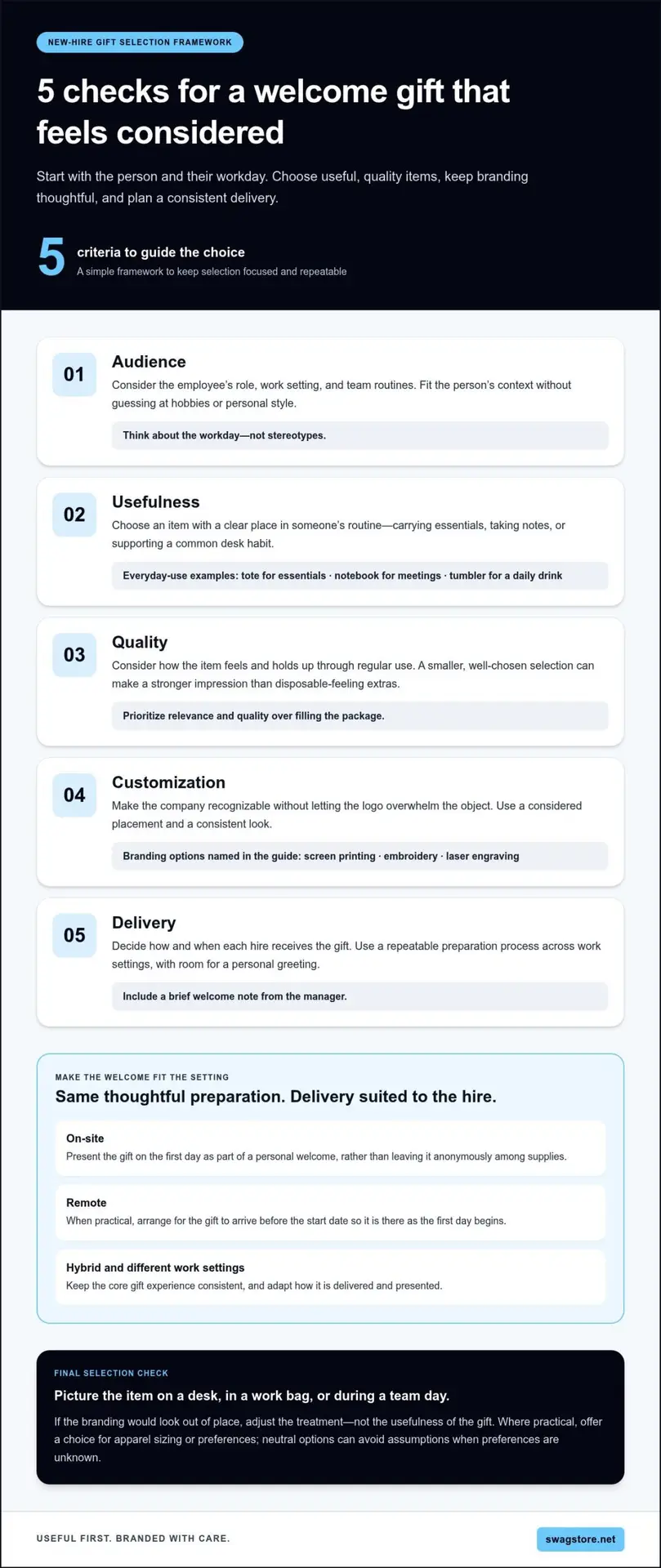
A simple framework keeps gift selection focused and repeatable. Instead of starting with a logo or product catalog, begin with the person who’ll use the gift and the moments in their workday it should support. Then consider these five criteria:
Quick checklist: Match the audience, prioritize usefulness, choose quality, personalize with restraint, and plan delivery.
Think about work context, not stereotypes. A notebook may suit someone who takes notes in meetings, while a tote can help carry everyday essentials. The right choice depends on how the role and work setting shape a typical day. Where practical, offer a choice, especially for apparel sizing or preferences. If you don’t know individual preferences, neutral options help avoid guesses that can make a gift feel less inclusive.
Consistency doesn’t have to mean impersonal. Keep the core gift experience recognizable across hires, then add a short welcome note or, where appropriate, the employee’s name. Give the logo enough visibility to connect the item to your company, but keep its size and placement suited to the item’s purpose. For broader planning across a coordinated kit, see this custom employee onboarding kits guide.
Before approving a selection, picture the item in a real routine: on a desk, in a work bag, or in use during a team day. If the branding would look out of place, adjust the treatment rather than adding more promotional detail. Screen printing, embroidery, and laser engraving can each support a clear brand identity when used thoughtfully. Apply the same approach to custom-branded welcome gifts for a consistent experience across new hires.
The most popular item isn’t automatically the best fit. A useful choice depends on how someone works, what they already use, and whether the gift supports a real routine. Compare each category by its everyday purpose and context before deciding how to personalize it. The table offers a starting point, not a one-size-fits-all ranking. Welcome gifts for new employees work best when their function comes first and branding complements it.
| Item category | Everyday purpose | Suitable context | Personalization approach |
|---|---|---|---|
| Apparel | Wear for work or team activities | Roles or events where branded clothing feels natural | Use screen printing or embroidery with a considered logo placement; offer choice where practical |
| Drinkware | Support a regular drink break at a desk or on the move | Employees who bring a drink to work or meetings | Keep the company mark visible without letting it dominate the design |
| Tech accessories | Support a relevant work setup | Roles that regularly use compatible devices or accessories | Add a clear logo treatment that suits the item’s purpose |
| Tote bags | Carry work or everyday essentials | Employees who travel between workspaces or bring items to the office | Choose a clean branded design that suits regular use |
| Notebooks | Capture notes, plans, or meeting takeaways | Roles involving discussions, training, or written planning | Use a subtle mark or personalized welcome message |
| Pens | Write and annotate during the workday | Employees who use pen and paper as part of their routine | Consider laser engraving for a refined company identifier |
Drinkware and notebooks can suit familiar workday habits, but neither is a universal must-have. A remote employee may have different routines from someone who spends time in meetings or shared workspaces. Tech accessories are most useful when they fit the employee’s setup. Apparel, totes, and pens also depend on role and preference, so use what you know about the work context and avoid guessing about personal tastes. For example, custom YETI or Stanley tumblers can be considered for employees who regularly use drinkware, while embroidered polos may suit teams where branded apparel feels appropriate.
When comparing options, ask what the employee is likely to use repeatedly and what they may already have. A practical item that fits a real routine is usually a better choice than a trendy giveaway with no clear purpose. Use that test to narrow the selection before deciding on colors, branding, or packaging.
Choose a small group of items that work together. For example, a notebook and pen support note-taking without feeling like unrelated giveaways. A tote can add a useful way to carry those items. Use a consistent visual treatment and thoughtful packaging to connect the pieces, then add a welcome message that explains the gesture. Build the selection around the recipient and purpose rather than assuming every kit needs the same products.
A thoughtful gift should feel equally intentional whether a new hire starts in an office, works remotely, or splits time between locations. A repeatable process helps teams create that consistency without treating every employee’s circumstances as identical. Plan the steps before hiring activity picks up, and keep personal details limited to what’s needed to prepare and deliver the gift.
Coordinate remote delivery so the gift can arrive near the employee’s start date, and include a short message that explains who it’s from and why the team is glad they’ve joined. For hybrid employees, decide whether the gift will be presented at the office or sent to them. Keep the items and welcome tone consistent across work arrangements, while adapting the handoff to each person’s location.
Use one checklist for recurring hires, with space to record quantities, current branding files, necessary recipient details, and presentation steps. Review the selection periodically to make sure it still supports actual work routines. A consistent kit approach can simplify hiring across teams or throughout the year, while a focused set of complementary items helps avoid redundant merchandise and excess packaging.
Inclusion also means allowing for practical differences without asking intrusive questions. For apparel, offer a way to share sizing or choose an alternative. Consider whether an item is accessible and suitable for the employee’s work context, and avoid food or dietary-related gifts unless preferences are known and relevant. Neutral, useful options are a sensible default when individual preferences aren’t available.
Before rolling out a gift program, have your HR or legal team review applicable workplace gift policies and tax treatment. Requirements can depend on the employer and context, so treat these as internal review points rather than assuming one rule applies everywhere.
A planned selection of custom employee onboarding gift kits can help make the welcome process repeatable while leaving room for a personal greeting.
SwagStore.NET creates bulk custom-branded merchandise and employee onboarding gift kits with a consistent, considered look. The goal isn’t to put a logo on as many objects as possible. It’s to bring together useful items that suit your new hires, work routines, and welcome goals, then apply branding in a way that feels intentional. A coordinated approach can connect each gift to your company while keeping the focus on the person receiving it.
Depending on your audience and the purpose of the welcome, a kit might include apparel, drinkware, tech accessories, tote bags, notebooks, or pens. Choose a compact mix around the needs you’ve identified, rather than assuming every new hire needs the same items. SwagStore.NET offers custom screen-printed T-shirts, embroidered Nike and Under Armour polos, YETI and Stanley tumblers, tech accessories, recycled tote bags, Moleskine notebooks, and laser-engraved metal pens. If apparel fits your team’s work context, consider how the garment, branding method, and logo placement can work together to create a polished, wearable welcome.
Customization can reinforce the kit’s visual identity across different merchandise types. Screen printing can put a company mark on apparel, while embroidery offers another branding approach for polos and other relevant garments. Laser engraving can add a branded detail to metal pens. The right method depends on the item and design, so consider how each treatment works with the object’s purpose rather than using one approach everywhere.
For example, a team that takes notes during training might prioritize a notebook and pen, while another group may value accessories that suit its work setup. These are starting points, not fixed formulas. A useful kit can be tailored to the company’s audience and welcome goals, with item choices, branding, and presentation planned as a whole.
Bulk customization helps organizations establish a recognizable look across new-hire groups, whether employees join at the same time or throughout the year. A shared design approach can keep the welcome experience coherent while allowing the selected merchandise to reflect the team’s practical needs. For organizations welcoming employees regularly, planned bulk orders can also make it easier to coordinate quantities and branding for each group.
Build the kit around the criteria that matter: who will use it, what supports their routines, the quality you want to represent, the right level of customization, and how each gift will be presented. SwagStore.NET works with businesses on bulk branded merchandise and employee onboarding gift kits, bringing those choices together into a cohesive welcome. The result can feel like more than a collection of promotional items. It can be a practical expression of your brand’s care for new team members.
Explore employee welcome gift solutions and plan a coordinated approach for your next group of new hires.
A new hire’s first gift can set a thoughtful tone, but its meaning grows through the moments that follow. Let it be a reminder that your team is ready to include them: invite them into conversations, make space for questions, and help them build connections as they settle in. That way, welcome gifts for new employees feel connected to a genuine experience, not like a gesture that ends when the package is opened.
Use your next hiring cycle to shape a welcome approach that feels true to your culture. Choose merchandise with intention, make the experience easy to repeat, and leave room for each manager to make the greeting personal. A considered start doesn’t need to be complicated. It needs to feel like it belongs to your team and the people joining it.
Ready to create a welcome that carries your brand’s care into someone’s first days? Explore employee welcome gift solutions and start shaping an experience your new hires will be glad to receive.
Good welcome gifts for new employees are useful, appropriate to the role, and easy to appreciate without knowing someone’s personal tastes. For example, a notebook can support a training-heavy start, while a branded tumbler may suit someone who regularly works at a desk or attends meetings. Focus on one or two considered items rather than trying to represent every department with the same collection of extras.
Give the gift during a planned welcome moment, such as the employee’s first check-in with their manager or an introduction to the team. That creates a natural opportunity to explain the gesture and start a conversation. For remote hires, coordinate delivery around the start date so the package feels connected to onboarding. Avoid letting gifts sit in storage until an unrelated event, which can make them feel like an afterthought.
Personalize the experience with details that are relevant and respectful, such as a note from the manager that welcomes the employee to their team and mentions what they’ll be working on. If you offer choices, keep them simple and optional, such as selecting from suitable apparel sizes or choosing between practical gift alternatives. Avoid guessing about hobbies, family circumstances, or other personal details. The aim is recognition, not overfamiliarity.
Yes. Remote employees can receive the same core gift and welcome message, with delivery arranged to suit their work setup. The practical difference is the handoff: an office-based employee may receive the package from a manager, while a remote hire may find it waiting at home. Keep the selection and quality consistent, and make sure the accompanying greeting clearly identifies the team or person welcoming them.
An employee welcome gift kit should include items chosen for a clear purpose, rather than a fixed set that may not suit every role. Start with an anchor item the employee can use during work, then add a complementary piece if it makes the experience more useful. For example, a notebook and pen can support a training-focused start. Tailor the contents to the employee group and avoid adding items just to fill space.
Tax treatment depends on the applicable jurisdiction and the details of the gift, so there isn’t one answer that applies to every employer. Before setting a company-wide gifting practice, ask your HR, legal, or tax team to review the relevant rules and how the organization should handle the gift. This is especially helpful when choosing between merchandise and other types of gifts, or when a program will be used repeatedly.
A welcome gift alone can’t guarantee that an employee will stay. It can contribute to a positive first impression, but retention depends on the broader experience, including clear expectations, manager support, role fit, and opportunities to connect with colleagues. Treat a gift as one small part of a thoughtful onboarding approach, then focus on the ongoing actions that help a new hire feel supported after the first day.